

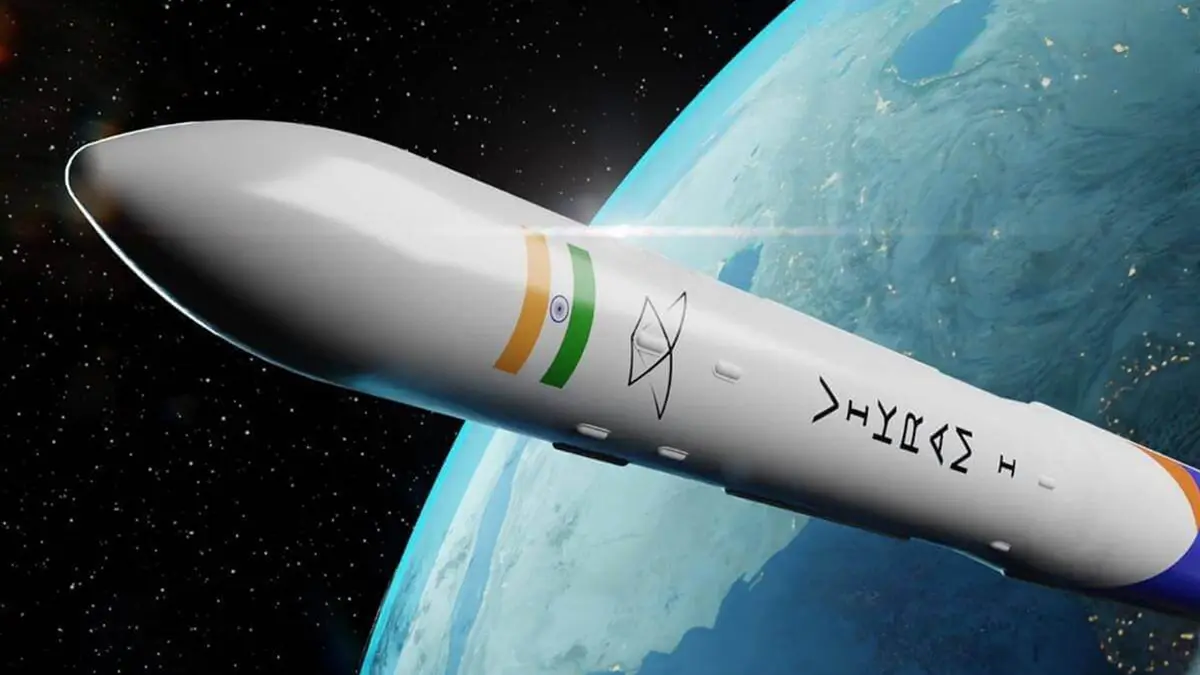
Why in news?
Skyroot Aerospace announced that its small satellite launcher, Vikram‑1, is scheduled for its maiden flight during a launch window from 12 July to 4 August 2026. This will be India’s first orbital mission developed by a private company.
Background
Skyroot Aerospace, founded by former ISRO engineers in 2018, aims to provide cost‑effective launch services for small satellites. After successfully flying the sub‑orbital Vikram‑S rocket in November 2022, the company began developing Vikram‑1. The 20‑metre‑tall, four‑stage launcher uses an all‑carbon composite structure and a mix of solid and liquid propulsion systems.
Design and capabilities
- Stages: The first three stages—Kalam‑1200, Kalam‑250 and Kalam‑100—are solid‑fuelled. The fourth stage uses a hypergolic Raman engine for precise orbital insertion .
- Payload: Vikram‑1 can carry up to 350 kg to low Earth orbit and about 260–290 kg to a sun‑synchronous orbit around 500 km.
- Materials and manufacturing: The rocket’s carbon composite body makes it light yet strong. Its engines are largely 3D‑printed, reducing weight by about half and shortening production time by 80 percent.
- Separation and avionics: Ultra‑low‑shock pneumatic separation systems minimise stress on payloads, while advanced avionics and inertial navigation allow quick turnaround launches.
- Launch infrastructure: The rocket can be integrated and launched within 24 hours, offering responsive access to space and reducing costs for customers.
Significance
- Private sector milestone: Vikram‑1 will be India’s first privately built orbital launch vehicle. Its success could open the door for more commercial missions.
- Small satellite market: The rocket targets rising demand for launching small Earth‑observation and communication satellites. Skyroot plans to offer regular rides for domestic and foreign customers by 2027.
- Industry growth: India’s new space policy encourages private participation. Start‑ups like Skyroot complement ISRO’s missions and could attract investment and innovation to the space sector.
Conclusion
Vikram‑1 represents a new era for India’s space industry. Its innovative design, quick turnaround and private funding model demonstrate that Indian companies can compete in the global launch market. The upcoming flight will test propulsion, guidance and separation systems and set the stage for future commercial missions.