

Why in news?
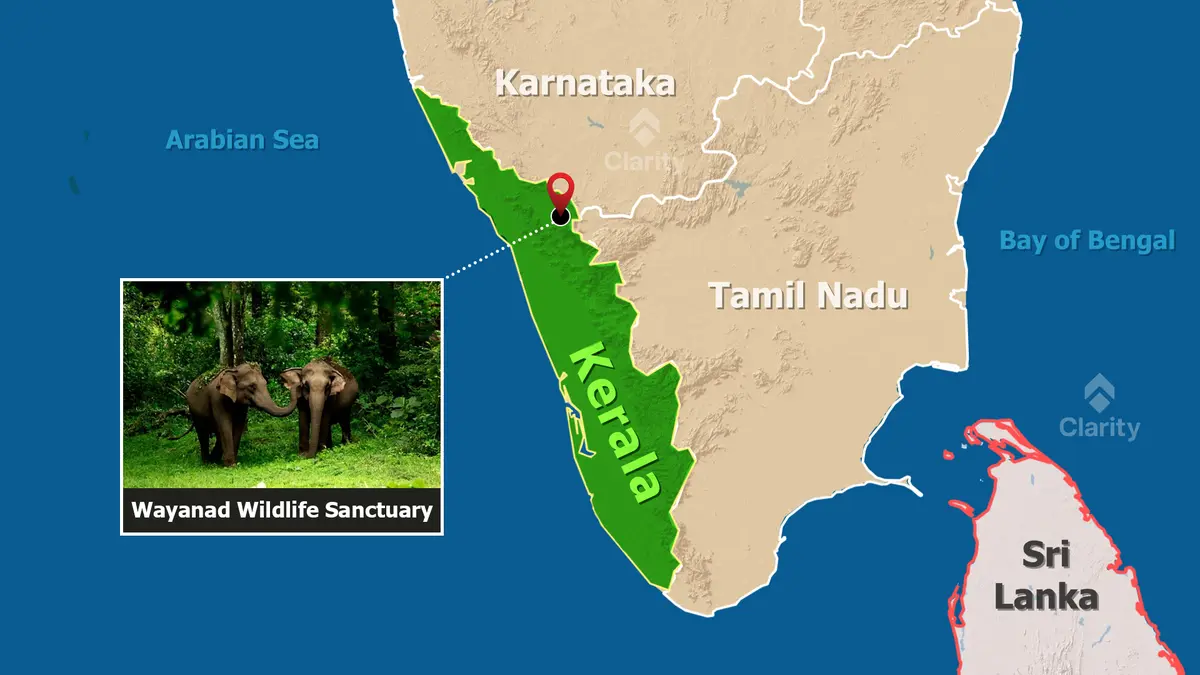
A two-day vulture survey began in Kerala's Wayanad Wildlife Sanctuary on 26 September, according to The Hindu. The Forest Department's Wayanad Wildlife Division organised it with World Wide Fund for Nature–India and the Hume Centre for Ecology and Wildlife Biology. The exercise seeks information on the birds' current status and distribution in an important southern Indian habitat. Vultures remove animal carcasses, but several resident species have suffered severe declines across their wider ranges. Wayanad's forests connect with protected landscapes in neighbouring Karnataka and Tamil Nadu, making the regional setting relevant to conservation. The announcement concerns the start of a survey, not a released population total or evidence that the birds have recovered.
Two blocks within a wider forest system
The sanctuary lies in Wayanad district in the Western Ghats of northern Kerala. It covers about 345 square kilometres in two separated blocks. Muthanga is in the southern part of the district, near Sulthan Bathery, while Tholpetty lies farther north near Thirunelli. Treating the sanctuary as one continuous block would miss an important feature of its geography.
Muthanga connects with the Bandipur landscape in Karnataka and Mudumalai in Tamil Nadu. Tholpetty adjoins the Nagarhole landscape in Karnataka. Together these forests form part of the larger Nilgiri Biosphere Reserve region. Administrative boundaries divide management responsibilities, but animals and ecological processes can extend across them. That makes coordination among neighbouring protected areas especially useful.
Declared a sanctuary in 1973, Wayanad contains mainly moist and dry deciduous forests, with some semi-evergreen patches. These habitats differ in vegetation and seasonal conditions. The landscape supports large mammals as well as birds, reptiles and other wildlife. Vulture conservation takes place within this broader ecological setting, rather than in a habitat occupied only by scavenging birds.
Which vultures are involved?
The survey report identifies three resident species: the White-rumped Vulture, Indian Vulture and Red-headed Vulture. Their scientific names are Gyps bengalensis, Gyps indicus and Sarcogyps calvus, respectively. Occasional records also include Himalayan Griffon and Cinereous vultures. A visiting species and a resident breeding population should not be treated as equivalent evidence of local status.
The resident trio are listed as Critically Endangered in the conservation organisations' species-status summary. This category indicates an extremely high risk of extinction in the wild. It is a global assessment, not a count of birds inside Wayanad. A sanctuary can remain important for a threatened species even when the species occupies other regions as well.
Why scavengers matter to the ecosystem
Vultures feed on dead animals and help remove carcasses from the landscape. This returns nutrients through the food web and affects how long carcasses remain available to other scavengers. Their role links wildlife ecology with livestock management and human surroundings. The loss of vultures can therefore have consequences beyond the disappearance of a conspicuous bird.
Conservation research has connected South Asia's vulture decline with changes in carcass disposal and greater opportunities for other scavengers. That does not mean every local disease event can be attributed to missing vultures. The underlying ecological point is more specific: removing an efficient scavenger changes how dead animal material is processed. Protecting that function requires both birds and a safe food supply.
A veterinary drug became a wildlife threat
A major cause of the collapse in South Asian Gyps populations was diclofenac used in livestock treatment. Vultures could ingest harmful residues when feeding on animals treated shortly before death. The drug damages their kidneys and can be fatal. This pathway explains how a medicine intended for domestic animals created a threat far beyond the place where it was administered.
India prohibited veterinary diclofenac, but conservation organisations continue to warn about unsafe veterinary drugs and their use. The Bombay Natural History Society also works on conservation breeding and safer conditions for released birds. Protecting nesting or roosting sites is necessary, but it cannot compensate for repeated poisoning through food. Wildlife management and veterinary practice must therefore be considered together.
What a survey can establish
A distribution survey helps identify where birds are being observed and which species are present. Its usefulness increases when observations can be compared with earlier records collected in a similar way. Differences in coverage, season, visibility or effort can otherwise look like changes in population. These are considerations for interpreting results, not claims about findings that this exercise has already produced.
Birds may move between feeding areas, resting places and nesting sites. A sighting at one location does not establish that the same number breeds there. Repeated observations, careful identification and information about breeding activity can strengthen an assessment. For a threatened population, the questions include not only how many birds are seen, but whether they survive and reproduce over time.
Why the surrounding landscape belongs in the response
The sanctuary's connections with Karnataka and Tamil Nadu make a purely local view incomplete. Birds can use resources outside the boundary where they are counted. Food safety, disturbance and habitat condition elsewhere may consequently affect a population observed within Wayanad. Survey results are most useful when they inform cooperation across the wider landscape rather than ending as an isolated total.
That cooperation also needs people living and working around the forests. Veterinary awareness, responsible carcass management and communication about injured or dead birds can support formal protection. Such measures should be shaped by evidence and local conditions. A survey provides part of that evidence base; it is not, by itself, a conservation outcome.
Conclusion
Wayanad's survey is an opportunity to improve knowledge of threatened vultures in a connected Western Ghats landscape. Its findings will need to distinguish residents, visitors and comparable population trends. The conservation response must then connect habitat protection with safe food and regional cooperation. Counting birds is valuable when it helps explain the conditions that allow them to survive and breed.