

Imagine travelling from a Himalayan valley to a Nicobar beach. The plants, animals and climate change along the journey. So do the dangers facing them. A red panda depends on mountain forests and bamboo. A Nicobar megapode needs suitable ground for its nesting mound. Protecting both requires understanding the places that sustain them.
India contains parts of four globally recognised biodiversity hotspots. Their importance comes from a particular combination: many plants occur nowhere else, and much original vegetation has disappeared. We begin with that idea, then travel through each region. The conservation choices become clearer once the geography and ecological processes connect.
1. What biodiversity includes
Biodiversity means the variety of life and its ecological relationships. It includes differences within species, differences between species, and different ecosystems. Counting animals alone therefore gives an incomplete picture of a landscape.
1.1 Genes, species and ecosystems
Consider rice cultivation beside a forest and a wetland. Farmers may grow several rice varieties with different inherited traits. The forest contains many tree, bird and insect species. The wetland supports a different community and different ecological processes.
- Genetic diversity is variation within a species. Different rice varieties may tolerate drought, flooding or disease differently. Preserving this variation keeps useful options available for future breeding.
- Species diversity concerns the species present and their relative abundance. A forest with many species differs from a plantation dominated by one tree. Species richness specifically counts how many species occur.
- Ecosystem diversity concerns different ecological systems across a region. Forests, grasslands, rivers, mangroves and coral reefs support distinct communities. Their connections matter as much as their separate identities.
These levels reinforce each other. Habitat loss can remove species and their genetic variation together. Conservation must therefore protect functioning places, alongside particular threatened animals.
1.2 Native, endemic and threatened are different descriptions
A native species occurs naturally in a place. An endemic species has a natural range restricted to a specified region. The Nilgiri tahr, for example, is endemic to the Western Ghats. It does not naturally occur throughout India or across the Himalaya.
The region must always be named when describing endemism. A species can be endemic to an island, a mountain range, or India. An introduced population elsewhere does not erase its original natural restriction. A widespread animal can be native to several countries without being endemic to any one.
Threatened status answers another question: how high is extinction risk? The IUCN Red List groups Vulnerable, Endangered and Critically Endangered species as threatened. Restricted range can increase risk, but endemism does not automatically establish a threat category. Global assessments, regional assessments and India's legal schedules also serve different purposes.
2. How a region qualifies as a hotspot
Conservation resources are limited, while habitat destruction is widespread. Norman Myers proposed the hotspot approach in 1988 to help set priorities. His original paper highlighted exceptional concentrations of restricted species facing rapid habitat loss. The framework subsequently developed into today's globally recognised hotspot system.
2.1 The two criteria must both be satisfied
A region must contain at least 1,500 endemic vascular plant species. Vascular plants have tissues that transport water and nutrients. The region must also have lost at least 70% of its original natural vegetation. Equivalently, no more than 30% remains. CEPF currently recognises 36 biodiversity hotspots worldwide.
The plant threshold measures biological irreplaceability. The vegetation-loss threshold measures the urgency of conservation. A species-rich area with little historical loss may fail the second test. A severely damaged landscape with few endemic plants may fail the first. Both can still deserve protection through other conservation approaches.
Apply the rule. Suppose a region has 1,800 endemic vascular plants. If 25% of its original vegetation remains, it meets both thresholds. Another region has 2,400 endemic plants but retains 60% of its vegetation. It fails the habitat-loss threshold, despite its exceptional biological richness.
2.2 What the label does and does not mean
A hotspot is a conservation-priority region, not a temperature category. It need not be uniformly hot, wet or forested. Himalayan alpine vegetation and Western Ghats grasslands are relevant natural habitats too.
The label also does not create an Indian legal protected area. A hotspot can include national parks, farms, villages and cities. Protection depends on laws, land management and community decisions within it. The 36-hotspot framework helps identify priorities; it does not make biodiversity elsewhere expendable.
3. Locating India's four hotspot regions
India intersects the Himalaya, Indo-Burma, Western Ghats–Sri Lanka and Sundaland hotspots. These are biogeographical regions rather than administrative divisions. Their boundaries do not neatly follow states or international borders. A list of states is therefore an orientation aid, not a substitute for the mapped boundary.
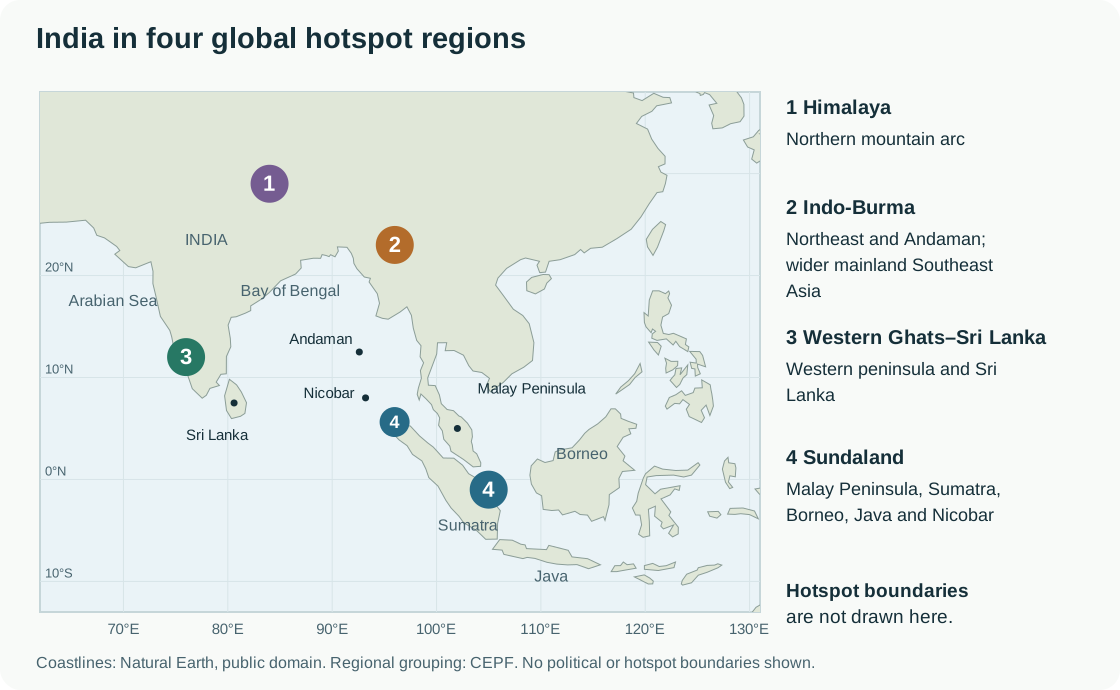
Start in the northern mountains with the Himalaya. Move east and southeast into Indo-Burma's forests and river systems. Follow the western peninsula to the Western Ghats and Sri Lanka. Finally, locate the Nicobar Islands within the wider Sundaland hotspot. India's participation in Sundaland comes through Nicobar; Andaman is associated with Indo-Burma. The two island groups should not be exchanged in a map question.
The locator shows broad geographic relationships. Its numbered markers do not represent precise hotspot boundaries.
4. The Himalaya: habitats change with height
A mountain journey can cross several ecological worlds within a short distance. Temperature generally falls as elevation rises, while rainfall changes between slopes. Valleys, ridges and rain shadows create additional variation. These interacting conditions help explain Himalayan biodiversity more effectively than the word “mountainous” alone.
4.1 Geographic extent and altitudinal zonation
The hotspot extends along the Himalayan mountain system across national frontiers. Its Indian landscapes include parts of the western, central and eastern Himalaya. Useful anchors include Jammu and Kashmir, Himachal Pradesh, Uttarakhand, Sikkim, the Darjeeling hills and Arunachal Pradesh. The wetter eastern mountains support especially rich forests and plant diversity. The entire administrative Indian Himalayan Region should not be assumed identical to the hotspot.
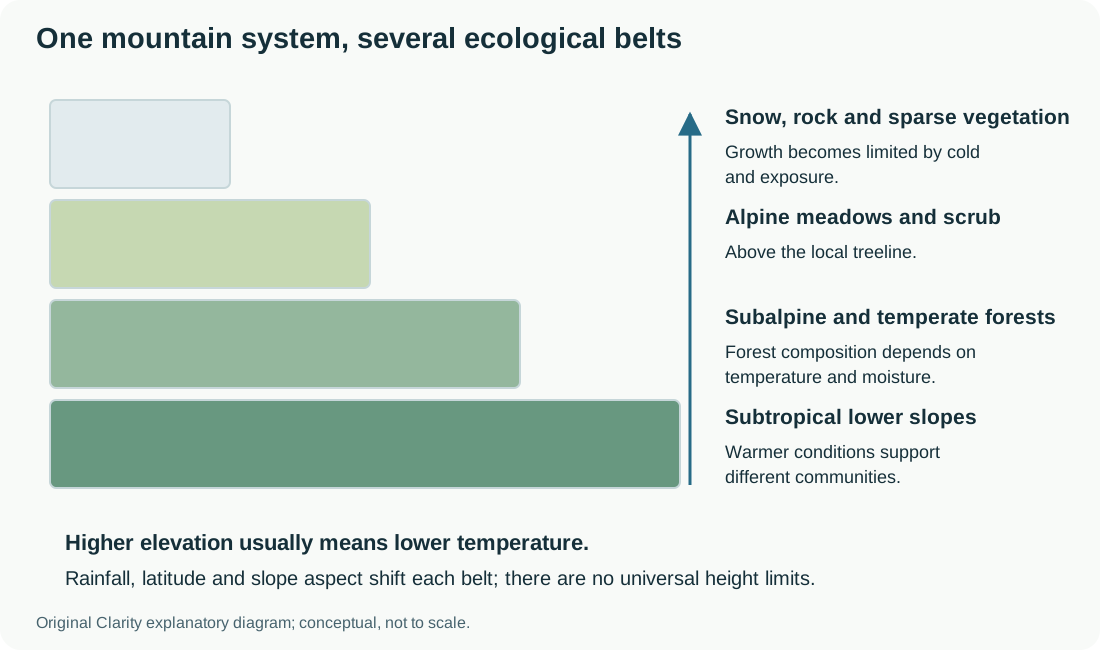
Altitudinal zonation means a sequence of ecological belts along an elevation gradient. Lower warm slopes may support subtropical forests. Higher slopes support temperate broadleaf or conifer forests, depending on moisture. Near the treeline, subalpine vegetation gives way to alpine meadows and scrub. Beyond suitable growing conditions lie sparse vegetation, rock, snow and ice.
These belts have no single elevation valid across the Himalaya. Latitude, slope direction, rainfall and local disturbance shift their limits. A sunny slope and shaded slope may differ at the same height. This is why conservation planning needs local ecological surveys.
4.2 Plants and animals reveal the habitat pattern
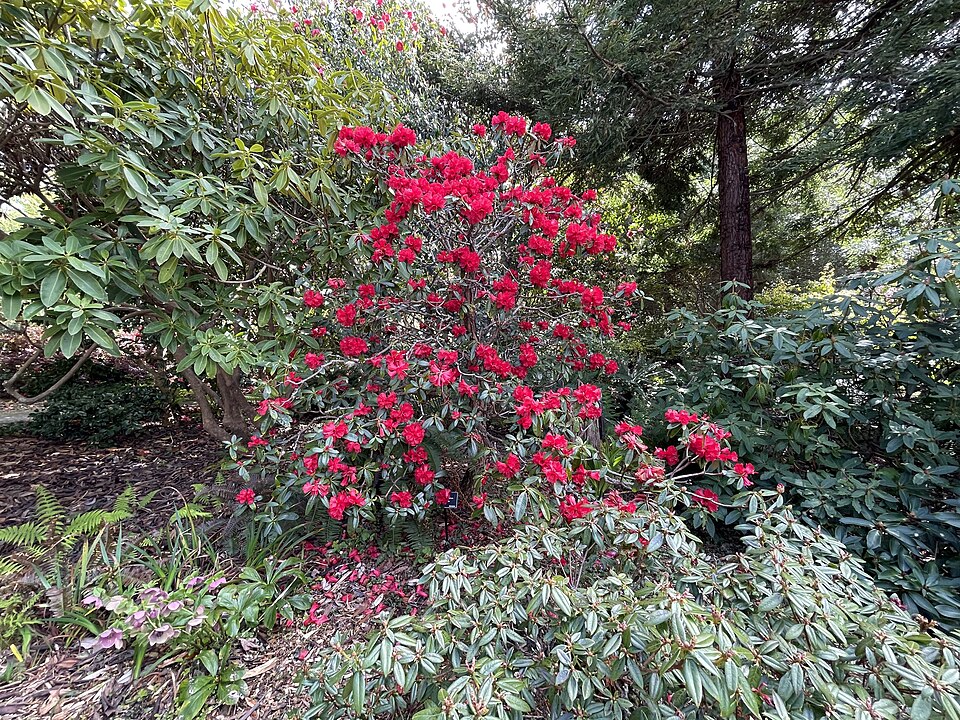
Rhododendrons, oaks, conifers, orchids and alpine herbs occupy different environments. Some plants require moist forest shade; others tolerate cold, exposed slopes. Flowering and fruiting seasons also provide food at different times. Protecting a range of habitats preserves these seasonal relationships.

.jpg)

The red panda illustrates why a flagship species needs precise geography. It occurs in Himalayan and neighbouring mountain forests, including India's eastern region. It belongs to its own family, Ailuridae, rather than the giant panda's bear family. Its needs connect forest structure, bamboo availability and habitat continuity.
Himalayan monals, pheasants and musk deer provide further habitat examples. “Musk deer” refers to multiple species, so one conservation category cannot safely cover them all. Similarly, the snow leopard represents high-mountain conservation, but its wider range extends far beyond this hotspot.
4.3 Why warming and fragmentation interact
As climates warm, suitable conditions may shift uphill. A species can respond only if suitable habitat remains accessible. Roads, settlements or degraded forest can interrupt that movement. Species already near summits also have limited space above them.
Construction can disturb slopes, drainage and river habitats. The damage depends on geology, design, scale and enforcement; every project has different risks. Cumulative assessment matters when several roads or dams affect one valley. Tourism planning should address sewage, waste, water demand and construction together.
Useful responses include connected forest belts, protected alpine wetlands and locally adapted restoration. Community participation helps align grazing, harvesting and tourism with ecological limits. The aim is to retain a functioning mountain landscape as conditions change.
5. Indo-Burma: forests, rivers and community landscapes
Indo-Burma connects much of northeastern India's biogeography with mainland Southeast Asia. The wider hotspot includes Myanmar and much of Thailand, Lao PDR, Cambodia and Viet Nam, along with parts of southern China. Forested hills, limestone landscapes, floodplains and wetlands create contrasting habitats. Rivers connect these places while also separating some animal populations.
5.1 Where the Indian component lies
Much of northeastern India outside the separately delineated Himalayan hotspot belongs here. Meghalaya, Nagaland, Manipur, Mizoram and Tripura provide useful regional anchors. Relevant Assam and adjoining hill landscapes require attention to the mapped boundary. Andaman is another Indian component; Nicobar belongs to Sundaland.
The wider region contains major river systems including the Irrawaddy, Salween and Mekong. Dams, floodplain conversion and fishing pressures can affect freshwater species across boundaries. A forest-only account would therefore miss a major part of this hotspot.
5.2 Canopy animals, hornbills and plant diversity
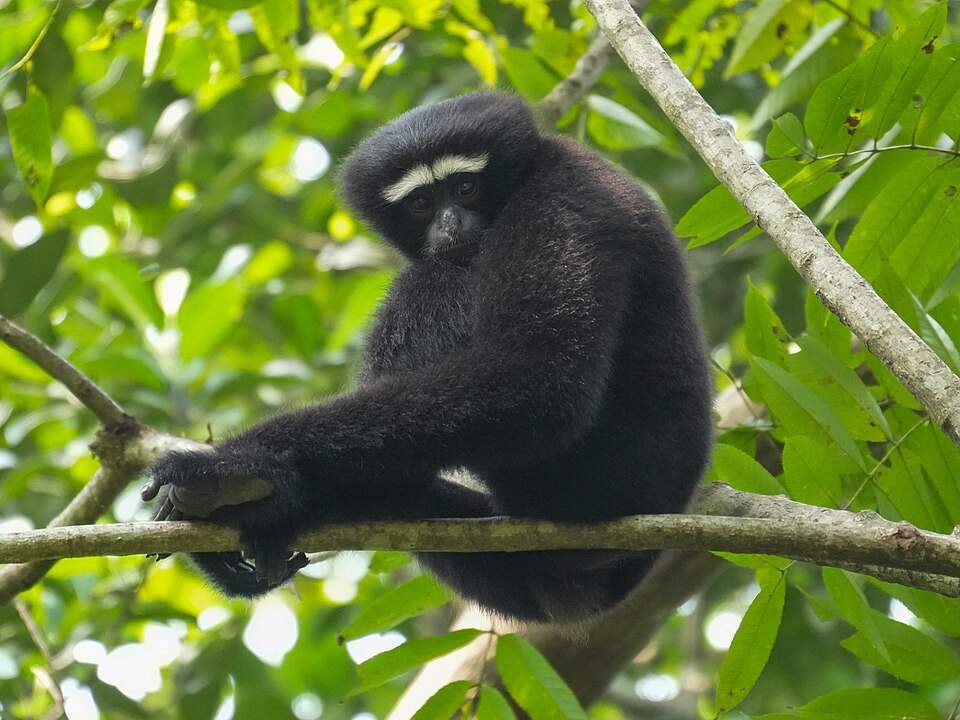
Hoolock gibbons move through trees using their long arms. A gap in the canopy can interrupt movement between feeding areas. Protecting scattered trees is therefore insufficient if the connecting canopy disappears. Western hoolock gibbons are native apes; “monkey” is an inaccurate identification.

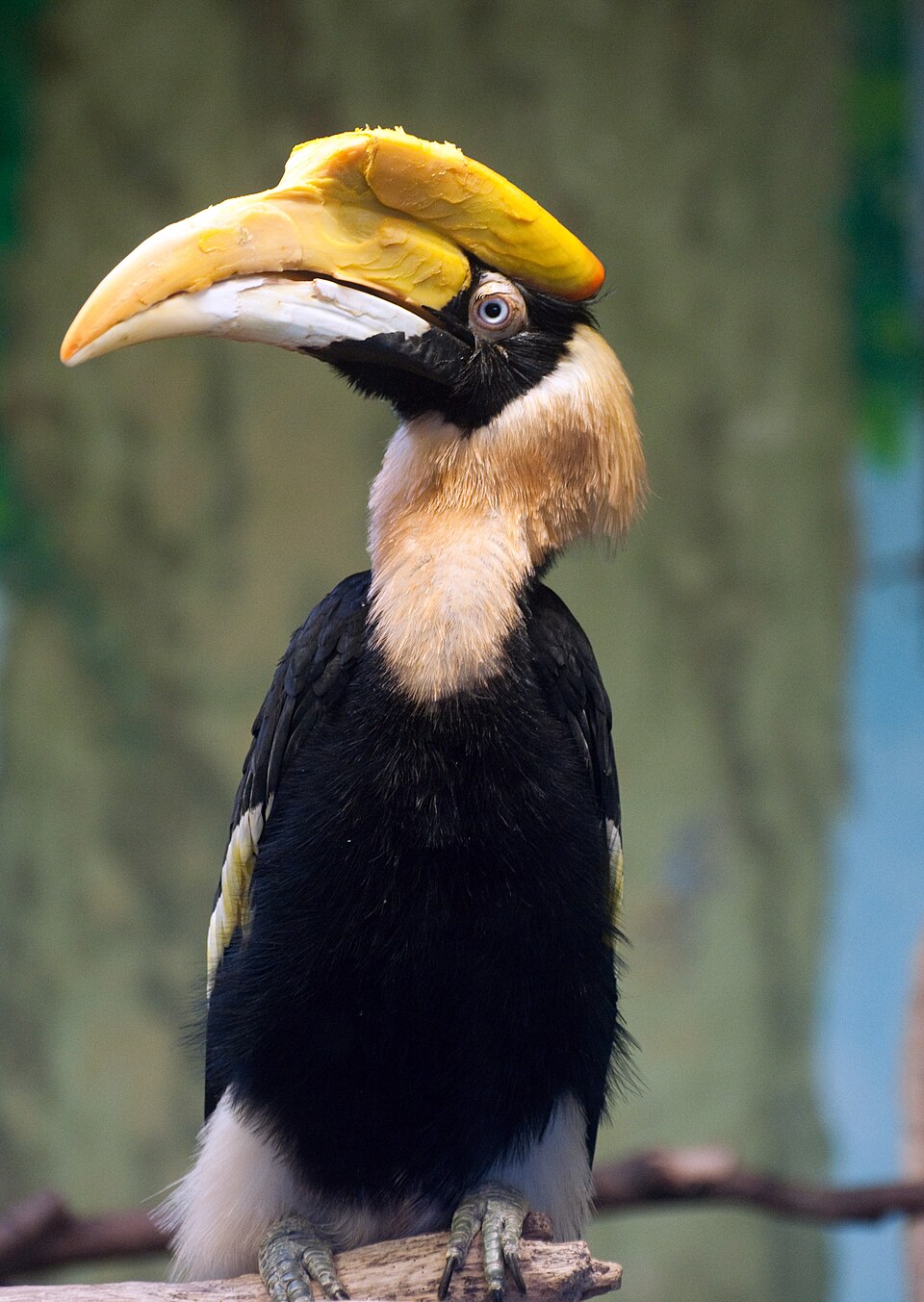

Hornbills illustrate another ecological relationship. Many eat fruit and disperse seeds across the forest. They also require suitable nesting trees, which may take decades to develop. Removing mature trees can therefore affect birds and future forest regeneration together.
Bamboos, orchids, canes and diverse evergreen trees enrich these landscapes. Orchids include terrestrial species and epiphytes growing on other plants. An epiphyte uses a tree for support without necessarily taking nutrients from it. High orchid diversity does not mean every orchid is endemic or threatened.
Threat categories sharpen these examples. The western hoolock gibbon is Endangered, while the great hornbill is Vulnerable. The Chinese pangolin, found in parts of northeastern India and neighbouring Asian regions, is Critically Endangered. Hunting and illegal trade threaten this scale-covered mammal; its scales are made of keratin, not armour against organised poaching. These species illustrate different ecological roles and risks.
5.3 Conservation must recognise local land systems
Community ownership and customary institutions shape many northeastern landscapes. Effective conservation needs to understand these arrangements before prescribing restrictions. Hunting pressures, commercial logging, road building and shortened cultivation cycles differ between places. Treating every community or farming system as identical produces poor policy.
Local conservation agreements can protect nesting trees, forest patches and wildlife movement. Livelihood support and reliable public services can reduce pressure on vulnerable habitats. River conservation also requires cooperation beyond a single village or protected area.
6. Understanding shifting cultivation
Shifting cultivation rotates farming between plots rather than continuously cultivating one field. A plot is cultivated, then left fallow while vegetation recovers. The fallow is an active ecological stage of the system. It should not automatically be classified as unused wasteland.
6.1 How a cultivation cycle works
In many rainfed systems, vegetation is cut during the drier period. Farmers allow it to dry and may burn it before cultivation. Ash temporarily supplies nutrients, while crops are planted around seasonal rains. Mixed cropping can spread household risks across crops with different needs.
The cultivated plot is later left to regenerate. Herbs and shrubs establish, followed by woody vegetation where conditions permit. Farmers cultivate another plot during this recovery period. Exact timings, crop mixtures and years of cultivation vary by place.
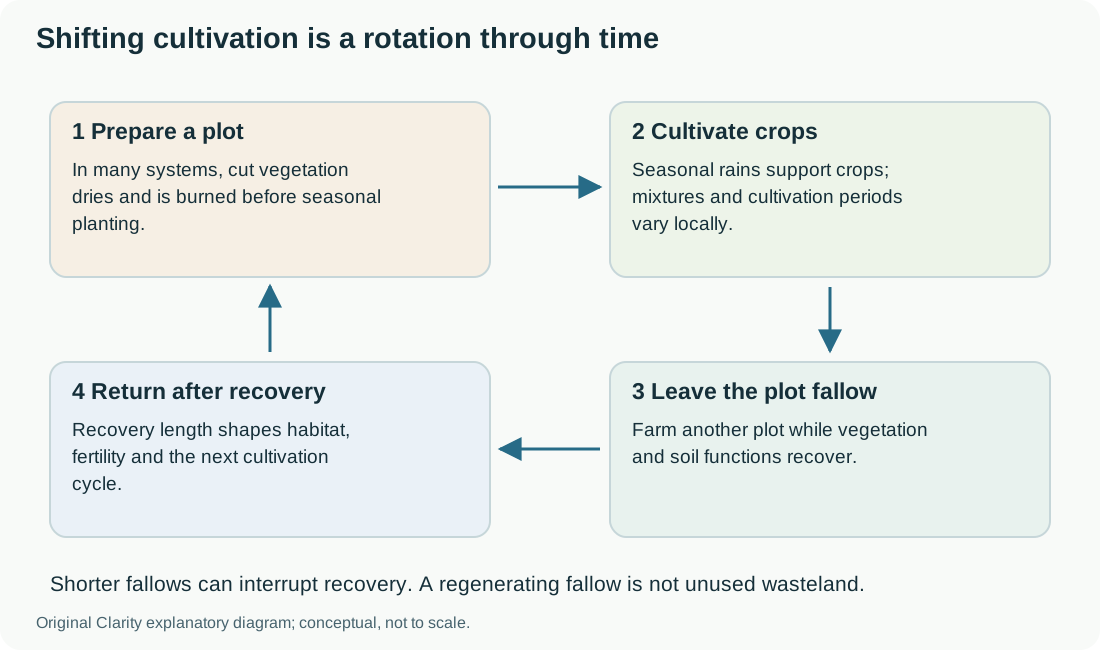
Burning has immediate consequences, including smoke and nutrient losses. Regrowth can restore some soil functions and biomass over time. However, a fallow forest is not automatically equivalent to old-growth forest. Its species composition and structure depend on recovery time and previous disturbance.
6.2 Names, communities and regional variation
Jhum is widely used in northeastern India, including Mizoram and Nagaland. Different Mizo, Naga and other communities practise locally distinct forms. Elsewhere, school geography describes podu in parts of Andhra Pradesh and bewar in Madhya Pradesh. These names identify regional practices, not a single uniform farming method.
Community identity alone cannot establish whether a household practises shifting cultivation. Households may combine settled farming, plantations, livestock, wage work and jhum. The relevant policy question is how a particular land-use system functions today.
6.3 Why shortened fallows create problems
A shorter fallow gives vegetation less time to recover. Repeated disturbance may reduce soil fertility and favour aggressive weeds. Farmers may then obtain lower yields from the same effort. Steep exposed slopes also become more vulnerable to erosion during heavy rain.
The solution cannot be reduced to simply banning a traditional practice. Secure land arrangements, locally suitable agroforestry and improved water management can help. Extension services should work with farmers on crops, soil cover and livelihoods. Where feasible, maintaining longer recovery periods can reduce ecological pressure.
Research in northeastern landscapes shows why cultivation and regenerating forest must be studied together. Integrated farming in Mizoram also illustrates how families can diversify livelihoods alongside cultivation.
7. Western Ghats–Sri Lanka: isolation, rain and endemism
The Western Ghats run broadly parallel to India's western coast. Moist monsoon air rises along the hills, influencing rainfall patterns. Elevation, seasonal rainfall and separation between hill blocks create many habitats. These conditions help explain the region's exceptional concentration of restricted species.
7.1 Extent, peaks and the Sri Lanka connection
The mountain chain extends roughly 1,600 kilometres along the western peninsula. It reaches from the Gujarat–Maharashtra end southwards through Goa, Karnataka, Kerala and Tamil Nadu. Anamudi in Kerala, at about 2,695 metres, is the highest peak. The Nilgiri, Anamalai and Agasthyamalai hills are useful southern geographic anchors.
The hotspot combines the Western Ghats with Sri Lanka's biologically rich habitats. Shared evolutionary and biogeographical relationships explain this grouping. It does not mean an uninterrupted mountain chain crosses the sea today. Nor does every species occur in both components.
Rainfall and terrain feed many short west-flowing rivers and major east-flowing systems. The Krishna and Kaveri basins connect upland ecological decisions with distant farms and cities. Headwater protection is therefore relevant far beyond the mountain slopes.
7.2 Shola forests and native grasslands
At higher southern elevations, sheltered folds often contain short evergreen forests called sholas. Native montane grasslands occupy many exposed slopes between them. Together they form a mosaic, with different communities in each component. Grassland here is not simply a forest waiting for tree planting.
Water moves through soils, roots and vegetation across this mosaic. Land conversion can change runoff, erosion and stream conditions. Planting unsuitable trees in native grassland may damage its distinctive species. Restoration should recover the appropriate ecosystem, not maximise tree cover everywhere.
7.3 Species that show different conservation needs
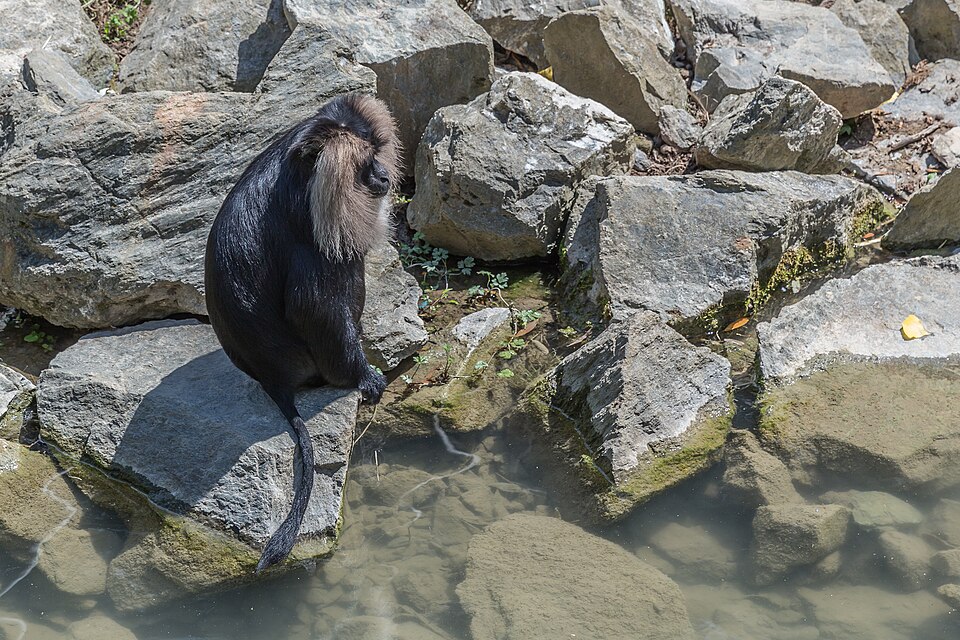
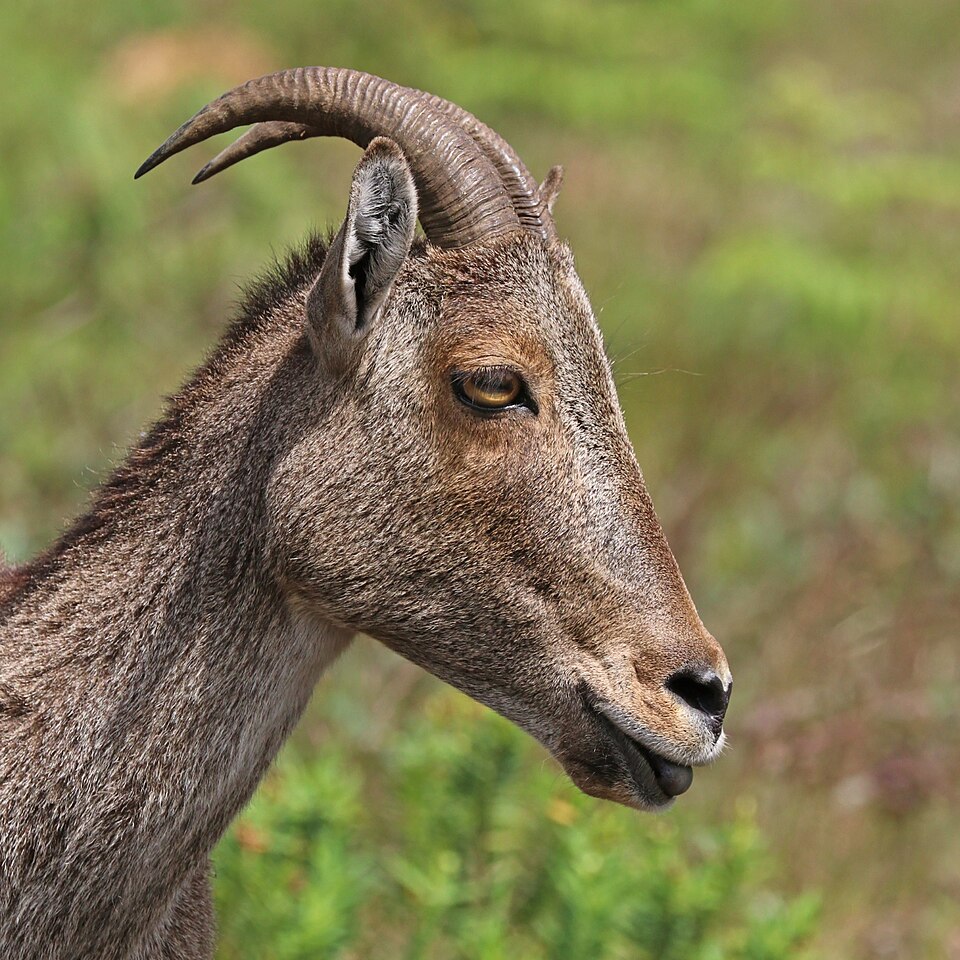
The lion-tailed macaque depends strongly on Western Ghats rainforest habitats. Its restricted range and fragmented forests make connectivity important. The Nilgiri tahr, by contrast, uses steep montane grassland and rocky terrain. Protecting either species requires understanding its habitat rather than assuming all wildlife needs dense forest.
_-_429.jpg)
_female_head.jpg)
Both animals are globally assessed as Endangered. Many endemic frogs and reptiles have much smaller ranges still. The purple frog illustrates the importance of soil, seasonal rain and breeding sites. The extremely rare Malabar civet also warns against presenting uncertain populations as a thriving success.
The 2025 Kerala Nilgiri tahr survey documents habitat and monitoring needs. Species accounts should identify assessment dates whenever precise population trends are discussed.
7.4 Neelakurinji and the meaning of mass flowering
Neelakurinji, Strobilanthes kunthiana, is associated with spectacular flowering in southern hill grasslands. Its well-known flowering cycle is about twelve years. Plants flower, produce seeds and then die, while the next generation develops. The event therefore represents a reproductive strategy, not merely a tourist attraction.
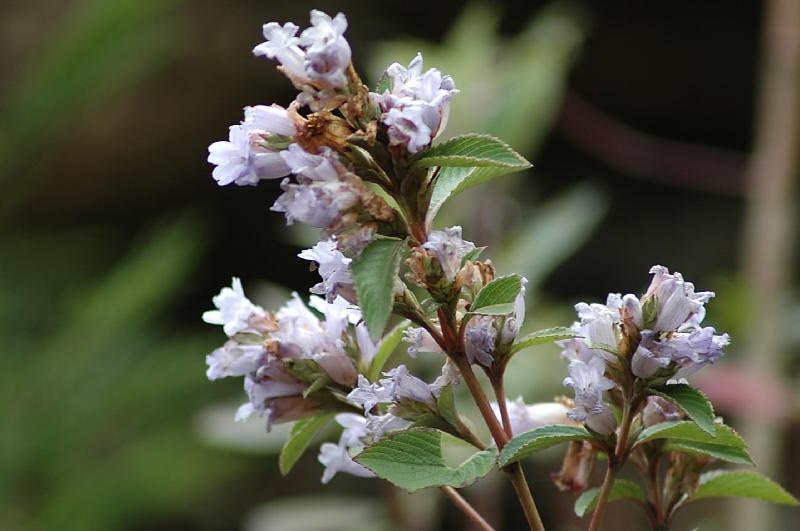

“Kurinji” is used for several related plants. Their flowering intervals are not all identical. Even populations of the same species may flower in different years. It is misleading to promise one universal next bloom across the entire Western Ghats.
7.5 Corridors and the conservation debate
Plantations, settlements, reservoirs and roads have divided many natural habitats. A corridor keeps movement possible between larger habitat blocks. It can support dispersal and genetic exchange, although different species require different connections. A forest strip suitable for an elephant may not solve a frog's breeding-site problem.
The Gadgil and Kasturirangan processes brought ecological sensitivity into the development debate. Their approaches differed in coverage and proposed regulation. The enduring issue is how land-use decisions protect ecological functions while recognising livelihoods. Expert recommendations, draft notifications and final legal restrictions must be distinguished.
Good planning uses village-level information, transparent consultation and cumulative impact assessment. Quarrying, construction and road proposals should address slope stability and water systems. Local people need credible information and workable livelihood options, alongside enforceable safeguards.
8. Sundaland and the Nicobar Islands
Sundaland includes the Malay Peninsula and major western Indonesian island landscapes. Sumatra, Borneo and Java are important geographic anchors. India's component is the Nicobar Islands, situated south of Andaman. The hotspot grouping reflects biogeographical relationships across this wider region.
8.1 Island isolation and the Sunda shelf distinction
Parts of continental Sundaland were connected across the exposed Sunda shelf during lower sea levels. That history should not be transferred automatically to Nicobar. The Nicobar chain belongs to a different island-arc setting. Membership in the same hotspot does not prove a former continuous land bridge.
Island biogeography examines colonisation, extinction, area and isolation. Larger islands often support more habitats and larger populations. Greater isolation can reduce colonisation while allowing distinctive lineages to develop. These are useful general relationships, not a formula predicting every island's species count.
8.2 The Nicobar megapode and coastal habitats
The Nicobar megapode is an endemic ground-dwelling bird. It builds nesting mounds using soil and organic material. Heat generated within the mound helps incubate the buried eggs. This unusual breeding system makes suitable ground and nesting habitat especially important.
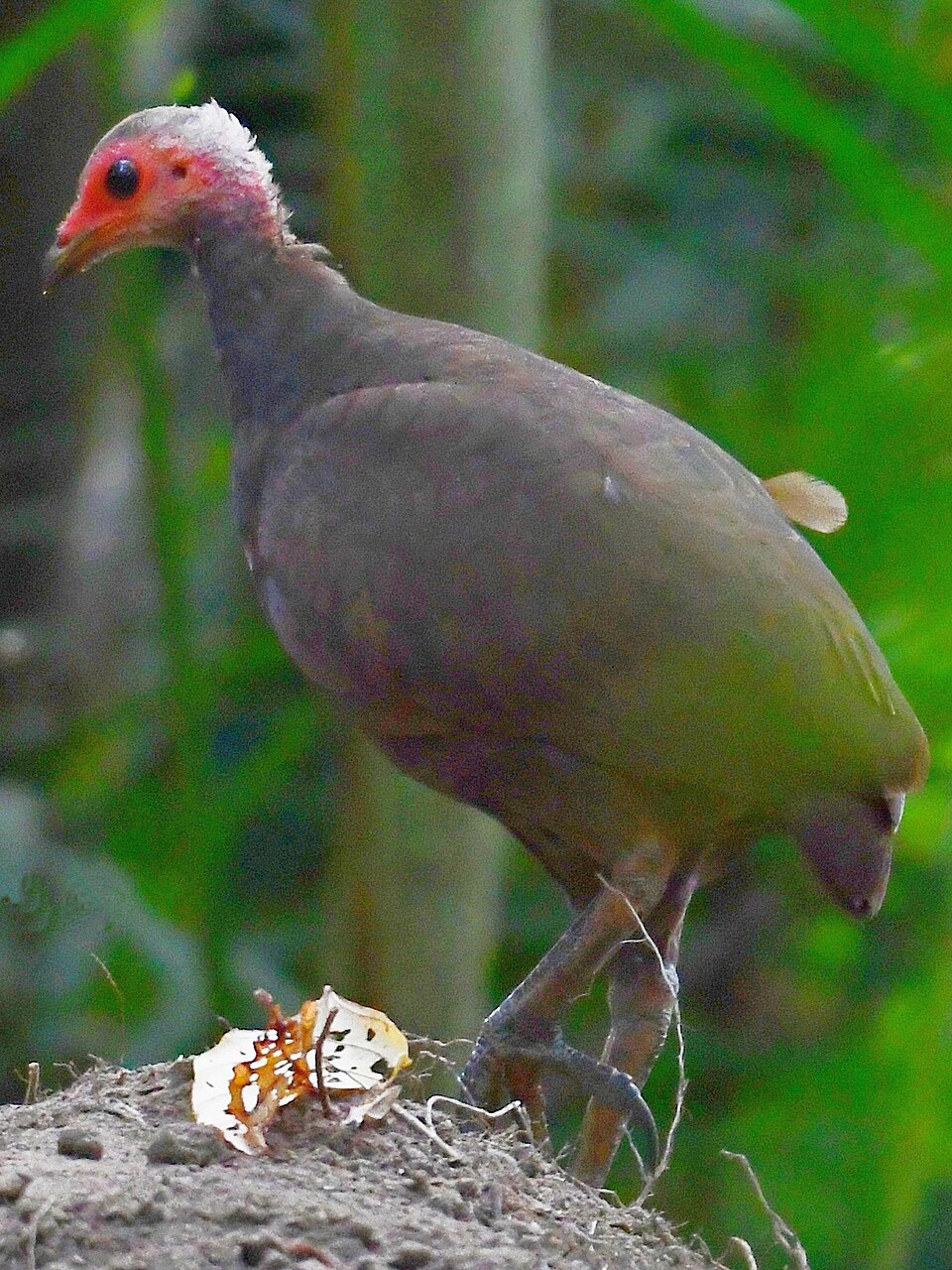

Nicobar's forests, mangroves and nearby seagrass and reef systems are connected. Sediment and pollution from land can damage coastal waters. Coastal vegetation also provides habitat and helps moderate some wave impacts. These benefits vary with vegetation structure, shoreline shape and event intensity.
8.3 Why small islands need careful planning
A restricted species may depend on a small number of sites. Land conversion can therefore remove a large share of its habitat. Introduced predators, invasive plants and disease can add new pressures. Earthquakes, tsunamis and storms may further reshape coastal habitats.
Conservation requires biosecurity, nesting-site protection and careful infrastructure assessment. Local and Indigenous communities' rights and knowledge must inform decisions. Development planning should examine freshwater, waste, coastal processes and disaster exposure together. Small islands offer limited room to relocate ecological damage elsewhere.
9. Comparing the four regions
The regions now have distinct ecological identities. The Himalaya highlights elevation and climate movement. Indo-Burma combines forest, freshwater and community landscapes. The Western Ghats demonstrate endemism across rainforest and montane grasslands. Nicobar shows how isolation and limited area shape vulnerability.
Four hotspot regions and their Indian connections
| Hotspot | Indian geographic anchor | Useful ecological example | Conservation implication |
|---|---|---|---|
| Himalaya | Himalayan mountain landscapes | Forest-to-alpine zonation; red panda habitat | Protect elevation gradients and connected habitats |
| Indo-Burma | Much of the northeast outside the Himalayan component; Andaman | Canopy-dependent gibbons; forest and river diversity | Combine community institutions, forest continuity and freshwater protection |
| Western Ghats–Sri Lanka | Western Ghats along the western peninsula | Lion-tailed macaque rainforest; tahr grasslands | Protect distinct native habitats and connections between hill blocks |
| Sundaland | Nicobar Islands | Island endemism; megapode nesting mounds | Protect small ranges, prevent invasions and assess coastal impacts |
On smaller screens, swipe across the table to read every column.
No row describes every species within its region. Use the comparison to organise understanding, then return to local evidence. Hotspot conservation ultimately depends on particular habitats, people and decisions.
10. How habitat loss becomes an extinction risk
Habitat loss removes living space, food and breeding sites. Fragmentation divides what remains into smaller, separated patches. A landscape can therefore retain considerable tree cover while losing ecological connectivity. These two processes often occur together but are not identical.
10.1 Small populations and edge effects
A small isolated population has fewer potential mates and less genetic exchange. Chance events, disease or a poor breeding season can have larger effects. Animals moving between patches may face traffic, fencing or conflict. Habitat quality between protected areas consequently matters for long-term survival.
Fragmentation also creates edges with altered light, temperature and wind. Some species tolerate these conditions; forest-interior specialists may not. Disturbance can favour invasive plants and increase access for extraction. Measuring only total forest area can miss these changes.
10.2 Pressures can reinforce each other
Consider a new road through an already fragmented forest. Direct clearing removes habitat, while traffic obstructs movement. New access may increase settlement or extraction unless managed. Warmer, disturbed edges may then become easier for invasive plants to occupy.
Other pressures include unsustainable harvesting, hunting, pollution and altered river flow. Climate change modifies rainfall, temperature and extreme events across these pressures. Conservation should identify interacting causes rather than produce an unconnected list of threats.
11. Why invasive alien species can transform habitats
An alien species has been introduced outside its natural range through human activity. An invasive alien species establishes and spreads with harmful ecological or related consequences. Being non-native alone does not prove that a species is invasive. Evidence of establishment, spread and impact matters.
11.1 Lantana in disturbed forests
Lantana camara, introduced from tropical America, can form dense thickets. It competes with native vegetation and obstructs movement through the understory. Birds disperse its fruits, helping it reach new locations. Cutting stems without addressing regrowth or reinvasion may produce only temporary clearance.
Effective restoration requires repeated follow-up and suitable native vegetation recovery. Managers need to examine grazing, fire, seed sources and renewed disturbance. Otherwise the conditions favouring invasion remain after the first removal effort.
11.2 Water hyacinth and island invaders
Water hyacinth can spread across nutrient-rich freshwater surfaces. Dense growth can obstruct water use and alter light and oxygen conditions. Removing plants while allowing sewage and nutrient inflows to continue may invite recurrence. Catchment pollution control is therefore part of managing the invasion.
Islands face additional risks from introduced predators such as rats and cats. Native ground-nesting species may have limited defences against unfamiliar predators. Preventing arrival can be more effective than removing an established invader. Biosecurity is consequently a central conservation measure for isolated islands.
12. What people gain from functioning ecosystems
Ecosystem services are benefits people obtain from ecological systems. Some benefits are direct, such as food and useful plant materials. Others arise from processes that people rarely notice until they fail. Pollination, soil formation and water regulation are examples.
12.1 Water, climate and agriculture
Vegetation, soils and wetlands influence how rainfall moves through a catchment. Healthy conditions can reduce erosion and moderate some runoff. They cannot prevent every flood or guarantee unlimited groundwater recharge. Geology, rainfall intensity and land use also shape the outcome.
Forests and soils store carbon, while destruction can release it. Diverse habitats support pollinators and natural enemies of crop pests. Wild relatives of crops preserve genetic traits useful for future breeding. These connections make biodiversity relevant to food and water security.
12.2 Livelihoods, culture and knowledge
Communities obtain food, medicines, fibres and income from biological resources. Sacred landscapes and species also carry cultural meaning beyond market prices. Nature tourism can support livelihoods when benefits and environmental limits are managed. Uncontrolled tourism can instead burden water, waste systems and wildlife.
Conservation decisions must therefore ask who receives benefits and who bears costs. Restricting local access while ignoring commercial damage can be both unfair and ineffective. Durable protection links ecological outcomes with rights, trust and livelihood security.
13. Conserving species within and outside their habitats
Conservation can protect species where they naturally live or maintain them elsewhere. These approaches are called in situ and ex situ. They can complement each other, but they solve different problems.
13.1 In-situ conservation keeps ecological relationships intact
A protected natural habitat conserves more than an individual species. It can retain food webs, breeding conditions and evolutionary processes. Eravikulam National Park, for example, protects important Nilgiri tahr habitat. Landscape conservation extends this approach beyond a single protected boundary.
National parks, sanctuaries and connected community-managed areas can contribute. Effective management still requires staff, monitoring, suitable rules and local cooperation. A notification by itself does not guarantee good habitat condition.
13.2 Ex-situ conservation provides additional safeguards
Seed banks, botanical gardens, tissue collections and carefully managed breeding programmes conserve biodiversity outside natural habitats. They can support research, genetic conservation and recovery efforts. Some seeds tolerate drying and cold storage; others need different methods. One storage technique therefore cannot protect every plant species.
Captive breeding also requires genetic and demographic management. Reintroduction needs suitable habitat and removal of the original threats. Releasing animals into an unsafe landscape does not solve conservation failure. Ex-situ measures are strongest when linked to a credible habitat strategy.
How the two approaches complement each other
| Approach | Example | Main strength | Limit |
|---|---|---|---|
| In situ | Protecting tahr habitat and surrounding ecological connections | Maintains species within living ecological systems | Requires effective landscape management and threat reduction |
| Ex situ | Conserving appropriate plant seeds in a seed bank | Safeguards genetic material and supports recovery | Cannot independently preserve the whole ecosystem |
On smaller screens, swipe across the table to read every column.
14. Laws, institutions and community protection
India uses several legal and institutional tools for biodiversity conservation. Each addresses different land, species or resource-use questions. Understanding their functions prevents the common mistake of treating every conservation label as legally equivalent.
14.1 The principal legal frameworks
The Wild Life (Protection) Act, 1972 regulates protected species and provides protected-area categories. Its amended framework includes national parks, sanctuaries, conservation reserves and community reserves. Current provisions must be read from the amended law, rather than older six-schedule summaries.
The Biological Diversity Act, 2002, amended in 2023, addresses conservation, sustainable use and benefit sharing. Its institutions include the National Biodiversity Authority, State Biodiversity Boards and local Biodiversity Management Committees. People's Biodiversity Registers document biological resources and associated knowledge. Documentation must respect community knowledge and applicable access arrangements.
The 1980 forest-conservation law, renamed Van (Sanrakshan Evam Samvardhan) Adhiniyam in 2023, governs specified forest-land diversion matters. The Environment (Protection) Act, 1986 supports measures including environmental regulation and notified eco-sensitive zones. Particular projects require examination of the applicable law, notification and judicial directions. A general article cannot replace that site-specific legal check.
14.2 Sacred groves, conservation reserves and community reserves
Sacred groves are patches protected through community beliefs and customary practices. Examples include devarakadus in Kodagu and sacred forests in Meghalaya. They can preserve mature trees, springs and locally rare species. Their ecological importance does not automatically give them a uniform statutory designation.
A conservation reserve can be declared on government-owned land under section 36A after consultation with local communities. Such areas can help protect landscapes or connections around protected areas. A community reserve under section 36C involves voluntarily conserved private or community land, subject to the statutory conditions.
These categories differ in land arrangements and governance. A sacred grove may overlap another recognised designation, but overlap must be established. Conservation works best when legal recognition strengthens effective local stewardship.
14.3 Biosphere reserves and corridors
Biosphere reserves integrate conservation, sustainable development and knowledge functions. Their core, buffer and transition zones are a planning framework. UNESCO recognition does not independently create all the legal restrictions of a national park. Underlying Indian designations and applicable laws still matter.
Similarly, an ecological corridor describes a connection used by wildlife. Its legal protection may depend on several land categories and decisions. Mapping the connection is the beginning of protection, not its completion.
15. Marine biodiversity and the hotspot distinction
India's marine environments also contain exceptional biodiversity and serious threats. Coral reefs, seagrass beds, mangroves and offshore waters support different communities. These ecosystems deserve conservation even though the formal 36-hotspot criteria use terrestrial vascular plants and vegetation loss.
15.1 Why there is no automatic fifth Indian hotspot
Writers sometimes use “marine hotspot” informally for rich marine regions. That usage should be distinguished from the formal terrestrial hotspot list. Coral biodiversity around Lakshadweep does not create a fifth Indian entry in that list. Nor does every marine protected area become a formal biodiversity hotspot.
The Gulf of Mannar, Gulf of Kachchh, Lakshadweep and Andaman–Nicobar waters provide useful marine examples. Their reef types, environmental conditions and management arrangements differ. Marine conservation must consider fishing pressure, warming, pollution and coastal development together.
15.2 Protected areas and biosphere recognition at sea
The Gulf of Mannar includes a marine national park and a wider biosphere reserve. These overlapping labels have different purposes and boundaries. Reefs and seagrass habitats support fisheries and species such as dugongs. Protection must connect habitat management with sustainable coastal livelihoods.
Land and sea conservation are also linked. Sediment, sewage and plastics can move from catchments into coastal waters. Protecting an island rainforest while neglecting its coast leaves part of the ecological system exposed.
16. Writing an evidence-based answer
A strong answer connects definitions, geographic examples and workable conservation measures. It should explain why a measure addresses a specific threat. Listing ten schemes without showing that connection adds little analytical value.
Question: “Protected areas alone cannot secure India's biodiversity hotspots.” Discuss with examples.
India contains parts of four global biodiversity hotspots, identified through exceptional plant endemism and extensive vegetation loss. Protected areas conserve vital habitats, but hotspot landscapes also contain farms, settlements, rivers and infrastructure.
First, isolated protected patches cannot ensure movement and genetic exchange. Connected forests matter for rainforest species in the Western Ghats. Himalayan species may also need accessible elevation gradients as climatic conditions change.
Second, several threats originate outside protected boundaries. Upstream pollution affects rivers and coastal habitats. Roads divide landscapes, while invasive plants can recolonise areas after incomplete removal. In Nicobar, development and introduced species can affect highly restricted populations.
Conservation should therefore combine effective protected-area management with landscape planning. Corridors, native-habitat restoration and cumulative environmental assessment can reduce fragmentation. Community institutions, secure rights and viable livelihoods improve cooperation. Long-term monitoring should measure habitat quality and ecological recovery, alongside area protected.
Protected areas remain essential, but their success depends on the surrounding landscape. A connected and socially credible conservation strategy better protects both biodiversity and ecosystem services.
The answer uses examples to explain mechanisms. It avoids claiming that plantation area equals restored biodiversity or that one legal label solves every problem. For a longer answer, add a small locator map and a specific community-conservation example.
17. Practice MCQs
These are newly written practice questions, not claimed as previous UPSC questions. Attempt them before opening the explanations. Each question tests a distinction developed in the chapter.
1. A region has 1,700 endemic vascular plant species and retains 28% of its original natural vegetation. Does it meet the two quantitative hotspot criteria?
- Yes, both criteria are met
- No, at least 2,000 endemic plants are required
- No, at least 70% vegetation must remain
- Only if it contains tropical rainforest
Answer and explanation
A. It exceeds 1,500 endemic vascular plants and has lost 72% of original vegetation. The test concerns loss, not remaining cover. A tropical climate is not a separate requirement.
2. Which pairing correctly identifies India's island components?
- Andaman—Sundaland; Nicobar—Himalaya
- Andaman—Indo-Burma; Nicobar—Sundaland
- Both groups—Western Ghats–Sri Lanka
- Nicobar—Indo-Burma; Andaman—Sundaland
Answer and explanation
B. Keep the two island groups distinct. Nicobar's hotspot membership also does not prove a former land bridge across the continental Sunda shelf.
3. Which statement about an endemic species is necessarily correct?
- It is globally Critically Endangered
- It occurs naturally only within a specified region
- It is legally protected under Schedule I
- It cannot survive in captivity elsewhere
Answer and explanation
B. Endemism describes natural geographic restriction. Threat status, legal protection and survival outside the natural range are separate questions.
4. Why may planting dense trees in a native montane grassland be harmful?
- All trees reduce biodiversity everywhere
- It may replace a distinct native habitat and its specialist species
- Grasslands never contain endemic species
- Only forests regulate water
Answer and explanation
B. Restoration should match the native ecosystem. Western Ghats grasslands form part of an ecological mosaic; they are not automatically degraded forest.
5. Shortening a shifting-cultivation fallow can directly reduce:
- The time available for vegetation and soil recovery
- The need for any livelihood support
- All rainfall on the cultivated slope
- The existence of customary land institutions
Answer and explanation
A. Reduced recovery time can contribute to lower fertility, weeds and erosion. Outcomes still depend on local conditions and management.
6. Which approach is most likely to sustain recovery after Lantana removal?
- Cut once and abandon the site
- Follow up regrowth, restore suitable native vegetation and manage renewed disturbance
- Plant the same commercial tree everywhere
- Remove all native understory plants
Answer and explanation
B. Removal must address the conditions and pathways sustaining invasion. Native recovery and repeated monitoring help prevent rapid reinvasion.
7. Which pairing is correct?
- Seed bank—in situ
- Natural-habitat protection—ex situ
- Botanical garden collection—ex situ
- Tissue culture—in situ
Answer and explanation
C. Ex-situ conservation occurs outside the natural habitat. The other listed collections also fall under ex situ, while natural-habitat protection is in situ.
8. What distinguishes a community reserve under the wildlife law?
- It must be a UNESCO biosphere reserve
- It involves voluntarily conserved private or community land, subject to the Act
- It is simply another name for any sacred grove
- It can contain no local management arrangements
Answer and explanation
B. The statutory category has specified land and governance conditions. Sacred groves and biosphere reserves are different concepts.
9. Which conclusion about Neelakurinji is sound?
- Every Strobilanthes species flowers every twelve years
- All Western Ghats populations must flower in the same year
- The well-known twelve-year cycle concerns Strobilanthes kunthiana; other species and local cohorts can differ
- Mass flowering proves that a habitat faces no threats
Answer and explanation
C. Common names can cover several related plants. Species identity and the particular population matter when describing flowering cycles.
10. Which inference best follows from the formal hotspot criteria?
- All marine biodiversity lies within the 36 hotspots
- Areas outside hotspots have no conservation value
- The framework prioritises exceptional terrestrial plant endemism combined with substantial vegetation loss
- Every hotspot is automatically an Indian national park
Answer and explanation
C. The framework has a defined purpose and limits. Other ecosystems and conservation-priority systems remain important.
18. Frequently asked questions
These questions address distinctions that often cause confusion during revision.
Does India have four hotspots or parts of four hotspots?
India contains parts of four global hotspots. Their full boundaries extend beyond India. Western Ghats–Sri Lanka and Sundaland make this especially clear.
Does 70% habitat loss mean that 70% must still remain?
No. At least 70% of original natural vegetation must have been lost. Therefore, at most 30% remains. Both this condition and the endemic-plant threshold are required.
Can an endemic species be common within its range?
Yes. Endemism concerns where a species naturally occurs, not how many individuals exist there. A restricted species may be locally common, although a small range can create vulnerability to concentrated threats.
Is all shifting cultivation equally damaging?
No. Fallow length, slope, crops, population pressures and land arrangements affect outcomes. Long fallows can allow substantial recovery, while shortened cycles may intensify pressure. Neither blanket condemnation nor uncritical romanticisation explains local conditions.
Are plantations equivalent to restored natural forests?
No. Tree cover alone does not establish native species diversity, habitat structure or ecological function. Some plantations provide useful products or partial habitat, but cannot automatically replace old-growth forest or native grassland.
Are sacred groves and community reserves identical?
No. Sacred groves arise from customary cultural protection. Community reserves are a statutory category with specified conditions. A place may have overlapping recognition, but the overlap must be verified.
Why is Nicobar placed in Sundaland?
The hotspot reflects wider biological relationships with Southeast Asian island landscapes. Its inclusion does not mean the Nicobar chain was simply part of the exposed continental Sunda shelf.
Can we call Lakshadweep a marine biodiversity hotspot?
The term can be used informally if its meaning is explained. It must not be presented as an additional member of the formal 36 terrestrial hotspots. Lakshadweep's marine biodiversity deserves protection on its own ecological merits.
19. Sources and further reading
Primary sources used in this chapter are collected here for further reading.
View sources (22)
- Myers's original paper
- CEPF's criteria and count
- Himalaya
- Indo-Burma
- Western Ghats–Sri Lanka
- Sundaland
- Smithsonian species account
- CEPF's Indo-Burma ecosystem profile
- Government biodiversity portal: western hoolock gibbon
- BirdLife: great hornbill assessment
- IUCN SSC Pangolin Specialist Group
- ATREE's landscape research
- ICAR account from Mizoram
- UNESCO's Western Ghats account
- Central Zoo Authority’s 2025 yearbook
- 2025 Kerala Nilgiri tahr survey
- Kerala Tourism's botanical explanation
- ATREE's restoration work
- Act and amendment resources
- India Code: current consolidated environmental legislation
- National Biodiversity Authority
- NCERT: Contemporary India II, Agriculture