

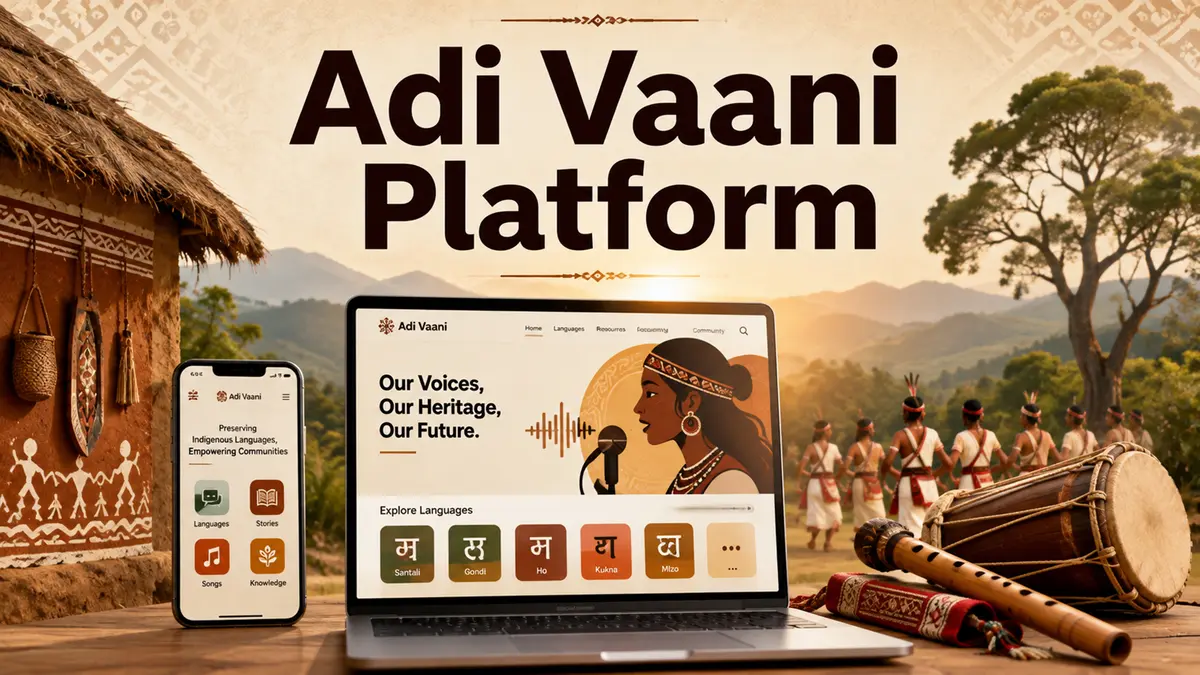
Why in news?
The Ministry of Tribal Affairs launched the upgraded Adi Vaani platform in Mysuru on 24 August. The launch added an iOS application, five more languages and a new platform identity. The Ministry also introduced its Jago artificial-intelligence assistant. A new agreement with the Central Institute of Indian Languages supports language documentation and corpus development.
What Adi Vaani is
Adi Vaani is a government-backed platform for tribal-language translation and preservation. Artificial intelligence helps process text, speech, images and recorded material. The service aims to improve access to public information. It also creates digital resources for languages with limited online content.
The platform began in beta form in September 2025. Its initial work covered Santali, Bhili, Mundari and Gondi. Garo and Kui were then under development. The present platform displays a wider group of languages from several language families.
The official launch release confirms five additions, but it does not name them individually. The current platform page lists thirteen languages in total. This edition does not guess which five formed the launch batch. That distinction preserves the exact official record.
How the tools can work
Text translation changes written material between supported languages. Automatic speech recognition converts spoken words into text. Text-to-speech produces audio from written material. Speech translation can connect these stages for a spoken exchange.
Optical character recognition extracts text from a photograph or scanned document. It can help digitise primers, notices and archival material. Subtitle tools can make recorded content more accessible. Dictionaries and primers provide human reference points for machine output.
Why tribal languages need special design
Many artificial-intelligence systems learn from large digital collections. Several tribal languages have very small online corpora. Their spelling may vary across places and scripts. Everyday speech can also differ from a formal written standard.
A model trained on weak data can produce confident errors. Literal translation may miss kinship, ritual or ecological meaning. Community speakers and trained linguists must therefore review the output. Adi Vaani says its translations use community collaboration and expert validation.
The role of CIIL and local institutions
The Central Institute of Indian Languages is based in Mysuru, Karnataka. It works on language research, documentation and teaching resources. Its memorandum with the Ministry covers data sharing and corpus development. A corpus is an organised collection of spoken or written language samples.
Tribal Research Institutes and academic partners can support field recording and validation. Elders preserve vocabulary and oral history. Younger speakers can test whether tools fit present use. Schools can connect home language with wider classroom learning.
Jago serves a different purpose
Jago is the Ministry’s conversational assistant. It is intended to help people find information on welfare schemes and official programmes. This function differs from language documentation. The assistant organises trusted government information through one interface.
Its value will depend on accurate answers and timely updates. A chatbot should show the source and date of important information. It should also provide a route to a human official. Automated guidance cannot replace an appeal or legal entitlement.
Education and public-service value
Children learn more easily when early teaching connects with their home language. Multilingual education can support comprehension while introducing regional and national languages. Digital tools may help teachers prepare local material. They cannot replace trained teachers or community-created content.
Translation can also improve health and welfare communication. A person may understand eligibility or treatment advice more clearly in a familiar language. Speech tools help where literacy is limited. Offline access remains important in areas with weak connectivity.
Data rights and cultural safeguards
Language data can contain songs, sacred knowledge and identifiable voices. Collection therefore needs informed community consent. People should know how recordings will be stored and reused. Commercial use requires especially clear rules and benefit sharing.
Security must cover voice files, transcripts and user queries. Communities also need a method to correct harmful translations. Open access can support research, but not every cultural record belongs in a public database. Governance must recognise collective rights as well as individual privacy.
Technology supports a living language only when people use it
A digital model can record words and widen access. Long-term survival still depends on speech at home, teaching in schools, cultural creation and public use. Community control gives the technology legitimacy.
Conclusion
Adi Vaani can reduce a serious language barrier in education and public services. Its wider platform and mobile access are useful steps. Accuracy must come from speakers, linguists and transparent review. Strong consent and data rules are equally important. The project should strengthen living communities, not merely build a larger technical database.