

Why in news?
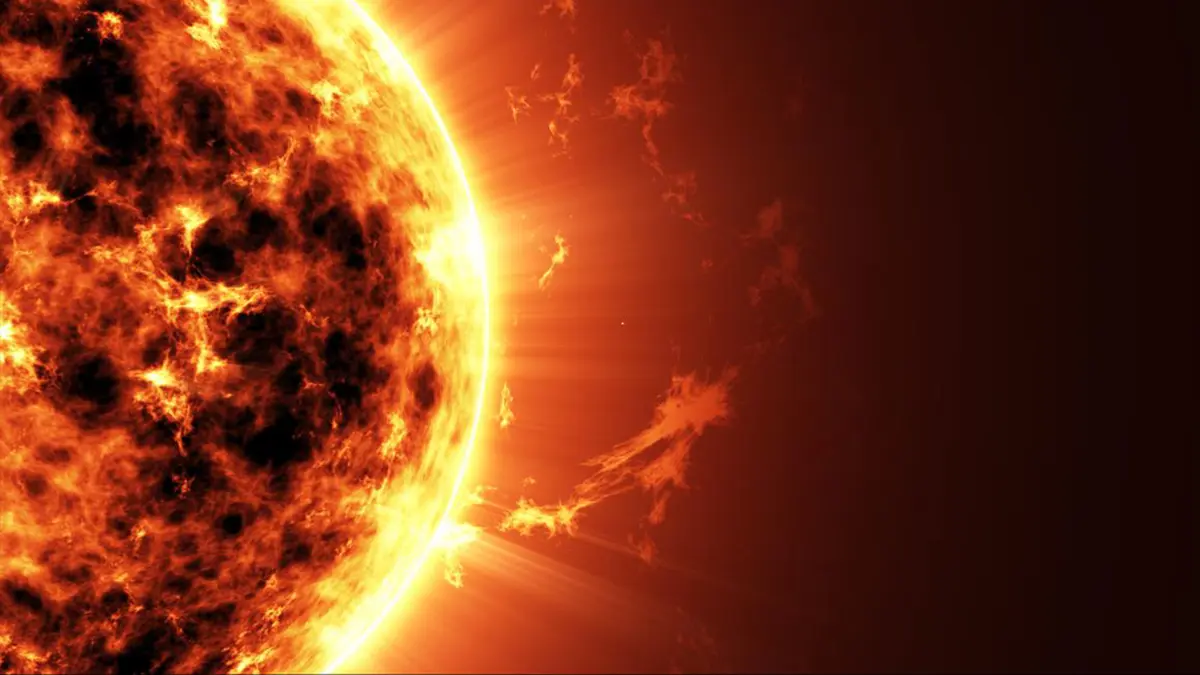
Indian researchers found small solar brightenings during the hours before major flares. The events clustered near places where the larger eruptions later began. Three Aditya-L1 instruments supplied simultaneous ultraviolet and X-ray observations. The study may improve understanding of flare onset and future forecasting.
What a solar flare is
A solar flare is a sudden burst of electromagnetic radiation from the Sun. It begins when stressed magnetic fields release stored energy. Magnetic reconnection can rapidly change their structure. Plasma then heats and particles accelerate.
Flares emit across radio, visible, ultraviolet and X-ray wavelengths. Strong radiation reaches Earth in about eight minutes. Earth’s atmosphere absorbs the most harmful wavelengths. Spacecraft and the upper atmosphere remain exposed.
A flare is not the same as a coronal mass ejection. The latter throws magnetised plasma into space. Both can occur together, but either can occur alone. Their effects and arrival times therefore differ.
The Aditya-L1 instruments
Aditya-L1 is India’s first dedicated solar observatory. It operates around the first Sun–Earth Lagrange point. This position allows nearly continuous observation without regular Earth eclipses. It lies about 1.5 million kilometres sunward from Earth.
The Solar Ultraviolet Imaging Telescope is called SUIT. It images the solar disc through eleven near-ultraviolet filters. Different filters sample the upper photosphere and chromosphere. Earth’s atmosphere blocks much of this radiation from ground telescopes.
The Solar Low Energy X-ray Spectrometer is shortened to SoLEXS. The High Energy L1 Orbiting X-ray Spectrometer is called HEL1OS. They measure lower and higher-energy X-rays. Together, the instruments connect activity across several atmospheric layers.
What the study found
Researchers examined several flares through SUIT’s magnesium filters. They detected many small, short-lived brightenings before major events. The same locations appeared in two similar ultraviolet channels. Some brightenings also produced X-ray signatures.
The events occurred in magnetically active regions. They clustered around the later flare location. Repeated small releases may gradually disturb an already stressed field. That interpretation connects lower-atmosphere activity with coronal energy release.
The Monthly Notices of the Royal Astronomical Society published the analysis. Researchers came from Manipal Academy of Higher Education and Indian institutions. The work is among the first systematic multi-instrument Aditya-L1 pre-flare studies. It demonstrates the mission’s scientific coordination.
Why the different wavelengths matter
The photosphere is the Sun’s visible surface. The chromosphere lies above it. The much hotter corona forms the extended outer atmosphere. A flare moves energy and particles across these connected layers.
Ultraviolet images show compact heating in the lower atmosphere. X-rays reveal hotter plasma and energetic processes higher above. Simultaneous timing helps distinguish related events from coincidence. It can also show how energy release develops.
SUIT’s magnesium-II h and k filters sample similar chromospheric heights. Their agreement improves confidence in detection. X-ray counterparts provide stronger evidence of magnetic energy release. Not every ultraviolet brightening showed the same X-ray response.
Flare classes and possible effects
Scientists classify flares as A, B, C, M or X. Each letter represents a tenfold rise in peak X-ray flux. X-class events are the strongest category. Numbers further divide each class.
Strong flares can disturb high-frequency radio communication on Earth’s sunlit side. Radiation can also affect satellites and astronauts. Navigation signals may experience ionospheric errors. A related coronal mass ejection can later drive a geomagnetic storm.
Geomagnetic storms can produce auroras and power-system stress. A flare alone does not automatically create that storm. Forecasters must track the ejected plasma and its magnetic direction. Clear terminology prevents exaggerated warnings.
Can the brightenings predict a flare?
The findings identify a promising precursor pattern. A useful forecast system needs more than repeated examples before flares. It must also study quiet periods with similar brightenings. That comparison determines the false-alarm rate.
Researchers need larger samples across many active regions. The signal must work with automatic detection and near-real-time data. Lead time and flare strength should be tested separately. Instrument calibration must remain stable.
A precursor can be physically meaningful without being a reliable prediction. Some brightenings may occur without a major flare. Some flares may also lack the pattern. The present study moves forecasting forward but does not solve it.
Why better forecasting matters
Satellite operators can postpone sensitive manoeuvres or protect instruments. Astronauts can move towards better shielding. Radio and navigation services can prepare for disruption. Power operators gain time to monitor wider space-weather conditions.
India operates communication, navigation and Earth-observation satellites. Domestic solar observations improve scientific independence and data continuity. International sharing strengthens global forecasts. Space weather crosses national borders.
Aditya-L1 also observes solar wind and magnetic fields near the Lagrange point. These measurements help assess Earth-directed disturbances later. Remote images show the source, while local instruments sample passing material. Combining both supports a fuller warning system.
A precursor is not yet a dependable warning
The brightenings are scientifically promising. Forecast value requires larger samples, quiet-period comparisons and measured false alarms.
Conclusion
The Aditya-L1 study connects small chromospheric events with later flare locations. Simultaneous ultraviolet and X-ray data make that connection more convincing. The result improves understanding of how stressed solar fields release energy. Much more testing is needed before operational prediction. Even so, the work strengthens India’s contribution to practical space-weather science.