

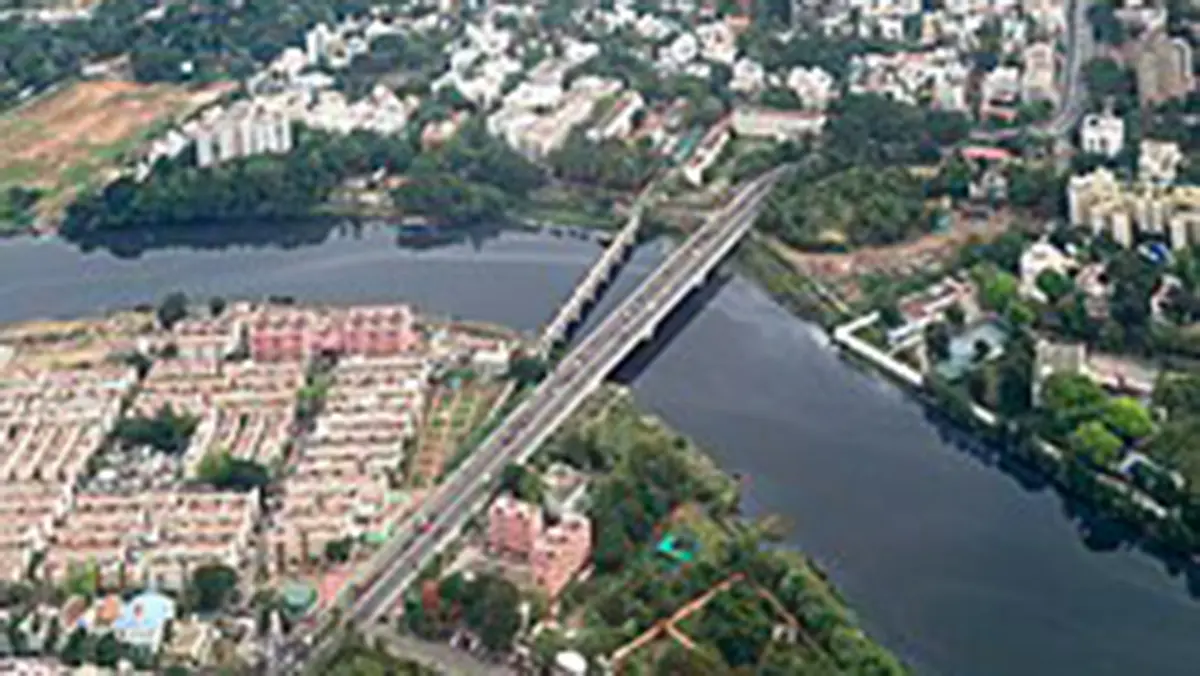
Why in news?
Tamil Nadu’s Water Resources Minister inspected areas along the Adyar River. He reviewed cleaning work and civic needs in riverbank settlements. The visit followed a late-July maintenance and desilting drive across Chennai’s major water bodies. That drive included the Adyar near Manapakkam.
A short river with several urban functions
The Adyar is about 42.5 kilometres long, according to the Tamil Nadu Pollution Control Board. It carries surplus water from upstream tanks. These include the Chembarambakkam system; the river then moves east through metropolitan Chennai towards the Bay of Bengal.
It reaches the sea through a tidal estuary and creek. Calling the Adyar merely a “drain” misses these hydrological functions.
It is a river and storm-water pathway; it is also an estuarine wetland and a living urban landscape.
These roles become especially visible during extreme rain; the channel and floodplain must carry large volumes of water. Wetlands and open spaces slow, spread and temporarily hold these flows. Bridges, embankments and encroachments can alter that movement.
Silt, solid waste and undersized drains can create further constraints. Poorly planned engineering may shift risk without solving upstream causes.
Unplanned eviction can also transfer hardship to poorer households. River management must integrate hydrology, housing, drainage, health and ecology.
The estuary is not merely the end of a sewer. Wetlands support biodiversity, flood mitigation and climate resilience; a February 2026 programme combined an estuary nature walk with a clean-up. Participants collected 86 kilograms of waste, mainly soft plastics.
Such events build awareness; the collected waste also shows how land-based litter reaches a sensitive tidal system.
The central pollution problem is sewage
A 2014 study examined Adyar pollution for the Tamil Nadu Pollution Control Board. The Indian Institute of Technology Madras conducted it; the study found severe pollution from high organic loading. Untreated or partly treated sewage was the main source.
It also found evidence linked to industrial and hospital discharges. Water quality was poor along the studied stretch.
The central recommendation was an interceptor sewer with intermediate treatment plants. This system would reduce the pollution entering the river.
That diagnosis changes how a cleaning campaign should be judged. Removing weeds, plastic and silt may improve local flow or appearance. Such work cannot restore water quality while sewage outfalls continue. Intercepted sewage also requires enough treatment capacity.
Pumps need reliable power and backup. Household connections must function, and authorities must control illegal discharges.
Continued water-quality monitoring is therefore crucial. Results should show whether investments reduce organic load, faecal contamination, nutrients and other pollutants.
Desilting is not automatically restoration
Sediment removal should follow surveys of channel capacity and sediment quality. Indiscriminate excavation can disturb habitat or destabilise banks; it can also release contaminated material. Without a lawful disposal site, the work merely moves pollution elsewhere.
Flood conveyance, drain clearance, ecological recovery and contaminated-sediment removal are distinct objectives; each must be stated and measured separately.
Governance priorities
First, responsibility must follow the river rather than municipal boundaries. Many institutions influence different parts of this single system; they include sewer agencies, local bodies and the Water Resources Department. The pollution board and Forest Department also have important roles.
Upstream tanks and peri-urban development affect the Chennai core; a basin-level mechanism should coordinate these links.
It should publish maps of outfalls and interceptor works. Residents also need clear water-quality results, floodplain changes and maintenance contracts.
Second, civic services in riverbank communities form part of restoration. Settlements without sewers or toilets cannot be treated only as polluters; they also need solid-waste collection and safe access. These services can reduce both environmental exposure and pollution.
Relocation may sometimes be necessary for demonstrable safety reasons; it must follow due process, consultation and access to livelihoods.
Replacement housing must be dignified. Where in-situ upgrading is safe, it should be preferred and properly serviced.
Third, flood and ecological work should reinforce each other. Protecting the estuary and floodplain can improve habitat while reducing risk. Native vegetation stabilises river edges. Storm-water drains should remain free of sewage so that they can perform their intended function.
Hard embankments may be necessary at constrained sites. Concreting the entire river would sacrifice its tidal and ecological roles.
Climate change makes this distinction more urgent. Intense rainfall and sea-level influence can interact near the river mouth.
Conclusion
The ministerial inspection is useful only if it produces coordinated follow-through; the Adyar cannot recover through episodic cleaning alone. Chennai needs continuous sewage treatment and evidence-based desilting; it also needs protected flood space, humane services and transparent basin-wide monitoring.