

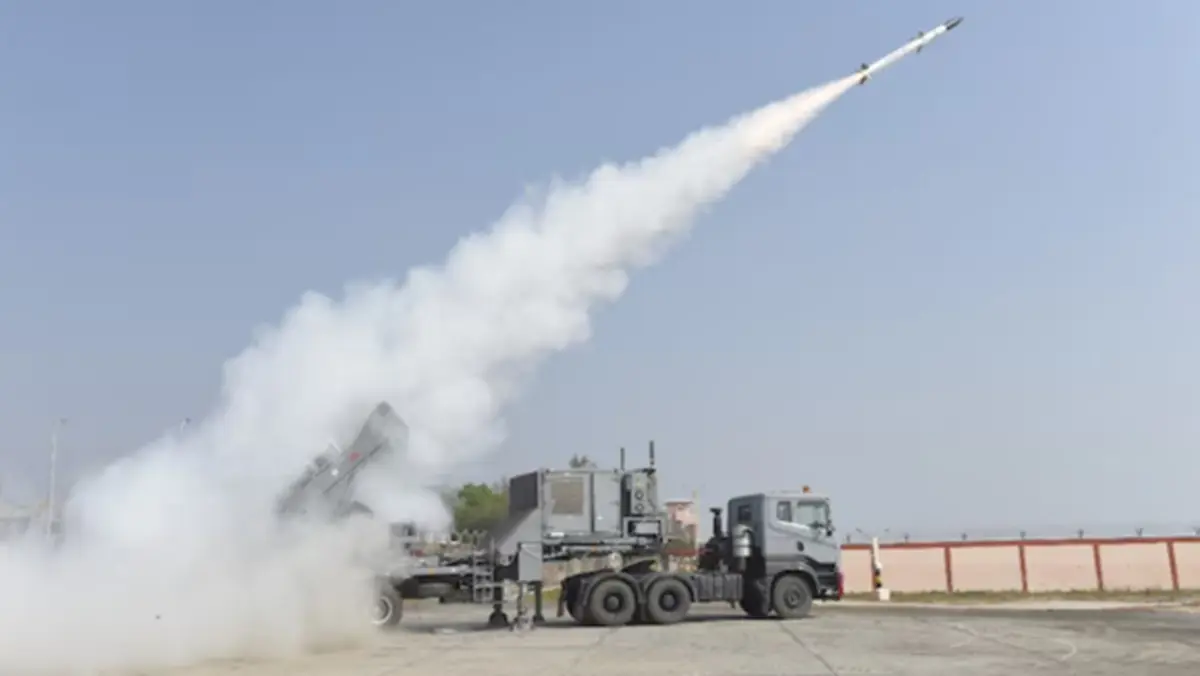
Why in news?
On 23 December 2025 the Defence Research and Development Organisation successfully completed user evaluation trials of the Akash‑NG (New Generation) surface‑to‑air missile. The tests involved multiple interceptions across different ranges and altitudes and cleared the way for the missile’s induction into the Indian Air Force.
Background
Origin: Akash‑NG is the successor to the Akash and Akash Prime missiles. Development began in the late 2010s to create a more compact, mobile and capable air‑defence system.
- Key features:
- Dual‑pulse solid rocket motor: Provides high acceleration and sustained thrust, giving the missile longer range (about 45 km) and better manoeuvrability.
- Active radio‑frequency seeker: An indigenous RF seeker helps the missile home in on targets with precision, even in heavy electronic jamming.
- Canisterised launcher: The missile is stored and transported in a sealed container that also serves as the launch tube, ensuring quick deployment and reduced maintenance.
- Multi‑function radar and command‑and‑control: A phased‑array radar tracks multiple targets and guides the missile. The entire system is network‑centric, enabling integration with other air‑defence assets.
- Testing milestones: Initial developmental trials were conducted in 2021. The user evaluation trials (December 2025) were carried out jointly by DRDO, the Indian Air Force and defence industry partners. The missile intercepted high‑speed, manoeuvring aerial targets at various ranges and altitudes.
- Indigenous content: All major subsystems—including the seeker, propulsion, radar, launcher and command unit—were designed and built in India with private and public sector collaboration.
Significance
- Air defence modernisation: Akash‑NG will replace older surface‑to‑air systems and provide better response against fighter aircraft, cruise missiles and drones.
- Mobility and flexibility: The canisterised launcher and compact system allow quick relocation and deployment, essential for protecting moving columns or high‑value assets.
- Indigenisation: Success of Akash‑NG reinforces India’s capability to design, develop and produce advanced missiles domestically and opens opportunities for export.
Source: NOA