

Why in news?
Astronomers recently used the Atacama Large Millimeter/submillimeter Array (ALMA) to create the largest‑ever mosaic of the Milky Way’s central region. The survey, known as the ALMA CMZ Exploration Survey (ACES), revealed an intricate network of cold molecular gas filaments and clumps in the Central Molecular Zone (CMZ) – the extreme environment around our galaxy’s supermassive black hole. These observations offer unprecedented detail about star formation processes near the galactic centre.
Background
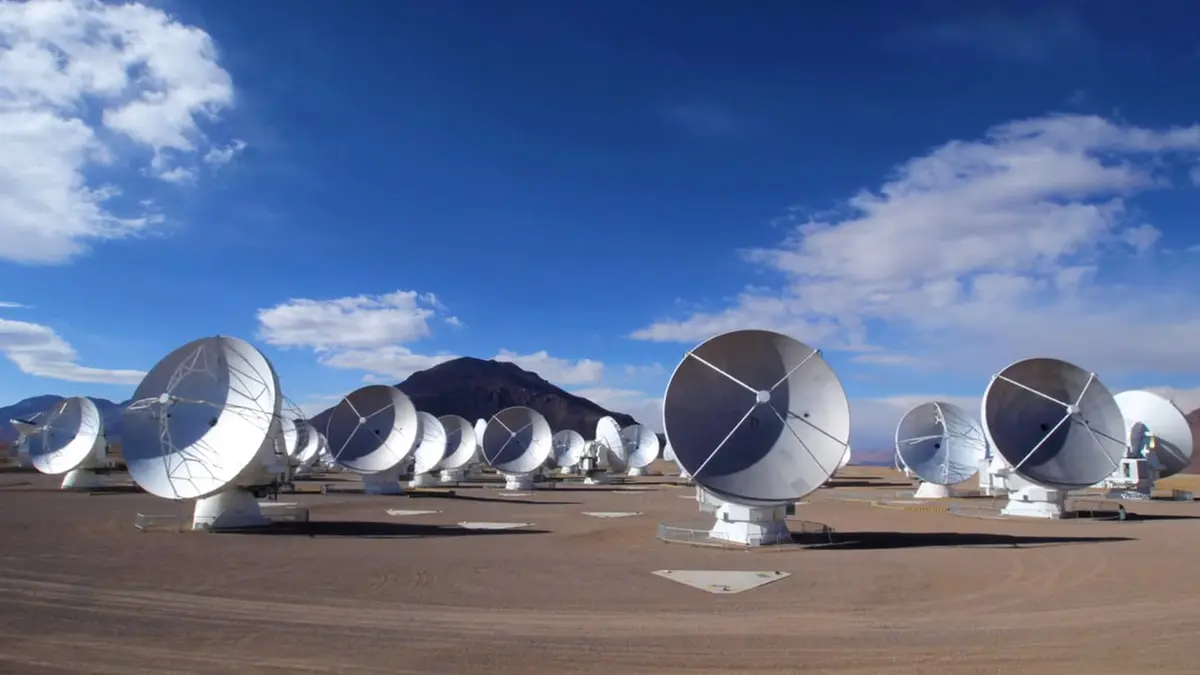
The Atacama Large Millimeter/submillimeter Array is an advanced radio telescope located in Chile’s high‑altitude Atacama Desert. It is operated by a partnership of the European Southern Observatory (ESO), the U.S. National Science Foundation and Japan’s National Astronomical Observatory. ALMA consists of 66 high‑precision antennas spread over a maximum baseline of 16 kilometres, which allows it to act like a giant virtual telescope with very high resolution. The antennas can be moved to different configurations, much like zooming in and out with a camera lens, enabling astronomers to study both large structures and tiny details in the cold universe.
Key properties and discoveries
- Exceptional sensitivity: ALMA’s receivers operate at millimetre and sub‑millimetre wavelengths, making them sensitive to the cold gas and dust from which stars and planets form. The telescope can detect faint emissions that other observatories cannot.
- Flexible array: Its 66 antennas can be arranged from compact formations to expanses spanning 16 km. This flexibility provides both high resolution for small features and wide fields for large structures.
- Notable discoveries: ALMA has imaged protoplanetary discs around young stars like HL Tauri, revealing gaps where planets may be forming. It has detected starburst galaxies in the distant universe and observed an Einstein ring – a phenomenon produced by gravitational lensing. The new ACES mosaic shows filaments of cold gas feeding star‑forming clumps near the Milky Way’s centre.
Significance of the new survey
- Understanding extreme environments: The CMZ hosts some of the most massive and short‑lived stars in our galaxy. Studying this region helps astronomers test theories about star formation under intense gravity, turbulence and radiation.
- Probing galaxy evolution: Observing how gas flows and forms stars near the Milky Way’s nucleus provides clues about how galaxies grew in the early universe when conditions were more chaotic. The data may also illuminate the role of supermassive black holes in regulating star formation.
- Technological achievement: The mosaic demonstrates ALMA’s capability to stitch together observations over a huge area, showing the power of international collaboration in modern astronomy.
Conclusion
The Atacama Large Millimeter/submillimeter Array is revolutionising our understanding of the cold universe. Its ability to capture detailed images of the Milky Way’s central region reveals spectacular filaments and star‑forming clouds that were previously hidden from view. Continued surveys will deepen our knowledge of star birth, galaxy evolution and the interplay between gas, stars and black holes.