

Why in news?
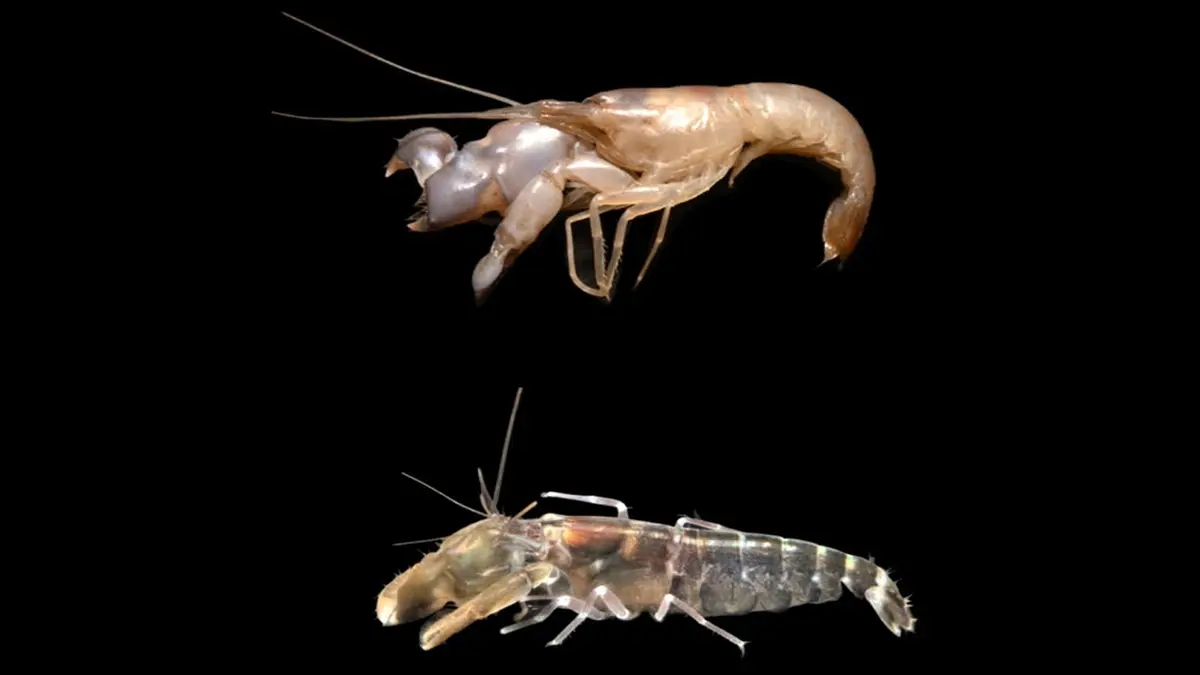
A research team has described two new pistol shrimp species from the Cochin estuary in Kerala. Their formal names are Alpheus vembanadi and Alpheus harii. Both descriptions appeared online in the journal Crustaceana on 24 August 2026. Public reports highlighted the discoveries during the first week of September.
What a new species description establishes
The shrimps did not suddenly appear in 2026. Scientists had collected specimens and then compared them with recognised species. A formal description names a repeatable set of distinguishing characters. Deposited specimens allow later researchers to test that decision.
The team combined visible anatomy with genetic evidence. It examined a section of mitochondrial 16S ribosomal ribonucleic acid. This marker helps compare evolutionary differences among related crustaceans. Genetic distance supports identification but does not replace careful morphology.
Researchers came from the Cochin University of Science and Technology and collaborating institutions. Japanese crustacean taxonomist Tomoyuki Komai joined both studies. The work divided the findings into two separate peer-reviewed papers. Each species therefore has its own diagnosis and comparison group.
Alpheus vembanadi
The name vembanadi recognises the Vembanad backwater system. The species belongs to the Alpheus crassimanus complex. Its closest reported comparison was Alpheus aestuaricola, then known from Japan. Several small claw and head features separate the two.
The partial 16S sequences differed from Alpheus aestuaricola by 11.9 to 12.2 per cent. That difference supported the anatomical diagnosis. The paper also reviewed uncertain older records from south-western India. Old names cannot be corrected confidently when original voucher specimens are unavailable.
Alpheus harii
The second name honours marine scientist Mahadevan Harikrishnan. The paper describes it as euryhaline, meaning tolerant of a broad salinity range. Specimens were recovered as bycatch from stake nets at about three metres depth. The species was placed within the Alpheus edwardsii group.
It resembles Alpheus nipa and Alpheus cyanoteles but differs in several structures. These include ridges and grooves near the rostrum and major claw. Its closest database sequence still showed more than 11.9 per cent divergence. The combined evidence supported recognition as a separate species.
Why pistol shrimps make a snap
Pistol shrimps in the family Alpheidae possess a specialised enlarged claw. Rapid closure pushes a fast jet of water away from the claw. The pressure drop forms a cavitation bubble. Its collapse creates the sharp sound and a brief shock wave.
The snap can help in prey capture, defence and communication. It comes from collapsing water vapour, not a fired projectile. Laboratory studies have even detected a brief flash during collapse. That physical effect does not make the shrimp dangerous like a firearm.
The Kochi backwater setting
The Cochin estuary forms the northern part of the Vembanad lagoon system. It connects rivers and inland waters with the Arabian Sea through Kochi. Tides and river discharge create strong changes in salinity. Such gradients support freshwater, brackish and marine organisms within one connected wetland.
Vembanad-Kol is a Ramsar wetland of international importance. Its ecological functions include fisheries, flood storage, navigation and bird habitat. It also supports farming, tourism and densely settled communities. Pollution, altered flows and habitat change can therefore affect both biodiversity and livelihoods.
Why the discovery matters
Accurate names are basic units for measuring biodiversity. Two similar shrimps may have different salinity limits or habitat needs. Combining anatomy and genetics reduces mistakes caused by outward similarity. It also improves later monitoring of environmental change.
The discovery does not yet establish either species' full range or abundance. Sampling through fishing nets may miss habitats and seasons. Dedicated surveys should examine distribution, breeding and ecological roles. Conservation decisions need this population evidence, not novelty alone.
Conclusion
Alpheus vembanadi and Alpheus harii add two verified names to India's estuarine fauna. Their recognition rests on separate anatomical and genetic studies. The discovery also shows how much remains undocumented in busy coastal waters. Wider surveys must now establish their ranges and ecological needs. Protecting Vembanad's water quality and connections will support such hidden diversity.