

Why in news?
The National Aeronautics and Space Administration (NASA) released a Hubble-based study of star formation across Andromeda. The measured rate declined steadily during the last 500 million years. The fall became sharper during the most recent 40 million years. Researchers linked much of the decline to Andromeda’s prominent star-forming ring.
Background
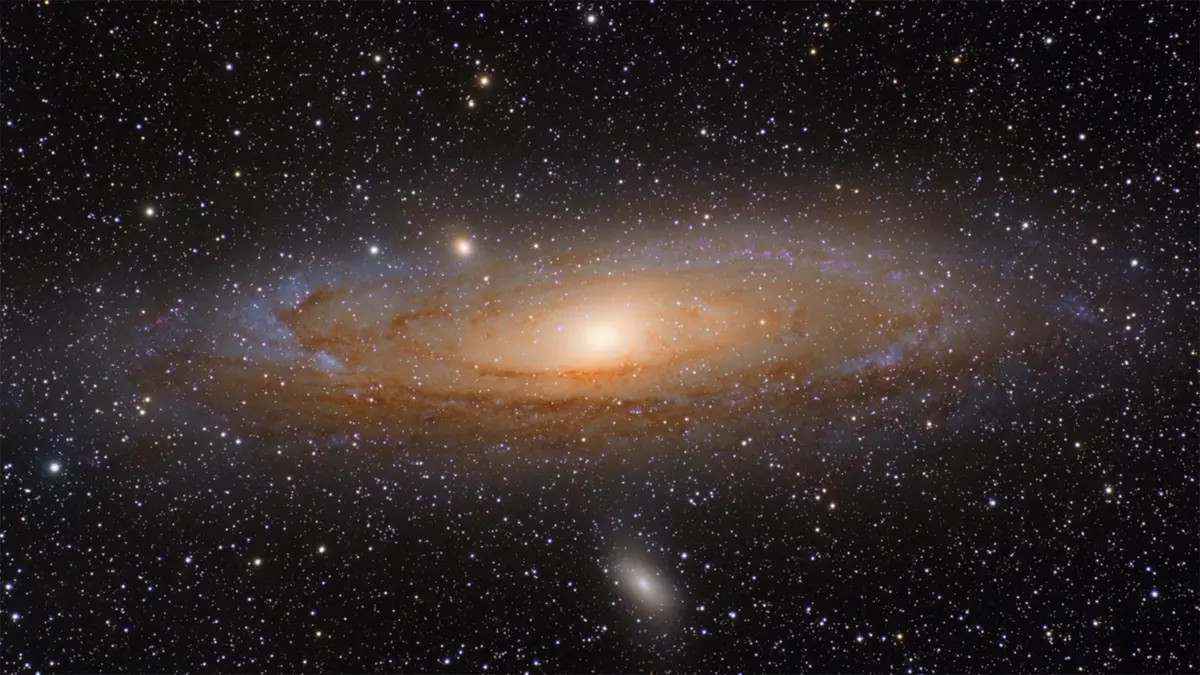
The Andromeda Galaxy is a large spiral galaxy about 2.5 million light-years from Earth.
A light-year measures distance, not time, and equals the distance light travels during one year.
Andromeda is also called Messier 31 or M31.
It belongs to the Local Group, which also includes the Milky Way and many smaller galaxies.
Dark, clear skies allow people to see Andromeda without optical instruments.
How do stars form?
Stars form when cold gas and dust collapse under gravity inside dense molecular clouds.
The material heats and compresses until nuclear fusion begins inside the new stellar core.
A galaxy’s star-formation rate measures how much material becomes stars during a stated period.
Astronomers usually express that rate in solar masses per year.
What did the Hubble team examine?
The team combined two large Hubble imaging programmes covering Andromeda’s northern and southern regions.
These programmes mapped roughly two-thirds of Andromeda’s stellar disk and measured about 200 million individual stars.
Researchers divided the images into thousands of squares measuring about 300 light-years on each side.
They then reconstructed each square’s recent star-formation history from its stellar colours and brightness.
Young, massive stars appear blue and live briefly, while smaller red stars survive much longer.
The changing mixture therefore preserves a record of when different stellar populations formed.
Chronology of Andromeda’s recent activity
| Period | Finding |
|---|---|
| About 2 billion years ago | Andromeda experienced a major star-formation burst, probably after an interaction or merger. |
| About 500 million years ago | It formed roughly one solar mass of stars every year. |
| About 40 million years ago | The rate had fallen to roughly half a solar mass yearly. |
| Present estimate | The rate is about one-fifth of a solar mass yearly. |
Why is the star-forming ring important?
Much recent activity occurred within a ring about 32,000 light-years from Andromeda’s centre.
Declining activity inside this ring explains a large part of the measured galaxy-wide fall.
The team found no evidence that a simple shortage of raw material caused the entire decline.
Instead, Andromeda may be settling after its earlier, unusually active period.
What about Messier 32?
Messier 32 is a compact satellite galaxy seen close to Andromeda’s disk.
The surrounding region began showing reduced star formation roughly 60 million years ago.
However, the satellite’s three-dimensional position and past orbit remain uncertain.
Researchers therefore cannot prove that Messier 32 caused the local decline.
Why was Hubble necessary?
Hubble operates above Earth’s atmosphere and delivers very sharp visible, ultraviolet and near-infrared images.
Its resolution can separate individual Andromeda stars across a very large survey area.
That combination lets astronomers study one neighbouring galaxy in exceptional detail.
The Hubble Space Telescope is a joint American–European project involving NASA and the European Space Agency.
Prelims facts
- Andromeda is a large spiral galaxy within the nearby Local Group.
- It is about 2.5 million light-years away from Earth today.
- Messier 31 and M31 are widely used alternative names for Andromeda.
- Blue massive stars usually indicate comparatively recent local star formation.
- Messier 32 is a compact satellite galaxy seen close to Andromeda.
Conclusion
Hubble converted millions of stars into a detailed record of Andromeda’s gradual slowdown.