

Why in news?
Djibouti signed the Artemis Accords on 14 September 2026, joining a framework for responsible civil exploration of space. The National Aeronautics and Space Administration (NASA) announced the signing in Washington, where Ambassador Mohamed Siad Douale represented Djibouti. It became the 72nd signatory and the eighth African country to join. The Accords set out shared principles for cooperation, including peaceful activity, transparency and the release of scientific information. For this small Horn of Africa country, the step extends a space programme begun in 2020. Signing establishes a political commitment to common principles; it does not itself allocate a Moon mission, launch facility or astronaut flight.
Locating Djibouti
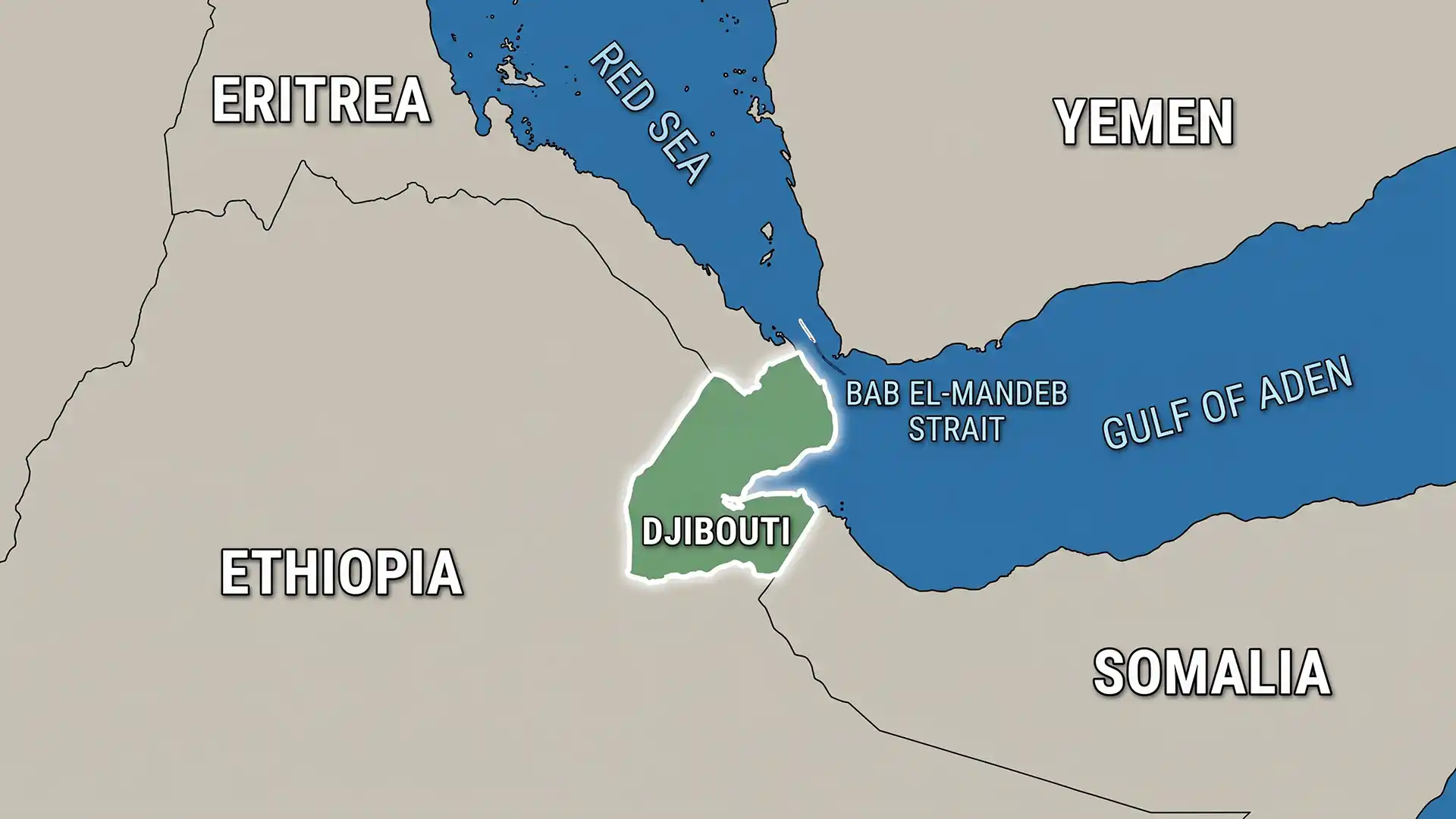
Djibouti lies in north-eastern Africa, at the southern approach to the Red Sea. Its three land neighbours are Eritrea to the north, Ethiopia to the west and south, and Somalia to the south-east. It is a coastal country, unlike neighbouring Ethiopia. Yemen lies across the water on the Arabian Peninsula and is not a land-border neighbour.
The Bab el-Mandeb Strait connects the Red Sea with the Gulf of Aden. Djibouti and Eritrea lie on its African side, opposite Yemen. This narrow connection links the Red Sea shipping route with the wider Indian Ocean. Djibouti city, the national capital and an important port, stands on the Gulf of Tadjoura, an inlet connected to the Gulf of Aden.
This location helps explain the country’s importance beyond its size. Its ports provide a maritime gateway for inland trade, particularly with Ethiopia. Much of the country is arid, making reliable water and environmental information valuable. Geography therefore gives context to potential uses of space-based observation, although joining the Accords does not by itself deliver those services.
A framework alongside existing space law
The Artemis Accords began in 2020 with the United States and seven other founding signatories. They concern cooperation in civil exploration and use of the Moon, Mars and other relevant destinations. They are not a replacement for the Outer Space Treaty of 1967. Instead, they set out practical commitments intended to support responsible activity within the existing international framework.
The treaty establishes basic principles, including freedom of exploration and the prohibition on national appropriation of celestial bodies. A country cannot acquire sovereignty over part of the Moon simply by using or occupying it. The treaty also makes states responsible for their national space activities. This includes authorisation and continuing supervision of activities conducted by non-governmental entities.
The distinction matters because cooperation principles and binding treaty obligations perform different functions. A shared operational approach may help partners coordinate their missions. It does not erase their existing legal responsibilities or settle every international disagreement about future space activity. Joining the Accords should therefore be understood as participation in a framework, not ownership of space resources or territory.
What the shared principles mean in practice
Transparency means explaining plans and policies so that other participants can understand an activity. Interoperability means designing systems that can work together where practical. For example, compatible equipment can make cooperation and emergency assistance easier. These ideas address a basic difficulty of exploration: different organisations may operate in the same environment using independently designed systems.
Other commitments concern scientific data, emergency assistance, registration of space objects and protection of historically important sites. Avoiding harmful interference requires communication about activities that could affect others. Limiting orbital debris addresses risks created by discarded objects or fragments. These are continuing responsibilities, rather than a one-time checklist completed when a government signs the document.
Djibouti’s next stage
NASA’s account places the signing within Djibouti’s developing space programme. It notes that the country launched its Djibouti 1A satellite in 2023 and Djibouti 1B in 2024. These precede the Accords decision, so the signing is not the beginning of all Djiboutian space activity. It is a further step in international engagement around that activity.
For an emerging programme, cooperation can create opportunities to develop skills and relationships. Turning those opportunities into useful services still requires trained people, sustained funding and appropriate institutions. Satellite information also needs interpretation before it can support decisions on land, water or infrastructure. A dataset is not automatically a functioning public service merely because it is available.
Conclusion
Djibouti’s accession broadens African participation in discussions about responsible exploration. Its immediate meaning is a commitment to common civil-space principles, building on an existing national programme. The practical value will depend on the cooperation and capabilities developed afterwards. That is a different measure of progress from counting signatures alone.