

Why in news?
A new study examined dhole food within Tadoba–Andhari Tiger Reserve. Researchers analysed 169 confirmed droppings through genetic methods. Chital and sambar dominated the detected wild prey. Domestic cattle and buffalo appeared only in very small proportions.
Background
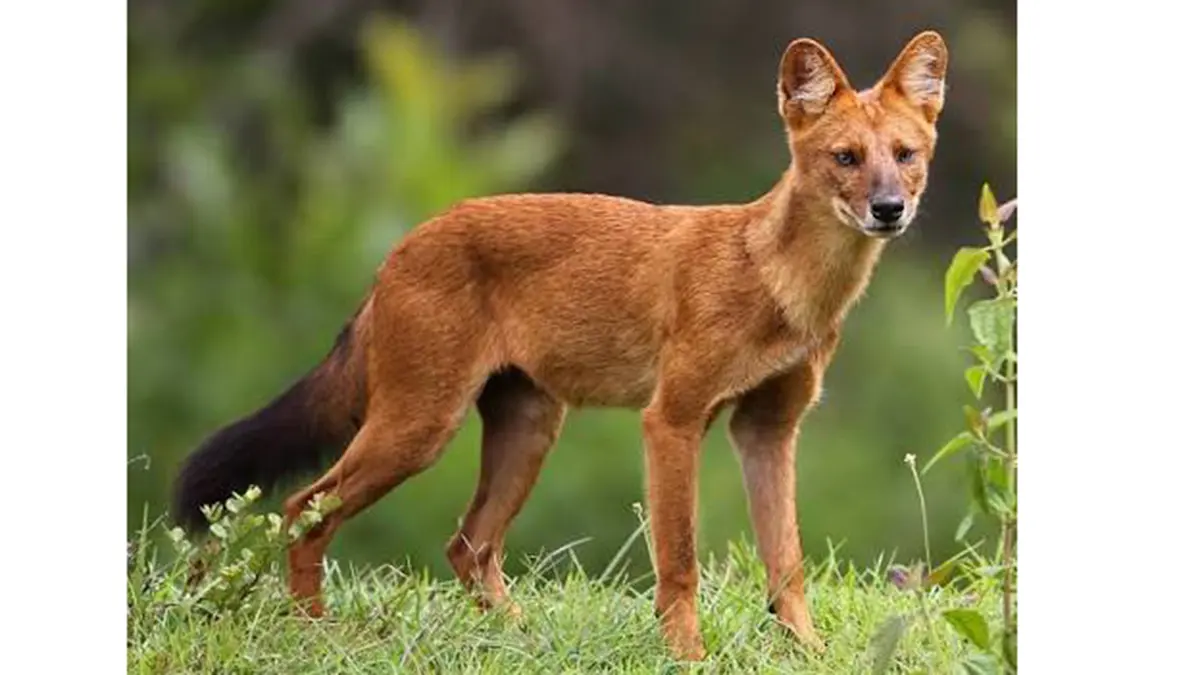
The Asiatic wild dog, commonly called the dhole, is a social Asian carnivore.
The species is Cuon alpinus, the only living member of genus Cuon.
Dholes belong to Canidae, the family containing dogs, wolves and foxes.
How can one recognise a dhole?
- Most adults have a reddish or rust-coloured coat.
- The muzzle is shorter than a wolf’s muzzle.
- The rounded ears usually stand upright.
- A dark, bushy tail often has a black tip.
- Pack members communicate through distinctive whistles and calls.
The whistle has also produced the common name “whistling dog.”
Range and habitat
Dholes once occupied wider Asian areas, but remaining populations are fragmented across southern and southeastern regions.
They use forests, grasslands, scrub and mountain landscapes, with India retaining three important population regions.
- The Western and Eastern Ghats support several connected landscapes.
- Central Indian forests contain important breeding populations.
- Northeastern and Himalayan foothill forests retain scattered populations.
How do dholes hunt?
Dholes hunt in organised packs, allowing them to chase prey larger than one individual.
Pack size changes with habitat and breeding conditions, while their meat-rich diet makes them hypercarnivores.
Where was the study conducted?
The study covered a 1,727-square-kilometre landscape around Tadoba–Andhari Tiger Reserve in Maharashtra’s Chandrapur district.
Its dry forests support many carnivores and herbivores across protected core and mixed-use buffer areas.
How did researchers study the diet?
- Teams collected droppings during monsoon 2022 and winter 2023.
- Laboratory tests first confirmed which samples came from dholes.
- Researchers retained 169 confirmed samples for dietary analysis.
- They extracted food-related genetic material from each sample.
- Computer comparisons matched sequences with likely prey species.
Deoxyribonucleic acid (DNA) metabarcoding can detect prey that ordinary visual examination might miss.
What did the study find?
Researchers identified 15 vertebrate prey species across all confirmed samples.
The authors called this the widest dietary breadth yet described for dholes.
They also described the work as India’s first comparable genetic study across seasons and zones.
| Prey | Frequency of occurrence | Meaning |
|---|---|---|
| Chital | 70.4 per cent | Its genetic material appeared most frequently. |
| Sambar | 66.9 per cent | It was another dominant wild prey. |
| Barking deer | 55.6 per cent | It appeared in over half the samples. |
| Black-naped hare | 30.8 per cent | This smaller animal also contributed substantially. |
| Wild boar | 26.6 per cent | Its material appeared in about one-quarter. |
| Four-horned antelope | 11.2 per cent | It occurred less frequently than larger deer. |
One sample can contain several prey species, so percentages exceed 100 together.
Was livestock absent?
Livestock signals remained small, with cattle in 6.5 per cent of samples.
Buffalo occurred in 7.7 per cent, but each livestock species formed below one per cent of genetic reads.
What is frequency of occurrence?
This measure records whether prey appears in each sample, but not its exact consumed weight.
Small traces and large meals both count once, so researchers also considered genetic-read shares.
Seasonal and spatial differences
- All 15 prey species appeared during the monsoon sampling.
- Only 11 prey species appeared during the winter sampling.
- Large wild herbivores dominated the winter diet more strongly.
- Core areas showed a broader diet than buffer areas.
- Season produced the strongest measured difference in diet composition.
Changing vegetation, water and prey behaviour may help explain these patterns.
A simpler sampling improvement
Researchers placed small inner pinches directly into preserving liquid instead of collecting whole droppings.
This method reduced the dhole’s genetic material, improved prey detection and simplified sample transport.
Leaving most material in place also preserves scent signals used by wild animals.
What can conservation managers learn?
Healthy wild prey reduces livestock dependence, so managers should protect deer, habitat and movement corridors together.
Domestic-dog vaccination and fair livestock compensation can reduce disease, conflict and retaliatory killing.
Conservation status and threats
The International Union for Conservation of Nature lists the dhole as Endangered.
- Habitat loss separates packs, while declining wild prey reduces available food across shrinking ranges.
- Human persecution follows livestock losses, while domestic dogs can transmit dangerous diseases.
- Roads and development weaken connections between forests.
Limits of the new study
The results cover one reserve and two seasons; dholes elsewhere may face different pressures.
Genetic occurrence cannot prove biomass or hunting, so broader studies should test other landscapes.
Conclusion
The study links dhole survival with abundant wild prey and healthy forests.