

Why in news?
Researchers comparing bird habitats in Asola-Bhatti Wildlife Sanctuary found rich communities in abandoned mining areas and deep lakes. The Press Trust of India highlighted the finding on 12 September. The study surveyed the sanctuary during 2024 and was published in June 2026 in Environmental Monitoring and Assessment. It found substantial differences between the birds supported by different habitat types. Asola-Bhatti occupies part of Delhi’s southern ridge near Haryana, within the Aravalli landscape. The finding is not an argument for new mining inside protected areas. Instead, it asks how managers should restore land already altered by mining without destroying the varied habitats that birds now use.
A protected area within the Delhi Ridge
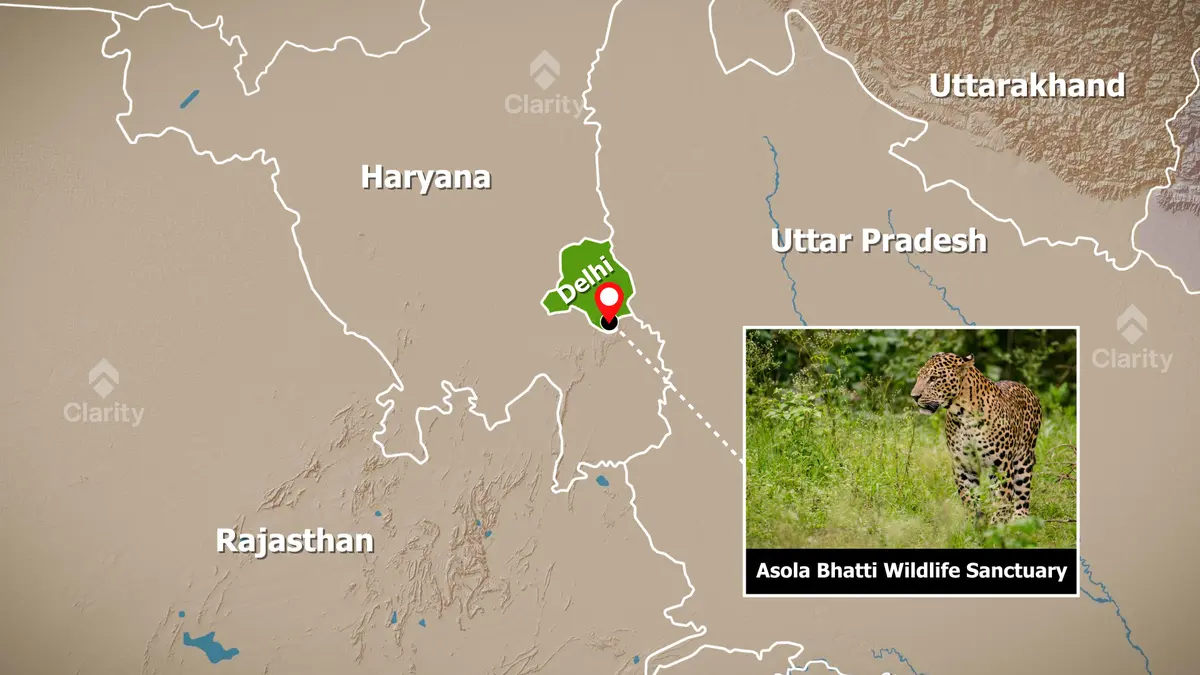
The Delhi Ridge is the northern continuation of the Aravalli landscape. Asola-Bhatti protects a section of its southern part, near the Delhi–Haryana boundary. Rocky ridges, scrub, wooded patches and old excavations create an uneven landscape. This is not a uniform forest. Its ecological value depends partly on the differences between those connected habitats.
The sanctuary’s official management plan for 2024–2035 records a notified area of 1,972.9 hectares, or about 19.73 square kilometres. It traces protection through several notifications beginning with Asola in 1986 and the addition of Bhatti in 1991. That legal area should not be confused with larger figures used for broader ridge or restoration landscapes.
The plan also documents the sanctuary’s mining history and the need to manage its altered terrain. Once excavation stops, pits, exposed rock and water bodies do not automatically return to their earlier condition. They become part of the management problem. Restoration must consider what remains, what is recovering and which interventions could cause fresh disturbance.
What the bird survey found
The researchers surveyed fifteen habitat types, grouped into wooded, open, aquatic and human-modified categories. Across the study, they recorded 130 bird species. Their analysis compared richness, diversity and differences in community composition. This matters because two places can contain similar numbers of birds while supporting quite different species.
The analysis placed abandoned mining habitats and deep lakes among the richer settings. Lantana-dominated areas and sewage habitats had lower estimated richness. The researchers adjusted comparisons for sampling coverage, reducing the influence of differences in sampling completeness. The result concerns the habitats examined within this sanctuary, rather than a universal ranking of every mine, lake or wooded area.
Why habitat variety matters
A water body, an open rocky area and a wooded patch offer different conditions. They need not serve the same birds in the same way. The important ecological idea is habitat heterogeneity: variation within a landscape. Where different habitats support different communities, conserving several habitat types can protect more biodiversity than making every patch look alike.
The reporting by the Press Trust of India drew attention to this variety in former mining areas. Yet the study does not justify treating every abandoned quarry as equally valuable. Outcomes depend on the particular site, its surroundings and subsequent management. A finding within one protected landscape cannot establish that mining generally benefits birds.
It is also important to separate a habitat’s present value from the damage caused during its creation. Birds may use an altered site after extraction has ended. That does not mean extraction improved the original ecosystem, or that renewed mining would preserve the birds now present. Conservation decisions need to compare realistic alternatives, not turn recovery into a justification for fresh disturbance.
Restoration is not simply planting more trees
The results support a more careful approach to restoration. If open habitats or water margins support distinctive bird communities, planting them indiscriminately could remove useful conditions. This does not mean that vegetation recovery is undesirable. It means that the desired habitat should be identified before choosing an intervention, rather than assuming that a single treatment suits every patch.
Invasive vegetation presents a related challenge. A dense patch may look green while providing a different ecological setting from a diverse native habitat. The management question concerns species composition and function, not appearance alone. The sanctuary plan addresses habitat management and invasive plants; the bird findings provide additional evidence for deciding where closer monitoring is needed.
Future monitoring should examine whether bird communities persist across seasons and years, especially where restoration changes the landscape. It should also distinguish the presence of birds from evidence of successful breeding or long-term population security. A one-year survey offers a valuable baseline. Repeated observations are needed to judge whether management improves conditions over time.
Conclusion
Asola-Bhatti demonstrates why urban conservation needs attention to the actual landscape rather than a simple forest-versus-wasteland distinction. Abandoned mining areas can acquire ecological value, but that value does not erase their history or support new extraction. The useful response is selective, evidence-based restoration that protects habitat variety, controls damaging pressures and checks the consequences through continued wildlife monitoring.