

Why in news?
NTPC Limited announced on 19 September that it had terminated the contract for a battery-storage project at Mouda, Maharashtra. The proposed system would store 400 megawatt-hours of electricity for later use, helping the grid balance supply and demand. NTPC attributed the decision to delays and contractual default by GR Infraprojects Limited. However, the contractor's 16 September exchange filing presented a different position, citing force majeure, war risk and contractual issues. NTPC said it was arranging a fresh tender, so the storage project itself had not been abandoned. The development highlights both the growing importance of electricity storage and the delivery risks facing individual projects.
A contract dispute around a continuing project
The project is located at Mouda Super Thermal Power Station in Maharashtra. NTPC said the contract was awarded in March 2026 for ₹413.37 crore, with a 15-month completion period. Its statement described inadequate progress despite a notice seeking corrective action. It also said approximately ₹91 crore in available securities had been encashed. This is NTPC's account of its actions and its reasons for taking them.
The contractor's filing requires separate attention. GR Infraprojects said it had itself issued an immediate termination notice to NTPC and invoked contractual dispute-resolution provisions. It cited continuing force majeure and war-risk circumstances, alongside contractual issues. Force majeure concerns exceptional events whose contractual consequences depend on the agreement and circumstances. The filing also dates execution of the agreements to 23 April. Award and execution are therefore different milestones, not interchangeable dates.
The available statements do not settle responsibility for the breakdown. NTPC's proposed retendering at the contractor's risk and cost describes its intended contractual course, not a final judicial determination. What is clear is that the original delivery arrangement has broken down while NTPC still intends to implement storage. Re-award, construction, testing and commissioning remain distinct stages before the grid can actually use the planned capacity.
What battery storage does
A battery energy storage system (BESS) takes electricity when it is available, stores energy chemically and releases electricity later. It does not create an additional primary energy source. Its value lies in changing when electricity becomes available. For example, solar generation may be plentiful during daylight while demand remains high after sunset. Storage can transfer part of that daytime supply into the evening, subject to its capacity and operating limits.
Two ratings describe different aspects of this service. Megawatts measure power: how quickly electricity can be supplied. Megawatt-hours measure energy: how much can be supplied over time. Thus, 400 megawatt-hours is not a 400-megawatt generating capacity. As a simplified illustration, 400 megawatt-hours could support 100 megawatts for four hours before allowing for losses and operating restrictions. That example explains the units; it is not Mouda's announced power rating.
From battery cells to a working grid asset
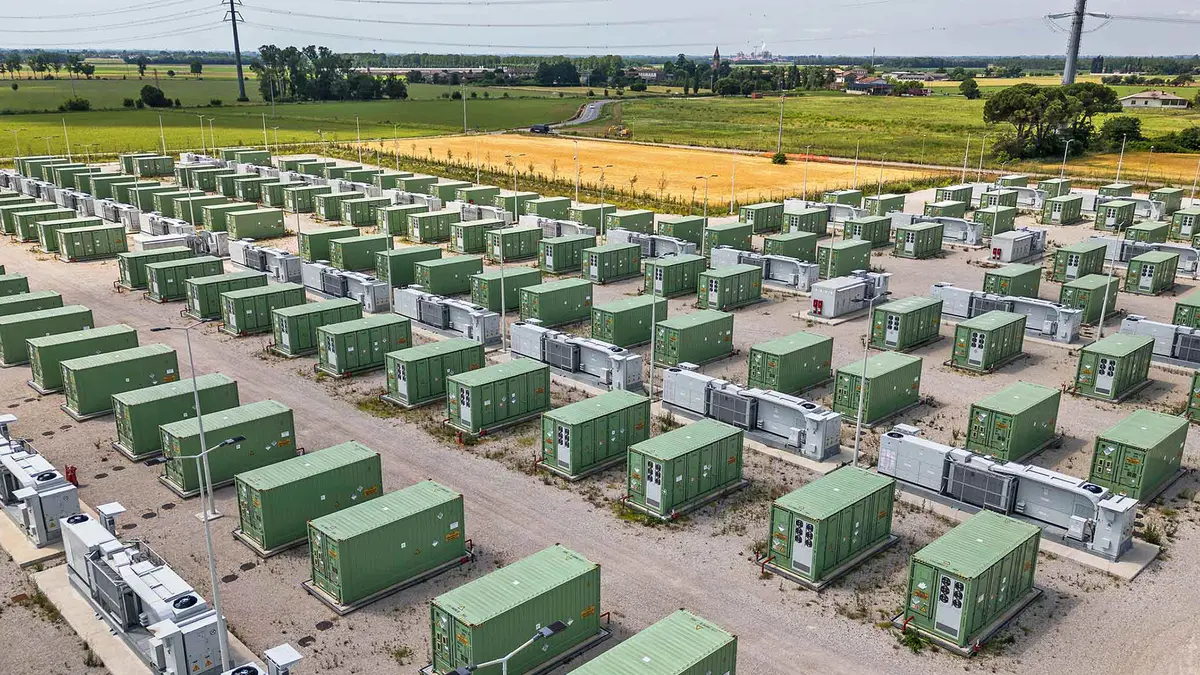
A utility-scale installation needs more than batteries. The cells store energy as direct current, while the grid operates with alternating current. Power-conversion equipment connects these electrical forms. Controls decide when to charge or discharge and monitor the system's condition. Appropriate protection and temperature management are also necessary. A large battery therefore functions as an integrated electrical installation, rather than a warehouse containing independent household-sized devices.
Its controls can respond to changing grid conditions by adjusting power output. This can help balance short-term differences between electricity production and consumption. Some inverter systems can also support voltage or frequency, depending on their design and operating arrangements. These services are different from simply delivering energy for several hours. A storage project's specifications must identify which services it is expected to provide and under what conditions.
Why useful storage still has limits
Charging and discharging involve losses, so a battery returns less energy than was used to charge it. Available capacity also depends on operating conditions and changes as the battery ages. Commercial assessment must therefore consider usable energy, efficiency, expected cycling, maintenance and replacement. A low initial price alone cannot establish that a project will deliver reliable service throughout its intended life.
Storage also has a finite duration. A system designed to shift afternoon electricity into evening hours cannot automatically cover a prolonged supply shortage. Nor does locating a battery beside a thermal station make its electricity renewable. The environmental effect depends partly on the electricity used for charging and the generation displaced during discharge. Those distinctions matter when assessing the contribution of storage to both grid reliability and cleaner electricity.
The Mouda dispute illustrates why procurement and technical planning have to progress together. Grid operators benefit only when equipment, connections, controls and operating arrangements are ready. Contractual safeguards can address commercial risk, but they do not replace the lost time before commissioning. The practical objective of retendering is therefore to restore a credible delivery path for the storage service, while the parties address their disagreement separately.
Conclusion
Mouda remains a proposed storage asset with a disputed delivery contract, not a cancelled national commitment to batteries. The next meaningful milestones are a new award and successful commissioning. Beyond this case, battery storage can make electricity available when it is more useful and support a changing grid. Its real contribution must be judged through delivered power, usable energy, safety and reliability—not the announced storage figure alone.