

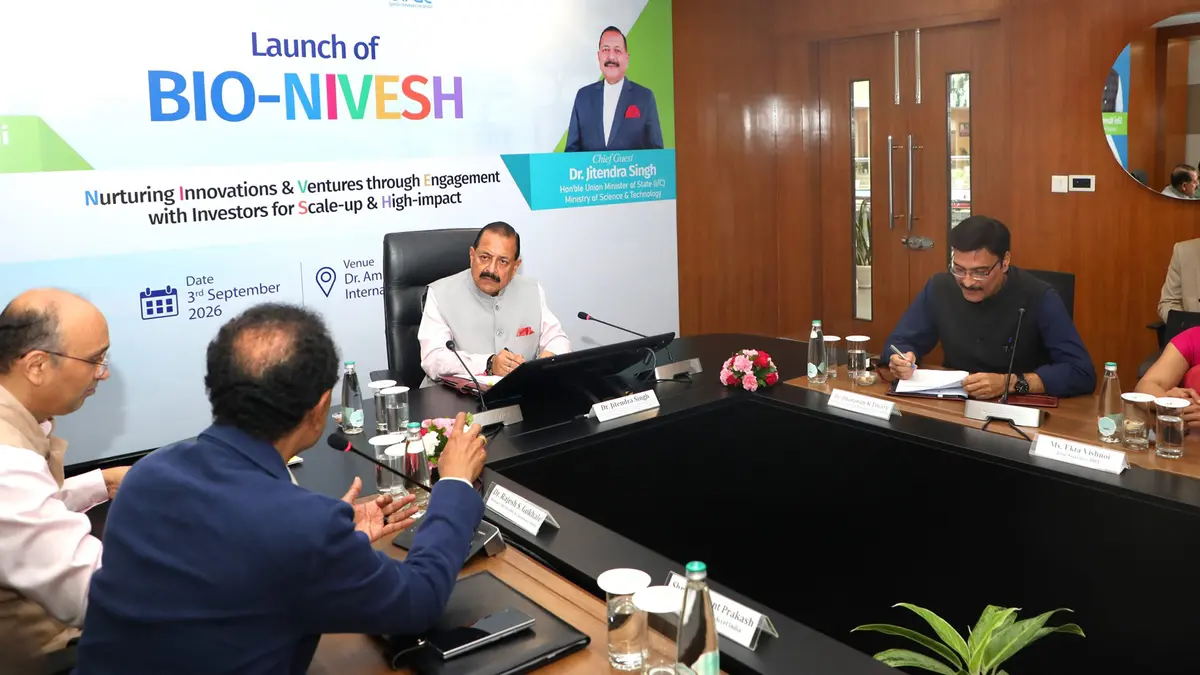
Why in news?
Union Minister Jitendra Singh launched BIO-NIVESH on 3 September 2026. The first roundtable connected twenty biotechnology and deep-technology start-ups with about fifty investors. The platform seeks private finance for commercialisation and scale-up. It is planned as a recurring engagement, rather than a single funding scheme.
What the platform is designed to do
Biotechnology can take years to move from discovery to a marketable product. Laboratories must establish performance, safety and reproducible manufacturing. Regulatory review can add further time and expense. Ordinary short-term investment expectations may not suit this development cycle.
BIO-NIVESH aims to bring innovators and investors into a deeper discussion. The official design goes beyond brief business pitches. Start-ups can explain their science, intellectual property and development pathway. Investors can test market assumptions and understand regulatory risk before committing capital.
The inaugural event selected start-ups using several stated factors. The factors covered innovation, maturity, market prospects, scalability and regulatory preparedness. Selection for a roundtable is not official approval of every claim. Technical due diligence must continue before any investment or public adoption.
The institutional setting
The Department of Biotechnology operates under the Ministry of Science and Technology. Its enterprise interface is the Biotechnology Industry Research Assistance Council, or BIRAC. BIRAC is a not-for-profit public-sector enterprise. It supports biotechnology firms through funding, mentoring, infrastructure and intellectual-property assistance.
BIRAC helped organise BIO-NIVESH and sits close to its intended purpose. Public support can absorb some early research risk. Private investors can later provide capital, manufacturing links and market knowledge. A useful platform should connect these stages without confusing their different responsibilities.
The official name is written as BIO-NIVESH. The launch release provides no expanded English acronym for it. Therefore, the name should not be given an invented full form. “Nivesh” is the Hindi word for investment and signals the platform’s central focus.
Connection with the national research fund
The launch also referred to the Research, Development and Innovation Fund. The Union Cabinet approved its ₹1 lakh crore corpus in July 2025. The fund was formally launched in November that year. It provides long-term, low-cost finance through second-level fund managers.
BIRAC and the Technology Development Board became fund managers during 2026. Each had received a ₹1,000 crore sanction by July. BIRAC had shortlisted eight projects involving ₹390.35 crore of proposed support. Those figures concern the wider fund, not automatic BIO-NIVESH allocations.
The Minister also suggested exploring a “Big Five in Five Years” approach. This was an idea for nurturing several large anchor companies. The launch release did not establish it as a funded target. Treating a suggestion as an approved programme would overstate the announcement.
Why biotechnology needs more than finance
Capital cannot substitute for scientific validation. Health products need appropriate trials, ethics review and regulatory approval. Agricultural or industrial products may follow different biosafety and environmental pathways. Manufacturing quality must remain consistent when production expands.
Intellectual property also needs balanced handling. Clear ownership can support investment and partnerships. However, public support should retain attention to affordability and social need. An expensive product with weak access may not deliver broad public value.
Investors must understand that a failed experiment can be informative without becoming commercially valuable. Start-ups must present evidence without hiding uncertainty. Independent expert review can reduce information gaps between both sides. Strong governance also protects public funds from promotional decisions.
How success should be measured
Attendance numbers show reach but not economic or scientific outcomes. The official launch itself proposed more meaningful measures. These include partnerships created, investment mobilised, technologies scaled and products brought to market. Later editions should report progress against those outcomes.
Regional events could connect start-ups outside established investment centres. The government has proposed future editions across different cities. That plan remains prospective until events are scheduled. Selection criteria and follow-up support should remain transparent as participation expands.
Conclusion
BIO-NIVESH addresses a genuine financing gap in biotechnology development. Its value will come from informed, patient and accountable investment. Scientific quality and regulation must remain central during commercial expansion. Public support should also protect affordability and wider social benefit. Measurable partnerships and successfully validated products will show whether the platform works.