

Why in news?
Researchers found new molecular evidence for a marine legacy beneath Antarctica's Blood Falls. Their study examined 167 environmental samples from the Taylor Glacier area. Marine-associated microorganisms were concentrated near the glacier's red brine outlet. The evidence supports ancient seawater influence without precisely dating the trapped system.
Background
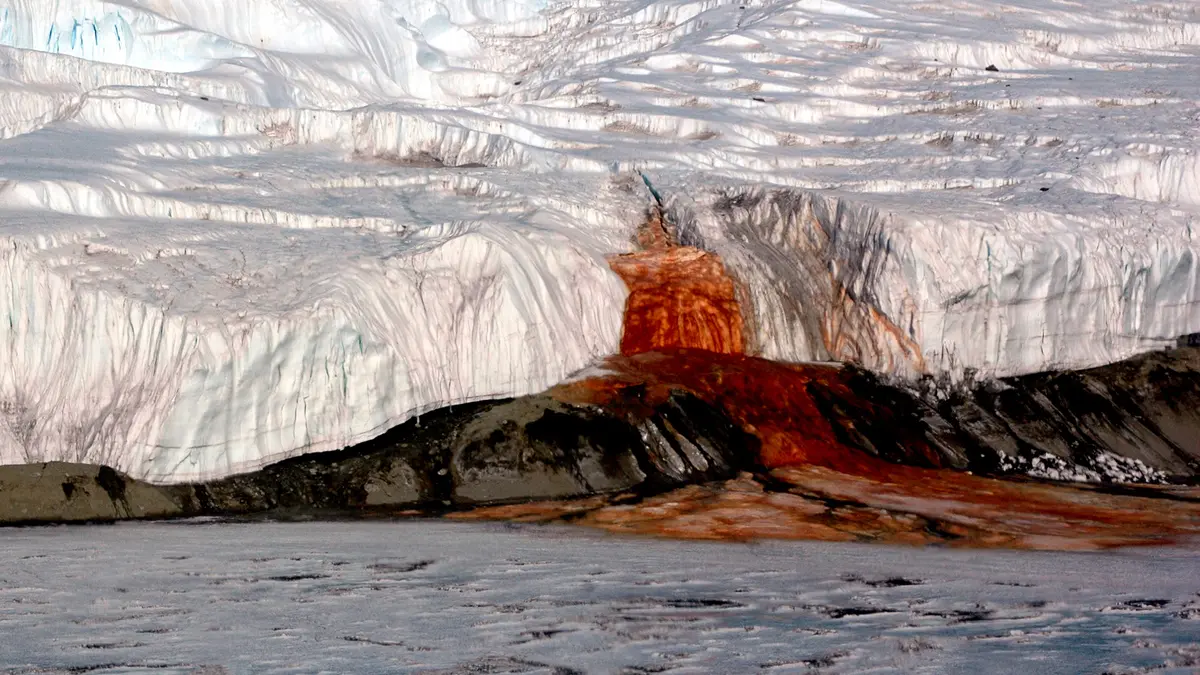
Blood Falls is a red-stained outflow at the terminus of Taylor Glacier. The glacier lies within Antarctica's ice-free McMurdo Dry Valleys. Its brine emerges near West Lake Bonney and sometimes spreads across the glacier surface.
Australian geologist Thomas Griffith Taylor recorded the feature during an expedition in 1911. Early observers linked the colour with red algae; later chemistry showed that dissolved iron causes the striking appearance.
The water travels through a cold, dark and hypersaline subglacial system. High salt levels depress its freezing point below zero degrees Celsius. Pressure and dissolved substances also help liquid persist beneath thick ice.
Once the brine reaches air, its dissolved iron oxidises rapidly. Iron oxides then create the rust-coloured stain. The colour therefore forms mainly at the surface, not inside a red underground lake.
How understanding developed
Research during the 2000s revealed a living microbial community within the brine. These organisms survive without sunlight and receive little fresh organic material. Their metabolism uses chemical reactions involving iron, sulphur and other compounds.
A 2007 study found many microbial relatives associated with marine environments. It also described a diverse bacterial community at the outlet. This work challenged the idea that Blood Falls was merely coloured meltwater.
Geochemical research published during 2019 examined salts and water sources more closely. It found strong evidence that original solutes came from ancient seawater. Subsequent rock interaction and freezing substantially altered that chemical inheritance.
The brine's water is not necessarily unchanged ocean water. Glacier melt and repeated freezing can modify its composition; the system is therefore better described as seawater-derived or marine-influenced.
What the 2026 study added
The new study combined environmental sampling with molecular identification of eukaryotic organisms. Eukaryotes have cells containing nuclei and include fungi, algae and many microscopic animals. Their genetic signatures can reveal links between otherwise separated ecosystems.
Researchers collected water, sediment and air from Blood Falls and nearby locations. They analysed 167 samples across the Taylor Valley area. This design helped distinguish local marine signals from material carried widely by wind.
About 9.34 per cent of eukaryotic sequences near the terminus matched nearby marine communities. The comparable share elsewhere was about 1.15 per cent; that contrast made ordinary regional wind deposition an incomplete explanation.
The team concluded that a relict marine community probably contributed to the outlet's biology. Ocean water may have entered a basin before glacier advance isolated it. Later physical and chemical changes created today's extreme habitat.
Why the system matters
Blood Falls provides a natural laboratory for life under ice; its organisms tolerate darkness, cold, salt and limited nutrients. Similar constraints may occur in other subglacial environments on Earth.
The site also informs astrobiology, which studies life's possibilities beyond Earth. Mars and icy moons may contain saline water beneath frozen surfaces. Antarctic findings help researchers design careful sampling and contamination controls.
However, an Earth analogue cannot prove extraterrestrial life; it only shows that certain conditions remain biologically workable here. Planetary claims require evidence collected directly from those worlds.
Physical movement and continuing questions
Blood Falls does not flow steadily throughout every season. Outbursts appear when pressure, ice movement and drainage pathways align. Glacier thinning may also change stresses around the buried brine network.
Researchers still need better maps of the subglacial reservoir and connecting channels. They must also separate living organisms from preserved environmental genetic material. Long-term sampling could reveal how discharge changes the community.
Clean access remains difficult because drilling can introduce foreign microbes and chemicals. Remote sensing and sterile instruments reduce that risk; international Antarctic rules also require careful environmental protection.
Conclusion
The latest evidence strengthens Blood Falls' connection with an ancient marine environment. Its history remains a transformed legacy rather than a sealed bottle of old seawater.