

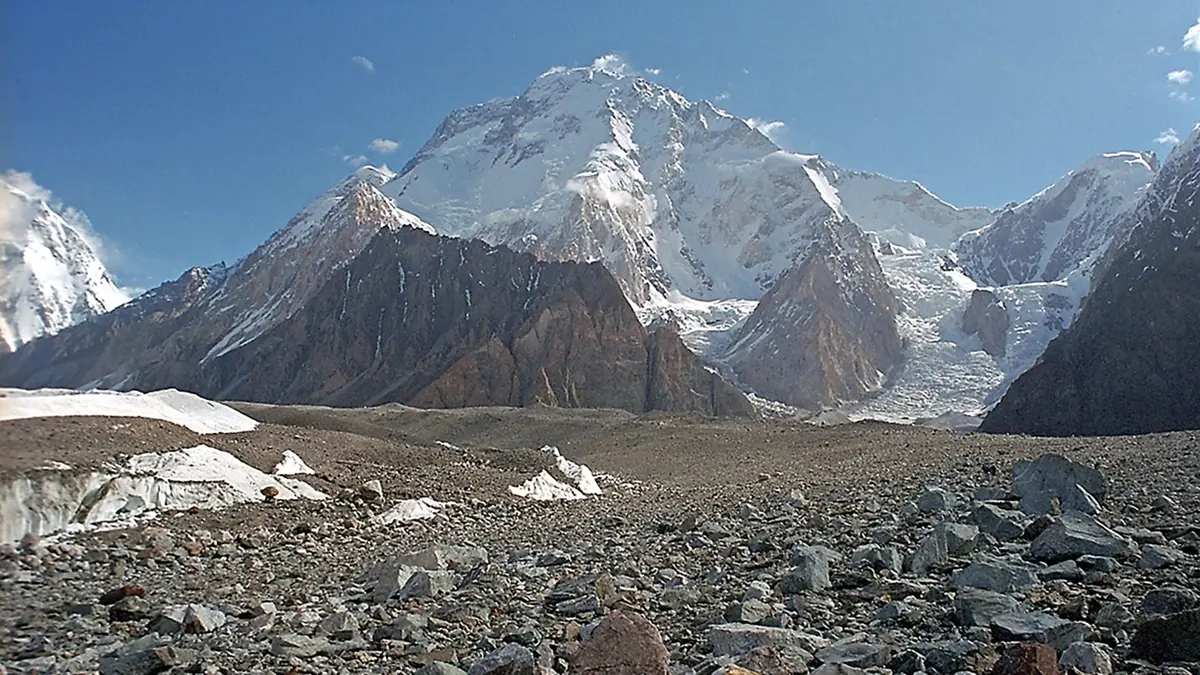
Why in news?
An avalanche struck an international expedition on Broad Peak.
The incident occurred on 30 July 2026 in northern Pakistan.
Initial reports described ten climbers as missing after contact stopped.
Search teams later located bodies while severe weather disrupted recovery.
Background
Broad Peak is an eight-thousander within the central Karakoram range. It stands on the Pakistan–China boundary near the upper Baltoro region. Pakistan's official records commonly give an elevation of 8,051 metres; some mountaineering reports instead use 8,047 metres.
Either measurement leaves Broad Peak twelfth among the world's highest mountains. It stands roughly eight kilometres from 8,611-metre K2.
Physical geography
Broad Peak belongs to the Gasherbrum massif of the Karakoram. Its long summit crest extends for roughly 1.5 kilometres; this unusual breadth inspired the mountain's English name. The Balti name is often written as Falchan Kangri; the approach crosses the Baltoro Glacier and the Concordia area.
Concordia offers access towards K2 and several Gasherbrum peaks.
Chronology of exploration and climbing
- Surveyors mapped major Karakoram peaks during the nineteenth century; explorer Martin Conway used the English name during the 1890s.
- A German expedition attempted the mountain unsuccessfully during 1954; four Austrian climbers reached the summit on 9 June 1957.
- They climbed without supplementary oxygen or high-altitude porters; a Polish team completed the first winter ascent during March 2013.
The first-ascent team included Hermann Buhl and Kurt Diemberger; Marcus Schmuck and Fritz Wintersteller also reached the summit. All four belonged to the successful Austrian expedition.
What happened during July 2026?
The avalanche struck climbers travelling between upper camps during a summit attempt. The team included mountaineers from several countries and support climbers. Communications failed after the avalanche, creating uncertainty about individual locations.
Ground teams, drones and military helicopters supported search and recovery efforts. High winds and cloud repeatedly limited safe helicopter operations; early reports consequently changed as rescuers obtained better information.
Why are avalanches dangerous?
An avalanche begins when a weak snow layer fails under additional stress. Fresh snowfall can overload older layers that have not bonded properly. Strong winds also move snow onto already unstable leeward slopes; warming can weaken bonds and increase wet-snow avalanche risk.
A climber's weight may provide the final trigger on fragile snow. Fast snow can bury people, cause trauma and block breathing. Survival chances decline sharply when location and excavation take longer.
At extreme altitude, cold and reduced oxygen further narrow rescue windows.
Why are eight-thousanders uniquely difficult?
- Air pressure provides far less usable oxygen than at sea level.
- Acclimatisation requires repeated movement between camps over several weeks; weather windows can close quickly above exposed ridges and glaciers.
- Helicopters cannot safely hover near every high-altitude accident site; crevasses, ice walls and seracs create hazards beyond avalanche danger.
- Fatigue weakens judgment during long summit attempts and descents.
Karakoram: geographical importance
The Karakoram meets the Himalaya and Hindu Kush within High Asia. It extends mainly across areas administered by Pakistan, India and China. The range contains K2, the world's second-highest mountain.
Major glaciers include Baltoro, Biafo, Hispar and Siachen; these glaciers store freshwater and influence downstream river systems.
Political boundaries and disputed territories make regional mapping especially sensitive.
Conclusion
The disaster illustrates how quickly combined mountain hazards can overwhelm experienced expeditions. Accurate reporting must separate early missing-person reports from later confirmed outcomes.