

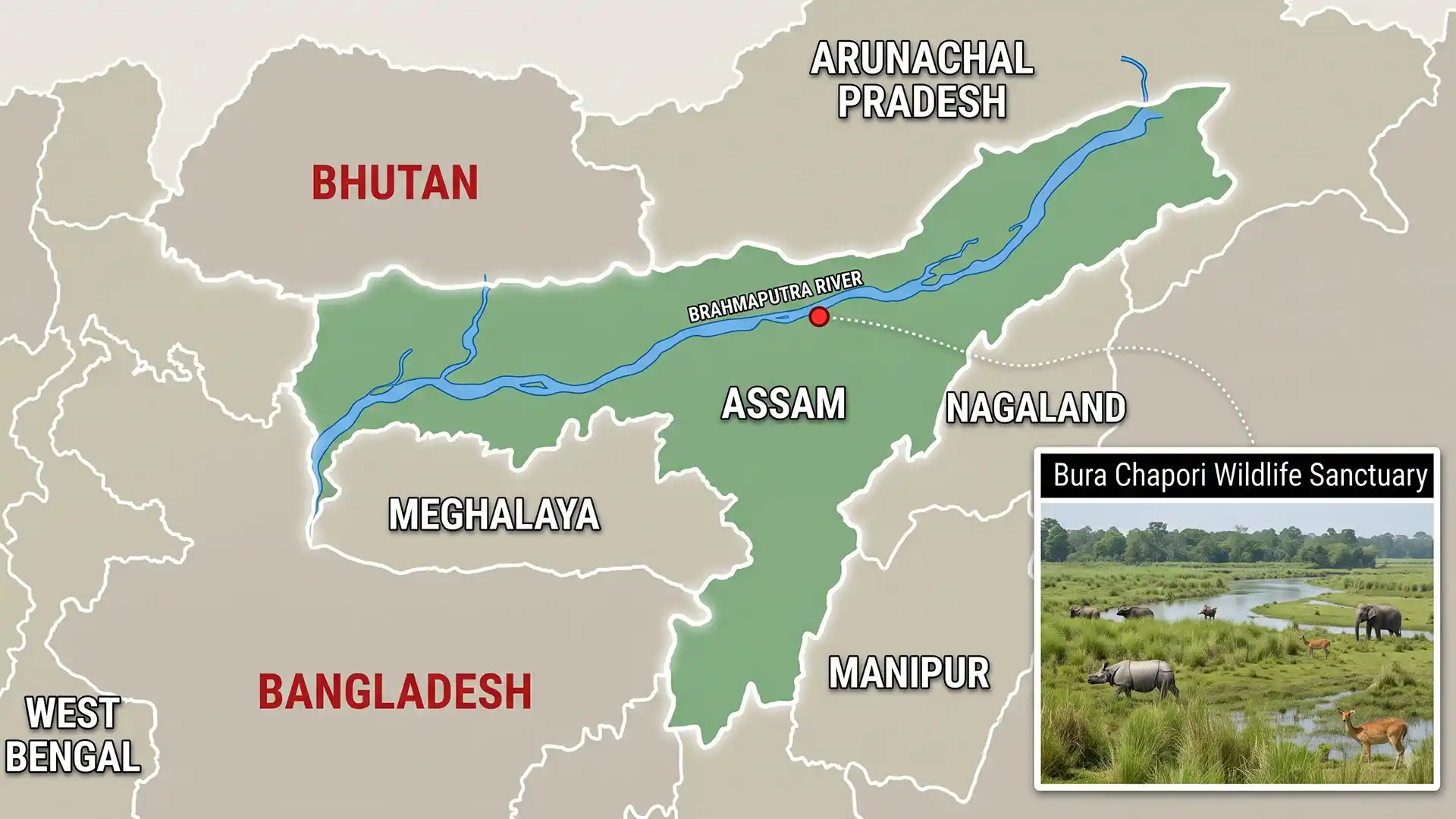
Why in news?
A wild buffalo killed a farm worker near Bura Chapori Wildlife Sanctuary in Assam on 6 September 2026. The incident occurred in a jute field on a nearby Brahmaputra river island. Local people recovered the man after the animal moved away. The case highlights field safety and compensation needs across this changing floodplain.
Keeping the location clear
The incident report placed the field on a river island in Nagaon district. Assam Forest Department records locate Bura Chapori Wildlife Sanctuary mainly in Sonitpur district. These statements are not necessarily inconsistent. Shifting river channels and nearby administrative boundaries create a connected landscape.
Bura Chapori lies on the southern bank of the Brahmaputra. Its official area is about 44.06 square kilometres. The sanctuary adjoins the wider Laokhowa–Burachapori protected landscape. Laokhowa Wildlife Sanctuary extends across about 70.13 square kilometres.
The Brahmaputra divides, deposits sand and changes channels across its floodplain. Temporary and permanent islands are locally called chars or chaporis. Farming, grazing and fishing occur on many accessible islands. Wildlife also uses them as water levels and vegetation change.
The sanctuary’s physical environment
Bura Chapori contains wet alluvial grassland, riparian forest and freshwater wetlands. Seasonal floods renew soil and reshape vegetation. Tall grasses provide cover and food for large herbivores. Sandbars and shallow channels support birds and aquatic life.
The landscape lies between larger conservation areas in central Assam. Kaziranga is eastward, while Orang lies towards the west. Forest and riverine patches can support animal movement between habitats. Roads, settlements and intensive cultivation can narrow these routes.
Floods are ecologically necessary but can intensify encounters. Animals move towards higher ground when low areas disappear. People also relocate livestock and protect crops during the same period. Shared refuge can bring both sides into close contact.
Understanding the wild water buffalo
The incident report called the animal a wild buffalo. It did not publish a veterinary or genetic identification. The sanctuary’s native wild water buffalo is Bubalus arnee. It is a large bovine of South and Southeast Asia.
Broad spreading horns distinguish many adults. Herds graze within wet floodplain grasslands and beside marshes. Assam holds an important part of the surviving global population. These animals need water, forage and room for seasonal movement.
The International Union for Conservation of Nature classifies the species as Endangered. Major threats include habitat loss and breeding with domestic buffalo. Hybridisation can weaken the genetic identity of wild populations. Disease transmission and direct conflict create further pressure.
Wild buffalo usually depend upon grasslands, marshes and nearby water. They can be powerful and unpredictable when threatened or surprised. A fatal encounter does not prove deliberate hunting of people. Field position, escape routes and animal behaviour all require investigation.
Why coexistence becomes difficult
Jute and other crops can border animal movement routes. Tall vegetation reduces visibility for workers and wildlife. Encounters may occur before either side has time to withdraw. Crop calendars can also overlap with seasonal wildlife movement.
Families bear immediate human and financial loss after a death. Prompt relief and a clear compensation process are essential. Delayed support can deepen anger towards conservation. Officials should explain documentation requirements and help families complete them.
Rapid local warnings can reduce risk when large animals enter fields. Forest teams can share movement information through village contacts. Workers may adjust timing or avoid dense plots temporarily. Any response must consider livelihoods rather than simply closing access.
Longer-term management
Authorities should map repeated encounters, crop damage and seasonal crossing points. Such maps can guide watchtowers, patrols and warning systems. Vegetation near busy paths may need selective management. Measures should avoid degrading the grassland itself.
Healthy corridors give animals alternatives to cultivated plots. Preventing encroachment at narrow passages can lower pressure. Domestic buffalo near wild herds require disease control and breeding safeguards. Conservation therefore extends beyond the sanctuary boundary.
Community knowledge can improve official monitoring. Farmers know fresh tracks, water routes and crop-use patterns. Their information should combine with camera traps and field signs. Trust grows when authorities respond quickly and report what they learned.
Conclusion
The death near Bura Chapori is a serious human loss. It occurred within a shared and constantly changing floodplain. Protecting wild buffalo cannot ignore the safety of field workers. Timely relief, warnings and secure movement routes are all necessary. Landscape planning can reduce encounters while preserving Assam’s rare grassland fauna.