

Why in news?
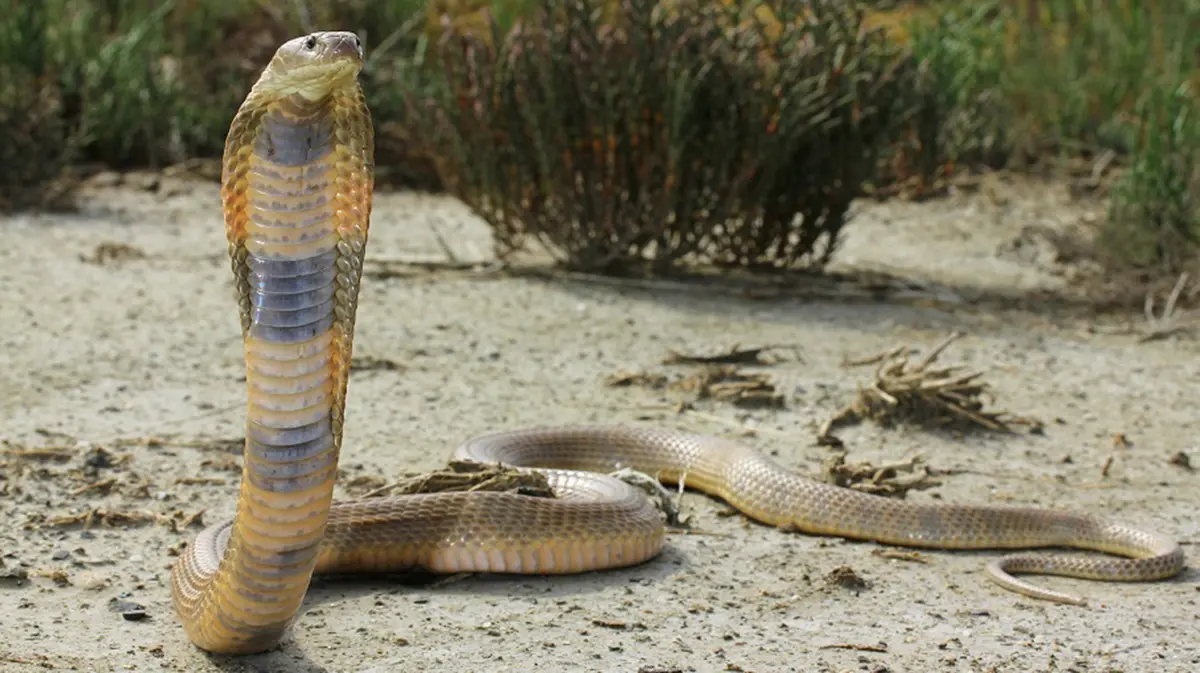
Researchers have documented what they describe as India's first reported human deaths from Caspian cobra bites in Himachal Pradesh. The September reporting concerns two deaths in Chamba district in July 2020 and July 2021, not a new outbreak. The Caspian cobra, scientifically named Naja oxiana, is a venomous species found across parts of Central and South Asia. Its recognition in the western Himalaya raises practical questions about identification, treatment access and the suitability of available antivenoms. The case reports make previously poorly documented risks more visible. They do not establish that these were the first bites ever to occur or that the snake has suddenly appeared across India.
A species beyond the familiar Indian cobra
The Caspian cobra belongs to the family Elapidae, which includes cobras and kraits. It is distinct from the spectacled cobra, Naja naja, widely associated with snakebite in India. Its range extends through countries including Iran, Afghanistan, Pakistan, Turkmenistan, Uzbekistan, Tajikistan and Kyrgyzstan, as well as north-western India. That distribution places the Himachal records near the species' wider regional range, rather than making them evidence of an entirely new species.
Chamba lies in the western Himalayan part of Himachal Pradesh. The reported cases came from localities in this mountainous district, where people may encounter snakes during agricultural work. The geography matters medically: reaching a suitably equipped hospital can involve distance and difficult transport. A species' presence is therefore only one part of risk. Exposure, recognition and the time taken to obtain care also influence the outcome.
What the newly reported cases establish
The Hindu's account identifies a paper in Epidemiology International documenting two deaths and two survivals. One fatal case involved a 40-year-old man bitten while working in an orchard in 2020. The report describes a delay before hospital care after a visit to a traditional healer. The other involved a 62-year-old man in 2021 who collapsed rapidly before reaching hospital. These histories illustrate different routes by which timely treatment can fail to reach a patient.
The authors' “first” claim concerns documented fatal cases attributed to this species in India. It is a claim about the medical record, not proof that no earlier death occurred. Snakebite records may lack reliable species identification, especially when no expert examination is possible. Better reporting can therefore reveal an old, under-recognised problem. It should not automatically be interpreted as an increase in the number of snakes or bites.
How venom can become a medical emergency
Research on Caspian cobra venom identifies neurotoxins among its important components. These can interfere with the signals that normally allow muscles to function. When breathing muscles are affected, the danger becomes immediate. This explains why a bite may require both appropriate antivenom and supportive hospital care. The quantity delivered, location of the bite, patient condition and delay to treatment can all influence severity.
Antivenoms contain antibodies intended to neutralise venom components. Their usefulness depends on whether those antibodies recognise the medically important toxins involved. India's commonly discussed “Big Four” antivenom framework centres on the spectacled cobra, common krait, Russell's viper and saw-scaled viper. A different species cannot simply be assumed to have identical venom because it belongs to the same broad group.
However, the reverse assumption is also unsafe. Antibodies can sometimes react with venom from related species. Laboratory research has examined such cross-reactivity among Indian Naja species, including Naja oxiana. It also found weak recognition of important toxin groups and differences between manufacturers' products. Recognising a venom component in a laboratory test is not the same as proving clinical protection in every patient. The case reports support further testing and preparedness; they do not provide a controlled comparison proving that all available antivenom is ineffective.
Preparedness requires more than identifying the snake
The World Health Organization treats snakebite envenoming as a major problem of access to effective care. Appropriate antivenom, trained staff, transport and facilities for complications must work together. A stock of medicine alone cannot compensate for delayed arrival or an inability to support breathing. Conversely, recognising unfamiliar species can help health systems investigate whether their existing products and clinical arrangements meet local needs.
For the public, the immediate priority after a suspected venomous bite is urgent medical assessment. Attempting to capture or handle the snake creates additional danger and can waste time. Species documentation is valuable for research, but treatment should not depend on a patient bringing in a live snake. The wider lesson from the Chamba accounts is to connect awareness with accessible care, rather than turn identification into another obstacle.
Conservation status and human danger measure different things
The International Union for Conservation of Nature's 2021 Red List change record placed the Central Asian cobra in the Near Threatened category. Central Asian cobra is another common name for Naja oxiana. That category concerns the species' conservation position, not the severity of an individual bite. A medically dangerous animal can still face pressures on its survival, and public-health protection does not require indiscriminate killing.
Reports of local sightings also need careful interpretation. More rescues or records may reflect better recognition, changes in reporting or actual shifts in occurrence. Establishing a range expansion requires consistent observations over time. Attributing it to climate change requires additional evidence. Neither conclusion follows solely from the publication of two historical fatal cases.
Conclusion
The Caspian cobra reports identify a specific gap in India's snakebite knowledge and preparedness. Their strongest message is the need for accurate records, prompt treatment access and regionally relevant antivenom research. The deaths occurred years before the current reporting, but their documentation can still improve present-day care. The response should combine medical readiness with reliable species knowledge, without exaggerating novelty or encouraging fear-driven harm to wildlife.