

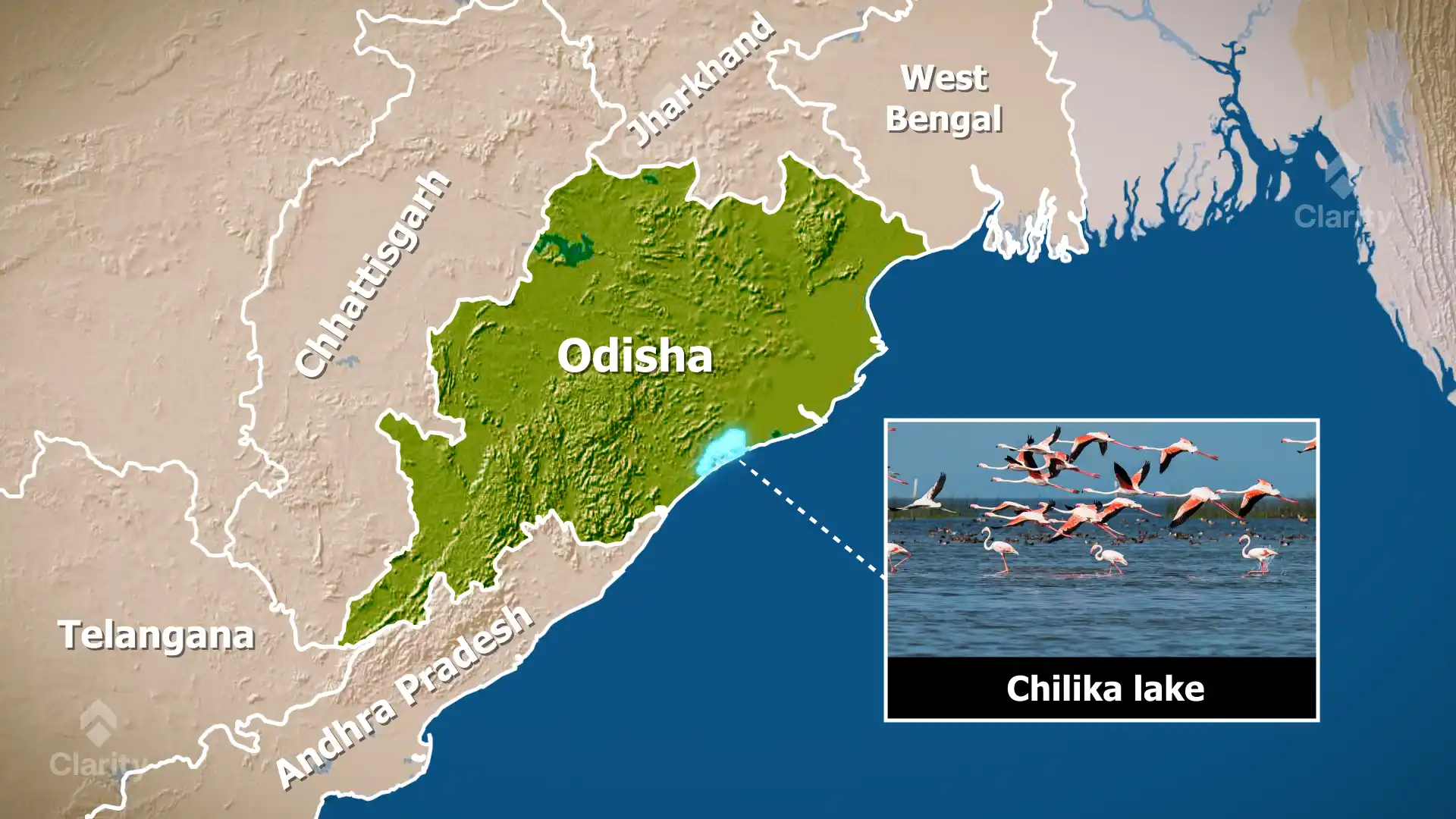
Why in news?
Odisha’s newly appointed revenue and disaster management minister Prithviraj Harichandan held a high‑level meeting on 3 January 2026 to prepare a scientific restoration plan for Chilika Lake. Siltation at the lagoon’s mouth and reduced salinity threaten its unique brackish ecosystem. The state government has directed the Chilika Development Authority and IIT Chennai to draft a detailed project report to restore tidal exchange with the Bay of Bengal and protect biodiversity.
Background
Chilika is a shallow brackish lagoon located at the mouth of the Daya River on the east coast of Odisha. Covering nearly 1,100 square kilometres, it is India’s largest coastal lagoon and the second‑largest brackish water lagoon in the world. The lagoon is connected to the Bay of Bengal via a 32 km long channel that allows seawater to mix with freshwater, creating a unique salinity gradient. Chilika was the first Indian wetland to be designated a Ramsar site in 1981 due to its rich biodiversity.
Islands and Ramsar status
- Nalabana Island: A central mudflat that becomes a nesting ground for thousands of migratory and resident birds. It is protected as the Nalabana Bird Sanctuary.
- Kalijai Island: Home to a temple dedicated to the goddess Kalijai and a popular destination for pilgrims.
- Other islands: Honeymoon Island, Breakfast Island, Birds’ Island and Parikud Island each have unique flora and fauna.
- Ramsar significance: Chilika supports over 225 species of fish, hundreds of bird species and rare animals such as the Irrawaddy dolphin. Its inclusion on the Ramsar List underscores its global importance as a wetland of international significance.
Threats and restoration plan
- Siltation and salinity loss: The natural sand bar at the lake’s mouth periodically closes, restricting tidal exchange. This causes accumulation of silt and reduces salinity, affecting fish breeding and migratory bird habitats.
- Weed growth and pollution: Excess nutrient inflow from agriculture and untreated sewage promotes invasive weeds, depleting oxygen in the water.
- Restoration initiative: The state government’s plan includes scientific dredging to reopen the mouth, controlling invasive weeds and regulating inflows. Collaboration with IIT Chennai aims to develop an eco‑sensitive engineering solution that maintains salinity while protecting the livelihoods of fisherfolk.
Sources: The Indian Express