

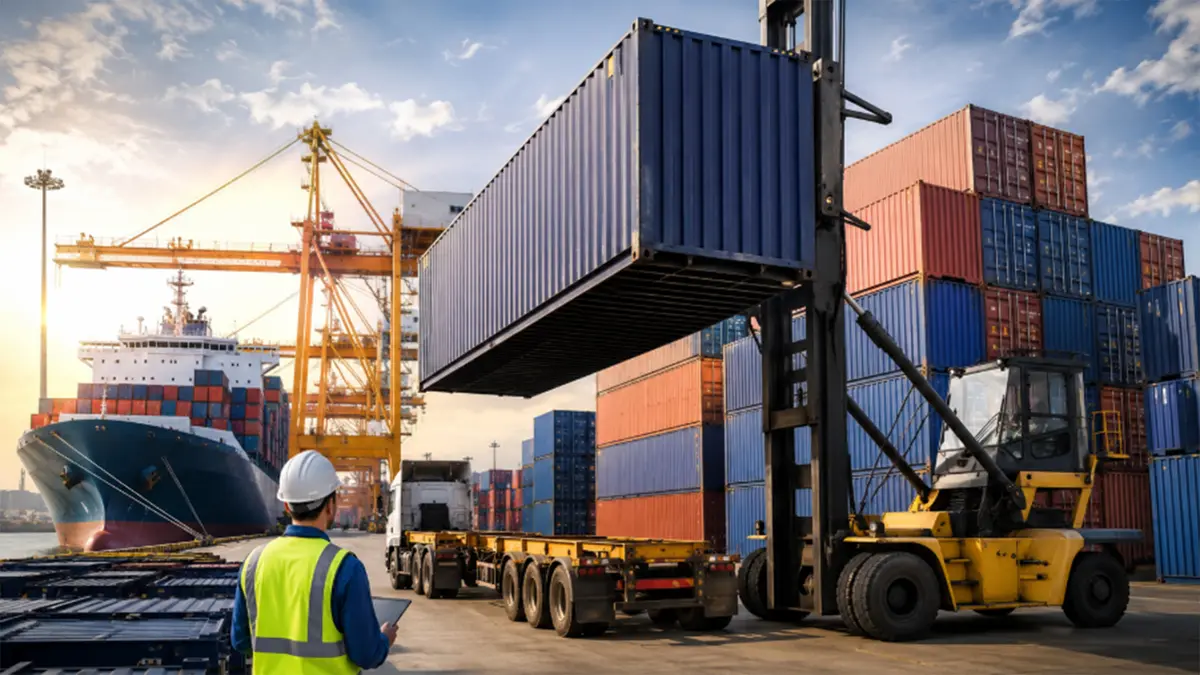
Why in news?
The Union Budget proposed a ₹10,000-crore Container Manufacturing Assistance Scheme. The five-year plan seeks to build a competitive domestic ecosystem.
Why containers matter
Standard containers connect ships, trains and trucks without repeated cargo handling. Their availability affects freight costs, turnaround time and export reliability.
India imports many containers and often depends on repositioned empty boxes. Global disruptions can therefore create shortages even when cargo demand remains strong.
The government targets annual domestic capacity near one million twenty-foot equivalent units over a decade. This is a policy goal, not achieved production.
Scheme design and early activity
The proposed assistance covers five years. Budget documents project a market worth ₹1.07 lakh crore and more than 50,000 indirect jobs.
These figures are government estimates and depend on investment, demand and execution. They should not be presented as realised outcomes.
A prototype container was unveiled at Dadri in Uttar Pradesh on 3 July 2026. Officials also reported an initial order for 1,000 units.
Standards and competitiveness
Containers must meet International Organization for Standardization dimensions and Convention for Safe Containers requirements. Certification protects interoperability and lifting safety.
Support should reward durable production rather than only installed capacity. Steel quality, corrosion resistance, repair networks and competitive pricing will determine demand.
Domestic production can reduce exposure to shortages, but it cannot eliminate repositioning costs. Trade imbalances still leave empty boxes in the wrong places.
Designing assistance carefully
Eligibility rules should prevent support from favouring only established conglomerates. Smaller suppliers may contribute components, repair services and specialised container designs.
Demand commitments can help factories reach scale, but guaranteed orders may weaken price discipline. Competitive procurement and published benchmarks can limit that risk.
Manufacturing also has environmental costs from steel and coatings. Lifecycle standards should reward durability, repairability and responsible waste management.
Regular scheme reviews should compare support with avoided imports and export performance. Weak products should not receive protection indefinitely.
Port and rail operators should join demand planning. Container availability depends on circulation across the full logistics network.
Reliable repair depots can extend asset life and reduce shortages. Their standards should be compatible with shipping-line inspection and international insurance requirements. Skilled repair work can also create continuing employment.
Measure use, not announcements
Useful indicators include certified output, export orders, repair performance and container availability. Subsidy disbursal alone cannot show success.
Conclusion
The scheme addresses a genuine logistics vulnerability. Its value will depend on standards, demand discipline and globally competitive manufacturing.