

Why in news?
Archaeologists have found an unusual grave near Żórawina, south of Wrocław in south-western Poland. The burial contains an almost complete adult male skeleton and rich deposits. These include a tooth necklace, an axe, amber beads and parts of two human skulls. The grave dates near 2900 Before Common Era (BCE), during the early Corded Ware period.
What the excavation revealed
The team encountered the grave while examining a much later Roman-period cemetery. Its position beneath another archaeological layer made the discovery unexpected. The skeleton lay with objects that had clearly been placed during burial. Their arrangement may help reconstruct the ceremony after careful laboratory study.
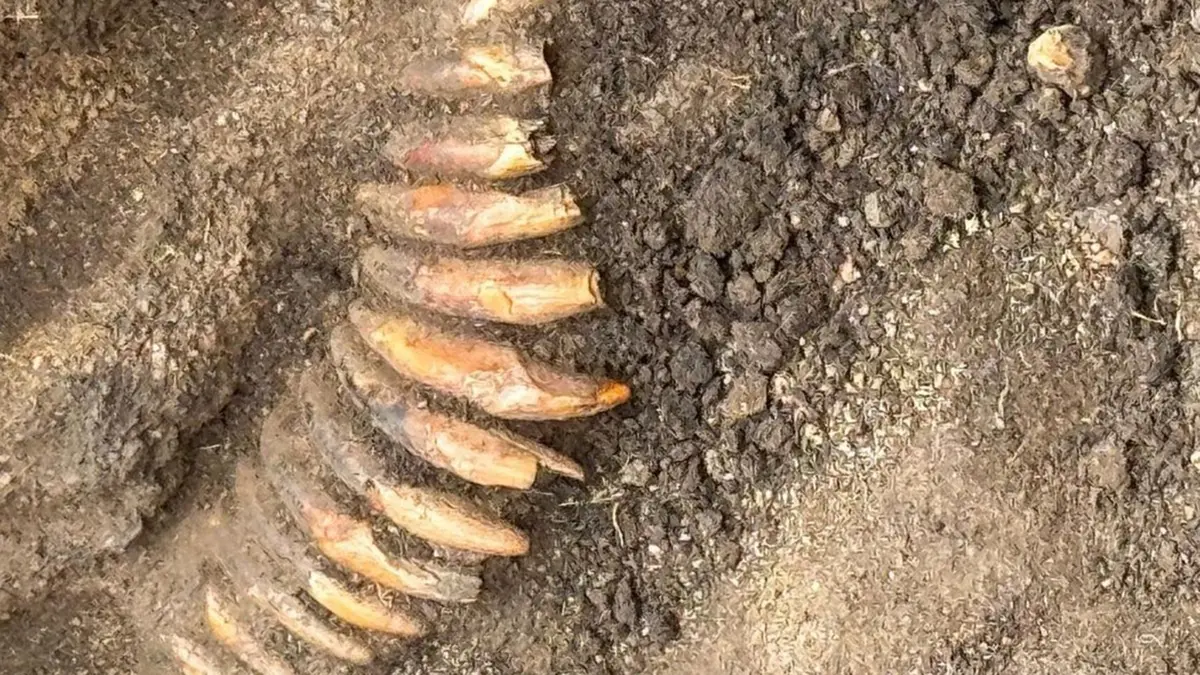
The necklace contains 42 drilled teeth, probably from large mammals. Researchers must still test whether every piece came from an animal. The grave also held amber beads and a used serpentinite battle axe. Two flint implements and fragments of two separate human skulls completed the unusual collection.
The axe’s form provides the main preliminary date of about 2900 BCE. This falls near the beginning of the Corded Ware horizon in the region. Archaeological dating by object type remains an estimate. Radiocarbon analysis can later give a firmer range for the burial.
Understanding the Corded Ware phenomenon
The term describes related archaeological traditions across much of Europe. They developed broadly between 2900 and 2300 BCE, with regional differences. Their name comes from twisted-cord impressions pressed into wet pottery. Beakers, stone battle axes and individual graves are other recurring features.
These similarities do not prove one kingdom or a uniform ethnic community. Material styles could spread through migration, marriage, exchange and imitation. Local communities also adapted shared practices in different ways. Archaeologists therefore use “Corded Ware” as a material and chronological category.
Many graves placed men on one side and women on the other. Bodies often faced a prescribed direction within each regional tradition. Weapons, tools, ornaments and drinking vessels sometimes accompanied the dead. Such patterns reveal social customs, but they cannot identify every person’s occupation.
What ancient DNA has added
Ancient deoxyribonucleic acid (DNA) has transformed research on this period. Many sampled Corded Ware people carried substantial ancestry related to Pontic-Caspian steppe pastoralists. That ancestry appeared rapidly in central Europe during the third millennium BCE. The evidence supports considerable movement alongside cultural exchange.
However, genetic ancestry is not the same as language or self-identity. Available skeletons represent selected places, periods and burial customs. Some regions show stronger continuity with earlier farming communities. Any account must combine DNA with archaeology, isotopes and local chronology.
Isotope analysis can reveal where a person spent childhood or obtained food. It may show whether the Żórawina man was locally raised. Genetic testing could explore biological relationships with the skull fragments. Taphonomic study must first establish how those fragments entered the grave.
Why the burial is exceptional
The skull deposits invite several possible explanations. They may represent enemies, ancestors, relatives or objects transferred from older burials. None of these readings is yet established. Researchers must examine cut marks, weathering, age, sex and genetic relationships.
The rich grave goods may indicate status, skill or ceremonial importance. Calling the man a warrior, hunter or clan leader remains speculative. A battle axe could carry symbolic meaning beyond fighting. Wear patterns and burial position may narrow the possibilities.
The location also matters. Żórawina lies in Lower Silesia, just south of Wrocław. The nearby Oder corridor connected communities across central Europe. Rivers and open land supported movement, farming and long-distance exchange. Amber in the grave points towards networks reaching beyond one settlement.
How the discovery should be studied
The first priority is secure documentation and conservation. Human remains, teeth, stone and amber require different handling. Radiocarbon dates should cover the man and the separate skull fragments. Consistent dates would support one ceremony, while differences could show deliberate curation.
Researchers should publish measurements, photographs and laboratory methods. Open comparisons can test links with neighbouring Corded Ware cemeteries. Ethical treatment of human remains is equally important. Public interest should not turn uncertain interpretations into sensational facts.
Conclusion
The Żórawina grave offers an unusually rich view of early Corded Ware burial practice. Its objects suggest complex ritual choices and wide exchange connections. They do not yet reveal the man’s identity or social role. Scientific tests can separate strong conclusions from attractive stories. Careful publication will place this exceptional burial within Europe’s wider transformation.