

Why in news?
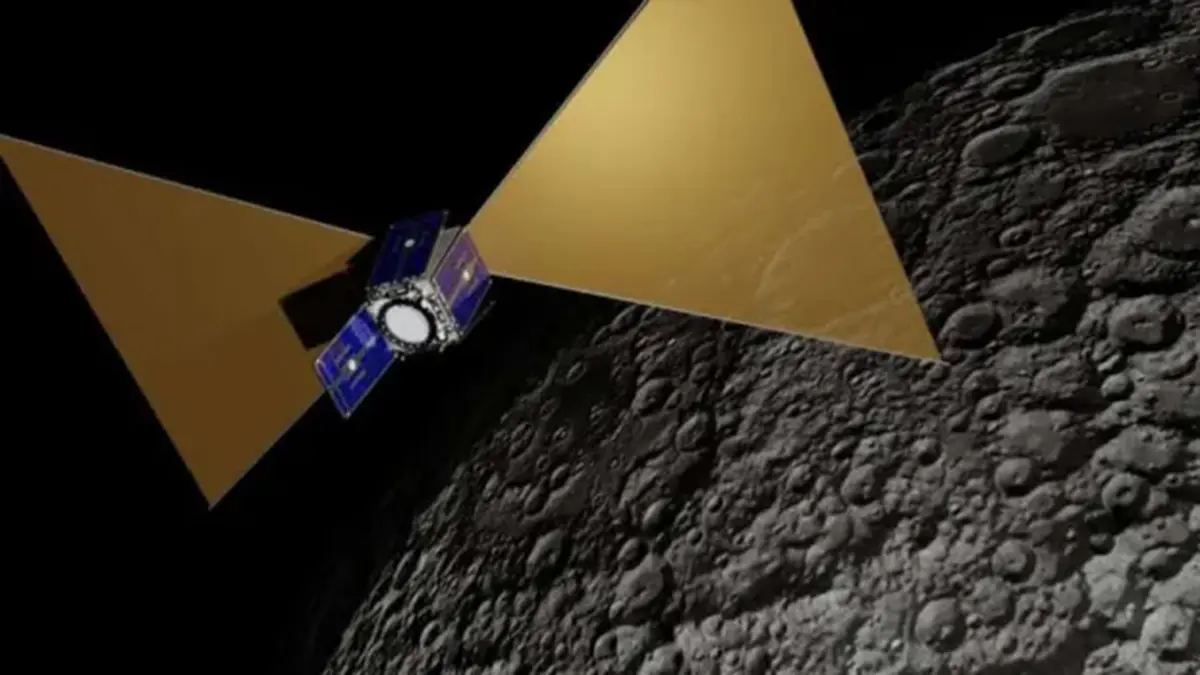
A British-led team has published the scientific case for the proposed CosmoCube mission. The small spacecraft would study very faint radio signals from neutral hydrogen. It would observe while passing behind the Moon, away from Earth’s radio noise. The project remains under development and has not yet received a launch date.
The scientific gap
The cosmic microwave background shows the Universe about 400,000 years after the Big Bang. The first stars appeared much later, perhaps after another hundred million years. The intervening period is called the cosmic dark ages. No stars yet illuminated the widely distributed hydrogen gas.
That gas can emit or absorb radiation at a wavelength of 21 centimetres. The signal arises from a tiny energy change within neutral hydrogen atoms. Expansion stretches ancient radiation to much longer wavelengths today. Astronomers therefore search for the signal at very low radio frequencies.
The signal can trace temperature, density and radiation across early cosmic time. Its shape may show when the first stars began heating their surroundings. Unexpected features could test ideas about dark matter or fundamental physics. The observation is difficult because the signal is extremely faint.
Why Earth is a difficult observatory
Human transmitters produce powerful radio-frequency interference. Broadcasts, communications and satellites can overwhelm the ancient signal. Earth’s ionosphere also absorbs and bends low-frequency radio waves. Ground observations become especially difficult below roughly 45 megahertz.
Remote terrestrial sites reduce some human interference. They cannot remove the ionosphere. Satellites above Earth’s atmosphere avoid that barrier. However, they still receive strong transmissions from Earth and other spacecraft.
The lunar far-side advantage
The Moon’s solid body can shield a spacecraft from direct terrestrial radio emissions. CosmoCube would use a low lunar orbit around 100 kilometres above the surface. It would collect its cleanest data while behind the Moon. The spacecraft would then transmit stored information when communication becomes possible.
The lunar far side is not permanently dark. It receives sunlight during the lunar day. The phrase describes the hemisphere usually facing away from Earth. Its value here comes from radio shielding, not darkness.
A moving satellite offers a practical route without landing equipment. It also faces changing temperatures and power conditions. Lunar gravity, radiation and communication gaps shape the engineering design. Accurate knowledge of the spacecraft’s own radio emissions is equally important.
Proposed instrument and mission
The design centres on a calibrated radiometer covering about 10 to 100 megahertz. A radiometer measures the total strength of radio energy across frequency. It does not make a conventional sky photograph. Scientists seek a broad spectral feature left by early neutral hydrogen.
The concept uses a CubeSat-sized or similar small platform. Its proposed mission life is about two years. Low power and compact components may lower cost. Small size does not remove the need for exact calibration.
Every electronic component can produce unwanted radio noise. The antenna response also changes with frequency and orientation. Engineers must measure these effects before launch and during flight. Otherwise, an instrument pattern could imitate a cosmic signal.
Present development status
Researchers from Cambridge, Portsmouth and the Science and Technology Facilities Council lead the work. Rutherford Appleton Laboratory Space is testing instrument hardware. Surrey Satellite Technology Limited is examining the spacecraft and mission concept. The United Kingdom Space Agency has supported this development.
Laboratory prototypes have undergone environmental and radio-frequency testing. The team describes a four-to-five-year development roadmap. Its ambition is lunar orbit before the decade ends. Funding, technical reviews and a launch opportunity will determine the real schedule.
The 2026 Nature Astronomy paper strengthens the scientific case. It does not convert the concept into an approved mission. Readers should distinguish a proposed design from an operational observatory. Future milestones should show hardware maturity and mission selection.
Why the mission matters
A successful measurement could open a largely unexplored period of cosmic history. It would complement later observations of early galaxies. The project can also develop low-noise instruments for future lunar astronomy. Its methods may guide larger arrays on or around the Moon.
Failure to detect the signal would still require careful interpretation. Instrument sensitivity might be insufficient. Foreground radiation from our galaxy can also hide the target. Open data and independent analysis will strengthen any major claim.
A proposal, not a launched spacecraft
CosmoCube currently has a scientific design, prototypes and a development roadmap. It still needs complete engineering, mission approval and a launch opportunity.
Conclusion
CosmoCube addresses a real observational gap in the history of the Universe. Lunar shielding could reveal frequencies that Earth makes difficult to study. The concept combines ambitious science with a relatively small spacecraft. Calibration and control of radio noise will decide its credibility. Its present importance lies in a strong proposal, not a completed mission.