

Why in news?
Researchers have identified Spanish dinosaur fossils as Diplodocus, a long-necked plant-eater previously confirmed only from North America. The publisher announced the finding on 15 September 2026, describing it as the genus’s first recorded occurrence outside that continent. The remains come from La Tejería near El Castellar in Teruel, eastern Spain, and date to roughly 150 million years ago. They are tail bones, not a complete skeleton. Their identification raises a geographical question: how did this dinosaur group occur on both sides of the developing Atlantic? The researchers propose temporary land connections during periods of lower sea level. That is an explanation inferred from fossils and ancient geography, not a directly established migration route.
Recognising the animal behind the familiar outline
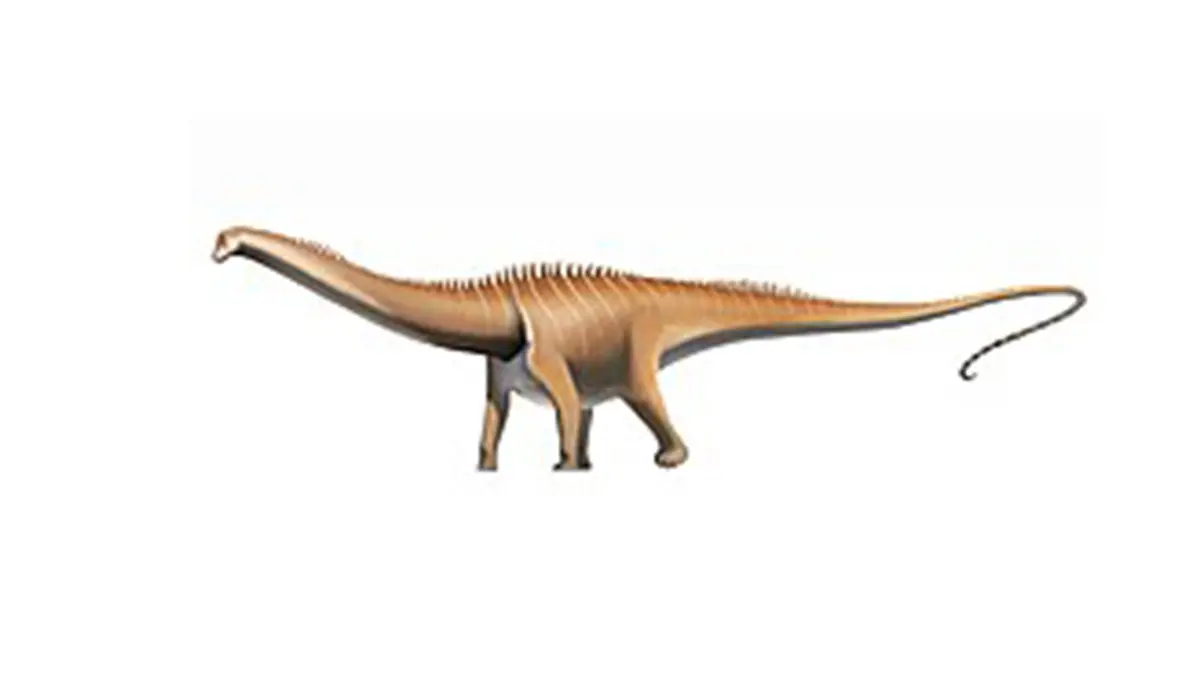
Diplodocus belonged to the sauropods, the dinosaur group recognised by long necks, large bodies and weight-bearing legs. Its long, tapering tail made its overall outline especially distinctive. It lived during the Late Jurassic, far earlier than humans. The Natural History Museum places the genus within a period around 152–145 million years ago.
Its size did not make it a predator. The narrow teeth near the front of its mouth were suited to gathering vegetation. Museum explanations describe a feeding method resembling stripping leaves rather than chewing food with broad grinding teeth. Tooth shape and patterns of wear help researchers investigate diet because the animal’s meals cannot usually be observed directly.
The name Diplodocus refers to the distinctive double-beamed form of some bones beneath its tail. These bones are called chevrons. The name identifies an anatomical feature, but that feature alone is not an infallible identification test. A scientific assignment must consider a combination of characteristics and compare the specimen with related animals.
What the Spanish material contains
The new study examined 14 tail vertebrae together with chevrons. Vertebrae are the individual bones forming the backbone; those from the tail can preserve useful diagnostic details. According to the publisher’s account, the researchers compared cavities, grooves and other anatomical features with known specimens. Their analysis placed the Spanish material within Diplodocus, close to Diplodocus hallorum.
Placement near that species does not necessarily establish that the Spanish animal belonged to exactly the same species. A genus is a broader classification than a species. The distinction matters here because the important geographical finding concerns the genus, while the more precise relationship remains a separate question. Additional associated bones could help resolve it.
The team estimated that the animal may have been around 25 metres long. This is a reconstruction informed by comparisons with related skeletons, not the measured length of an intact Spanish skeleton. Palaeontology often works from incomplete material. Its strength comes from making the relationship between surviving evidence and reconstructed appearance explicit.
Why North America was central to its history
Well-known Diplodocus remains come from the Morrison Formation of the western United States. A geological formation is a recognisable body of rock, not a modern political region. Sediments that became the Morrison rocks preserved many Late Jurassic dinosaurs. The National Park Service’s account places Diplodocus within this fossil-rich setting, including the Dinosaur National Monument region.
The Spanish identification therefore changes the known geographical record rather than proving that every similar European dinosaur was Diplodocus. Related long-necked dinosaurs already had a wider distribution. Finding one particular genus beyond its previously confirmed range is a narrower but scientifically meaningful result. It allows researchers to test relationships using newly located evidence.
Reading a Jurassic map rather than a modern one
Modern Spain is separated from North America by a wide ocean. The Late Jurassic world had a different arrangement of land and sea. The Atlantic was developing as continental blocks separated, while coastlines shifted with changing sea levels. A modern map therefore cannot by itself establish whether land animals could once move between those regions.
The proposed land-connection explanation remains a hypothesis. Lower sea levels could have exposed routes that later became submerged. Fossils can show that related animals occurred in different places, but they do not preserve a record of each journey. Establishing when and where a connection existed requires agreement between fossil ages and geological reconstructions.
Conclusion
The Spanish tail material adds a potentially important location to the known Diplodocus record. Its value is not limited to identifying a familiar dinosaur: it provides evidence for investigating how Jurassic animal populations were connected. More fossils and closer comparisons can test the identification and refine the proposed geography without treating an inferred land route as settled history.