

Why in news?
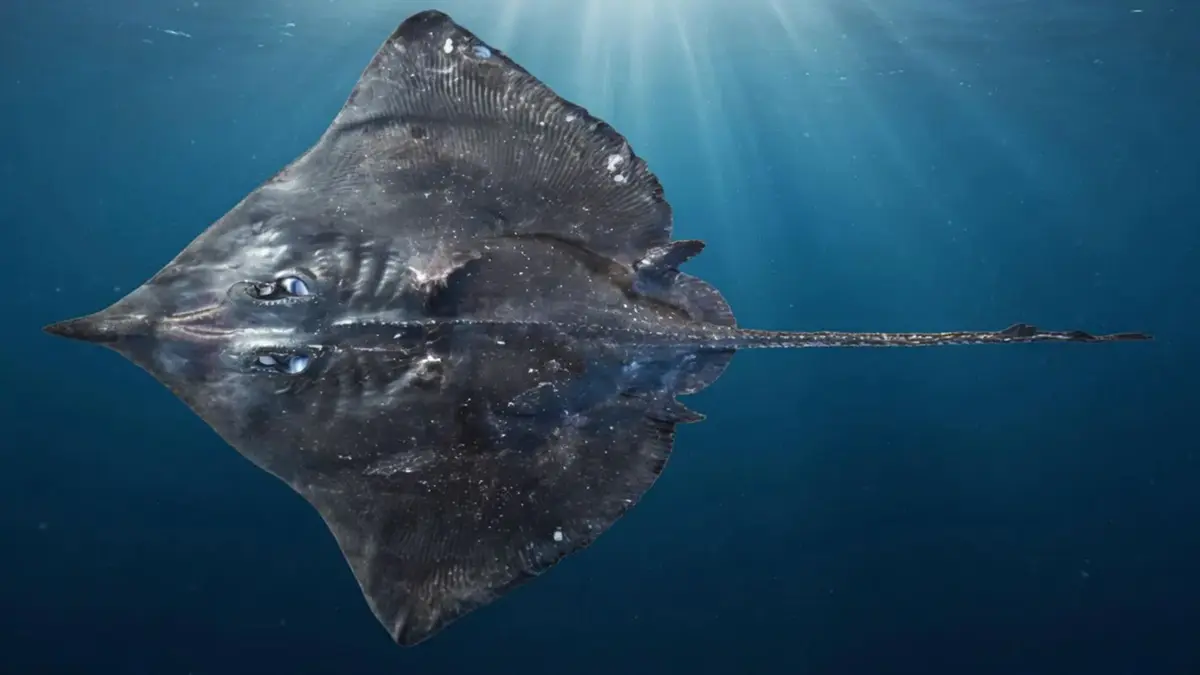
Scientists have announced a newly recognised deep-sea skate from the southeastern Arabian Sea. The Zoological Survey of India announced the discovery on 1 September 2026. Named Dipturus dhritiae, the fish is also called the Arabian skate. Its identification resolves a long-standing classification problem and strengthens the case for monitoring deep-water fishing impacts.
How the species was recognised
The work involved the Zoological Survey of India and international specialists. Researchers from the Indian Council of Agricultural Research–Central Marine Fisheries Research Institute also participated. They combined comparisons of physical features with genetic evidence. This approach helps separate closely related animals that may look similar.
The official account identifies five rows of thorns along the tail as a distinguishing feature. It reports a maximum known specimen length of 131.5 centimetres. That figure describes the specimens known to researchers. It should not be treated as a proven biological size limit.
For decades, specimens had been confused with Dipturus springeri. The new identification separates those records from the previously used name. Genetic comparisons also distinguished the Arabian skate from the Travancore skate, Dipturus johannisdavisi. The species honours Dhriti Banerjee, the survey’s first woman Director.
What is a skate?
Skates are fishes related to sharks and rays. Their skeletons are mainly cartilage rather than the bony framework found in many familiar fishes. Their broad, flattened bodies suit life near the seabed. They belong to the wider group known as cartilaginous fishes.
Skates lay eggs enclosed in protective cases. Research on other skate species has identified distinct nursery areas containing these cases. Such findings show why reproductive habitats matter in conservation. They do not establish an exact breeding site or breeding rate for the Arabian skate.
Recognising a species is the beginning of biological understanding. Scientists still need information about growth, reproduction, diet and population size. These questions require repeated sampling across time and locations. A formal name makes those future records easier to compare consistently.
The deep-water setting off southwestern India
The reported specimens came from depths of 400–600 metres. Their locations include waters off Kerala and the Wadge Bank region. Both belong to the marine setting around southwestern India. These are deep-water records, not sightings from coastal beaches or shallow lagoons.
The Kollam Slope is another important part of this regional context. It lies offshore between roughly Kochi and Kollam in Kerala. Its seabed includes muddy areas, sand and rocky outcrops. The continental slope links shallower coastal waters with deeper ocean habitats.
The Kollam Slope has been identified as an Important Shark and Ray Area. This scientific designation highlights habitat relevant to threatened, range-restricted or reproducing species. It can guide conservation planning and research priorities. It does not, by itself, create a statutory marine protected area.
Monsoon-driven changes influence the waters off Kerala. Nutrients, organic matter and oxygen conditions vary through the year. The area therefore contains more than a uniform stretch of deep seabed. Understanding habitat differences is important when interpreting where animals occur.
Why identification matters for fisheries
The Arabian skate has appeared as incidental catch in deep-sea shrimp trawling. Such unwanted or non-target catch is called bycatch. It can expose poorly studied species to fishing pressure. A fish need not be commercially targeted to face repeated capture.
Misidentification can hide changes in individual species. Records may combine several different animals under one familiar name. An apparently stable catch category could then conceal a decline within it. Better identification makes fisheries information more useful for conservation decisions.
Monitoring should record the species, location, depth and circumstances of capture. Researchers can work with fishing communities and landing centres to improve reporting. Photographs and specimen records can support identification. Participation should be designed around practical fishing operations and safe handling.
The wider Deep Ocean Mission supports investigation of these poorly understood environments. Exploration should produce usable baseline information, not merely lists of discoveries. That knowledge can inform assessments before fishing pressure expands. It can also help identify habitats needing closer attention.
Conclusion
The Arabian skate demonstrates how marine diversity can remain hidden within familiar fishing records. Careful taxonomy has now clarified one part of that picture. The next task is to understand its biology and exposure to bycatch. Research, accurate reporting and habitat-based planning should proceed together. Naming a species becomes most valuable when it improves decisions affecting its survival.