

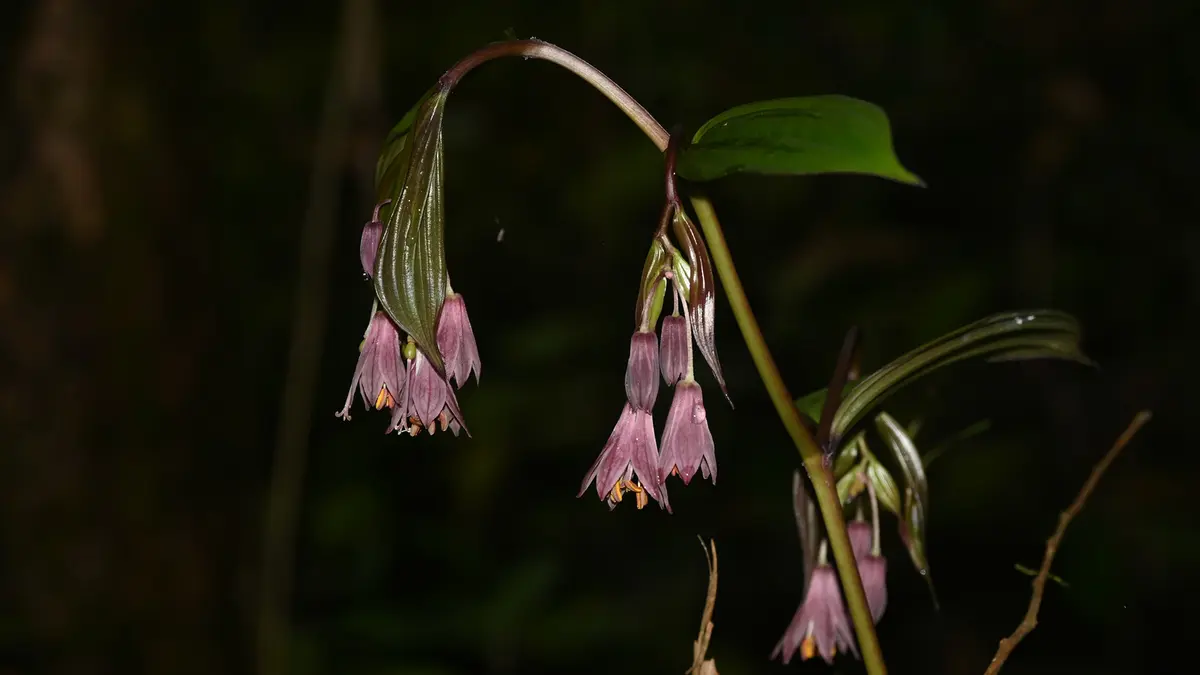
Why in news?
Botanists described a new flowering plant from Arunachal Pradesh. They named it Disporum yobinorum after the local Yobin community. The scientific description appeared on 16 July 2026.
Background
A new species is not confirmed merely because a plant looks unusual.
Botanists compare its flowers, leaves, stems and reproductive structures with known species.
They also study preserved specimens, earlier descriptions and accepted scientific names.
A peer-reviewed paper then records the identifying features and the type specimen.
The type specimen becomes the permanent reference for that scientific name.
Who made the discovery?
Vinay Kumar Sahani and Krishna Chowlu formally described the species.
Both researchers work at the Botanical Survey of India’s Arunachal Pradesh Regional Centre.
Their paper appeared on pages 93 to 97 of volume 767 in the botanical journal Phytotaxa.
Where was the plant found?
The researchers found it near Vijaynagar in Changlang district, Arunachal Pradesh.
This remote landscape lies near India’s boundary with Myanmar’s Kachin State.
Its forests form part of the biologically rich Eastern Himalayan region.
Nearby landscapes also share ecological links with northern Myanmar and south-western China.
Habitat and known population
- The plant grows beside streams within moist, shaded evergreen forest containing dense native vegetation.
- The recorded elevation ranges from about 1,100 to 1,500 metres.
- Researchers have found fewer than forty plants at one known location.
This narrow record does not prove that the species exists nowhere else.
It instead shows that further field surveys are urgently required.
What does its name mean?
The name yobinorum honours the Yobin community, whose members supported exploration across this isolated landscape.
The Yobin people are also known as Lisu in Myanmar and China.
They form one of Arunachal Pradesh’s smaller indigenous communities.
Scientific names can therefore acknowledge local knowledge and assistance during field research.
What is the genus Disporum?
Disporum contains perennial Colchicaceae herbs, which survive beyond one growing season.
Members commonly have fleshy roots, leafy stems and six-part flowers.
The paper reports forty-two accepted species worldwide, citing Plants of the World Online (2026).
The original paper reports ten accepted names from India within this genus.
Its wider range includes parts of Asia, especially temperate and montane forests.
Taxonomy trail: Kingdom Plantae; flowering plant; monocot; family Colchicaceae; genus Disporum.
What does “Data Deficient” mean?
The researchers recommended Data Deficient assessment because available information cannot support a reliable extinction-risk assessment.
It never means the species is safe or free from threats.
Moreover, the authors’ recommendation is not an official global listing by itself.
More surveys must establish its distribution, population trend and possible habitat pressures.
Why is the finding important?
Each documented species improves understanding of India’s biological wealth and evolutionary history.
A precise record can also guide forest planning before roads or projects alter habitats.
Local communities remain valuable partners because they know remote landscapes across seasons.
Conclusion
Disporum yobinorum highlights Arunachal Pradesh’s richness, while its protection requires further surveys and continued community cooperation.