

Why in news?
A government explainer on 2 September 2026 reviewed the Districts as Export Hubs initiative. It described district-level planning and a focused implementation approach introduced from 1 June 2026. The first phase covers districts across twenty-seven States and Union Territories. The initiative seeks to connect local goods and services with international buyers.
Why export planning begins in districts
A product can be valued locally without being ready for overseas sale. Exporting also requires reliable quality, documentation, finance and delivery. Smaller producers may struggle to access these services individually. District-level planning aims to identify the specific obstacles between local production and international markets.
The initiative covers services as well as physical goods. It builds on local strengths rather than requiring every district to develop the same industry. Agricultural products, manufacturing clusters and specialised skills create different opportunities. Their support needs also differ, making a uniform checklist insufficient.
The One District One Product approach helps identify and promote distinctive local products. Districts as Export Hubs has a wider export-development purpose. It can address several promising products and services within one district. The approach does not mean that only one item may be exported from each district.
Who is responsible for implementation?
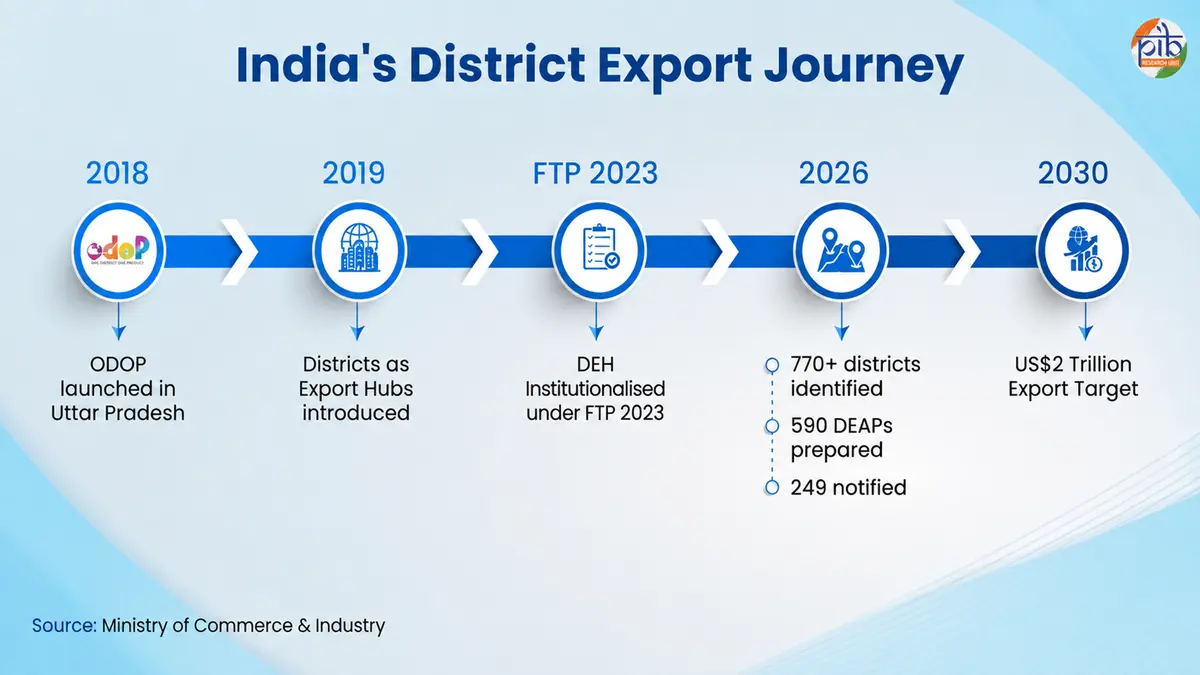
The initiative began in August 2019. The Foreign Trade Policy, 2023 included district-led export development in Chapter 3. The current work therefore builds on an existing policy framework. The June 2026 focused approach represents a further implementation stage, not the original launch.
The Department of Commerce provides overall policy direction. The Directorate General of Foreign Trade, or DGFT, anchors implementation and coordination. Its regional authorities work with State governments and district administrations. This arrangement brings national trade expertise closer to producers and their local constraints.
A District Export Promotion Committee usually has the District Collector as chairperson. A designated DGFT regional authority serves as co-chair. The committee brings relevant departments and other stakeholders into planning. Its responsibilities include identifying export opportunities, examining bottlenecks and preparing a district action plan.
At State level, a State Export Promotion Committee is headed by the Chief Secretary. This mechanism can address issues that extend beyond one district. State-level coordination is important for infrastructure and departmental cooperation. District committees cannot independently resolve every transport, testing or regulatory difficulty.
What the plans and funding actually mean
District Export Action Plans should establish existing exports and future opportunities. They should identify constraints, responsibilities, measurable targets and timelines. By March 2026, draft plans had been prepared for 590 districts. Of these, 249 had been formally adopted by their district committees.
Preparation and adoption are different stages of implementation. A draft records proposed priorities, while adoption creates an agreed local plan. Neither stage alone proves that exports or incomes have increased. Results require follow-through on the specific actions identified in the plan.
The initiative is a coordination framework rather than a separate funding scheme. It seeks to bring together support available through existing Central and State programmes. Therefore, announcing a district plan does not automatically create a new grant. Each proposed intervention still needs a suitable funding route and responsible implementing agency.
From planning to practical export readiness
Quality testing and certification can determine whether a product enters a foreign market. Packaging must protect the product and meet the buyer’s requirements. Training should explain these conditions in terms that producers can use. Market access depends on repeatable compliance, not simply attractive branding.
Geography affects the cost of reaching those markets. An inland producer must connect local transport with an appropriate export gateway. Perishable goods may need dependable cold-chain facilities throughout that journey. A district plan should map these actual connections instead of treating proximity to a port as the only advantage.
Digital commerce can create additional routes for smaller consignments. Postal export facilities and other partners can help with procedures and shipment options. However, producers still face payment, buyer-verification and return-related risks. Training must address these issues alongside the process of listing products online.
Performance measures should show whether local businesses gain sustained opportunities. New registrations are useful, but repeat orders and reliable deliveries reveal more. Authorities should also examine who receives support and whether smaller enterprises participate. This would connect export promotion with local employment and wider economic inclusion.
Conclusion
Districts as Export Hubs brings trade planning closer to the places where production occurs. Its strength lies in solving specific local constraints through coordinated action. Plans, committees and publicity are only starting points. Progress should be judged through reliable market access and sustained business participation. Clear responsibilities and measurable outcomes can turn local strengths into lasting export opportunities.