

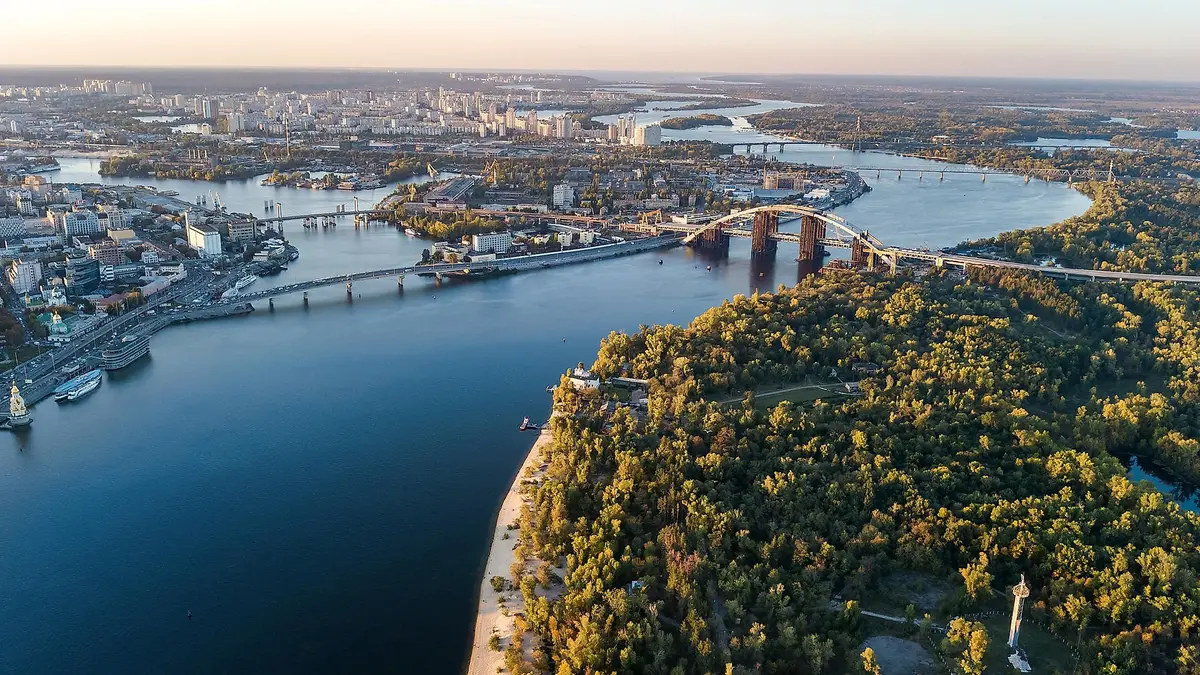
Why in news?
Russian attacks on 1–2 October 2026 disrupted bridges across the Dnipro River in Ukraine's capital, Kyiv. Reuters reported a further strike on the Southern Bridge and full or partial traffic restrictions affecting several crossings. The Dnipro separates major residential and employment areas, so damage to a bridge can disrupt daily journeys across the city. The river is also part of a much larger basin extending through Russia, Belarus and Ukraine to the Black Sea. The immediate news concerns damaged transport connections and civilian disruption. It does not establish that every crossing is unusable or that the river's wider water-management system has failed.
Following the river from its source to the sea
The Dnipro, also widely called the Dnieper, rises in the Valdai uplands of western Russia. It flows through Belarus and Ukraine before reaching the Black Sea through its lower estuarine system. Its total length is approximately 2,200 kilometres. This international course places Kyiv within a connected river system. The capital's section receives water from upstream and passes it onwards; it is not an isolated urban water body.
A river basin includes the main channel and the land drained by its tributaries. The United Nations Economic Commission for Europe describes a Dnipro basin of about 504,000 square kilometres shared by the three countries. Among its important tributaries are the Pripyat and Desna. Water entering through these connected rivers carries the effects of conditions beyond the main channel, including changes in runoff and water quality.
Understanding Kyiv's left and right banks
A river's left and right banks are named while facing downstream. Around Kyiv, the left bank is broadly the eastern side and the right bank the western side. These terms describe orientation along the river, not political alignment. They are useful when reading reports about neighbourhoods, transport and services on opposite sides of the capital.
Reuters describes a longstanding separation between many homes on the left bank and jobs concentrated on the right. Its reporters observed long traffic queues as people adjusted to restrictions. A bridge therefore serves more than the vehicles immediately using it: it connects homes with workplaces and other services. When traffic is diverted, pressure can spread to crossings that remain open.
A waterway transformed by human use
The Dnipro has long supported settlements, industry, agriculture and transport. Reservoir construction changed substantial stretches of its flow and created linked uses for stored water. A reservoir can support a use at its own site while affecting conditions downstream. This is why river management involves the whole system, rather than treating each dam, intake or city as a separate unit.
Water quantity and water quality are also different dimensions of that system. A large volume is not automatically suitable for drinking or industrial use without treatment. Conversely, cleaner water cannot meet a need if the required intake or supply connection is unavailable. The distinction becomes particularly important when conflict damages infrastructure: the river's presence alone does not guarantee that connected services continue functioning.
The Kakhovka breach shows a different kind of vulnerability
A separate, earlier disaster illustrates the consequences of disrupting river storage. The Kakhovka dam on the lower Dnipro was breached on 6 June 2023. The United Nations Environment Programme's assessment documented extensive downstream flooding and the draining of large reservoir and wetland areas. This was a change in the water system itself, not simply the temporary loss of a transport crossing.
The assessment examined sediment movement, possible contamination, waste and ecological damage. It also explained the limits caused by restricted access to affected areas. Some impacts could be observed remotely, while others required further investigation. Those findings show why old maps of a reservoir system cannot be assumed to describe its present functioning. They do not prove that the October bridge attacks caused another dam-related disaster.
Why the distinction matters for recovery
Transport repair and water-system recovery involve different tasks, although both affect the same population. Reopening a crossing can restore access between neighbourhoods without resolving an interrupted water or energy service. Likewise, a functioning water supply does not remove the disruption caused by detours. Understanding these dependencies makes the civilian consequences more concrete than describing every attack as a single, undifferentiated infrastructure loss.
Conclusion
The October attacks demonstrate how strongly Kyiv depends on dependable links across the Dnipro. The river's broader significance lies in the settlements, tributaries and services connected along its course. Assessing damage accurately means identifying which connection has failed, what still functions and what the affected communities need restored.