

Why in news?
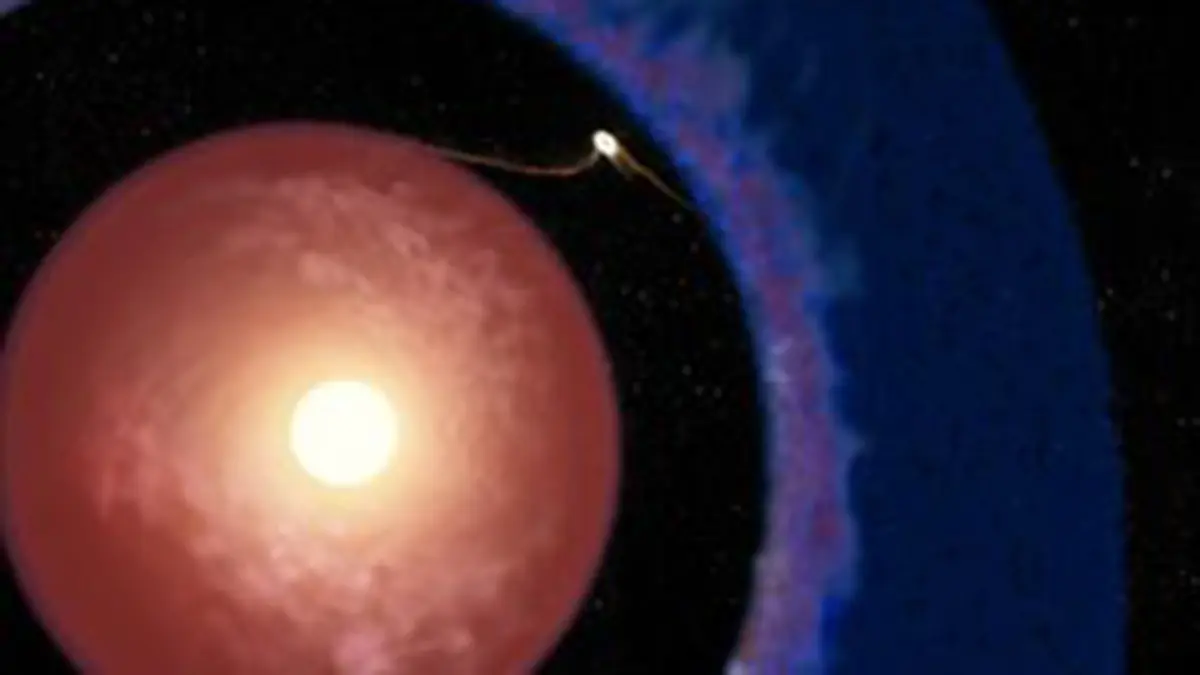
Astronomers have confirmed a very young planet still embedded in the disc of material around its parent star. The planet, Elias 2-24 b, lies about 450 light-years from Earth. A study published on 16 September combines observations of the star's dusty disc with evidence from infrared imaging. The researchers place the system's age at around one million years or less. The National Aeronautics and Space Administration describes it as the youngest known planet detected so far. That claim depends on current observations and age estimates. More importantly, astronomers can examine a giant planet while formation continues. They need not reconstruct its birth only from a mature system.
A planet within a planet-forming disc
Young stars can be surrounded by rotating discs of gas and dust. These are called protoplanetary discs because they provide material from which planets may form. Dust can accumulate, solid bodies can grow and sufficiently massive bodies can gather gas. Elias 2-24 b remains associated with such a disc. It therefore offers a view of an early stage that is difficult to observe directly.
The star is called Elias 2-24, while the lower-case letter in Elias 2-24 b identifies the planet. The letter does not mean that the planet has Earth-like properties. The observations instead point to a young giant planet. It orbits at a separation of roughly 55 astronomical units. One astronomical unit is the average Earth–Sun distance, so the separation places it well beyond Earth's orbital scale.
From a gap in dust to a planetary detection
Observations with the Atacama Large Millimeter/submillimeter Array in Chile showed a narrow gap in the disc. Such a gap can suggest that an orbiting body is disturbing surrounding material. However, a gap alone does not prove that a planet is present. Other processes can alter a disc's appearance. Astronomers therefore needed evidence of an object at the relevant location, not simply an appealing explanation for the shape.
The investigation brought together observations from the Very Large Telescope and the W. M. Keck Observatory. The Keck work used infrared imaging, including observations originally collected in 2018 and 2020. Comparing observations across time helped test whether the candidate was associated with the young star. This matters because an apparent point of light could otherwise be an unrelated background source or an artefact created during image processing.
Detecting a faint planet beside a much brighter star is technically demanding. A coronagraph suppresses part of the star's light so nearby faint structures become easier to detect. Adaptive optics corrects distortions produced by Earth's atmosphere. Infrared observations are useful because young planets can remain hot and emit strongly at these wavelengths. None of these techniques works in isolation: the credibility comes from the combined observations and analysis.
What its mass and age tell researchers
The study estimates a mass of approximately 1.9 to 4 times Jupiter's mass under a specified set of models. This is not a direct weighing of the planet. The estimate depends on how a very young object's brightness relates to its age and mass. Material still falling onto the planet can also contribute light. The paper explicitly notes assumptions about this accretion, so the numerical range should be understood as model-dependent.
The age estimate is similarly central to the claim about youth. Astronomers infer ages from the properties and development of young stellar systems. Calling Elias 2-24 b the youngest known detected planet does not mean younger planets cannot exist elsewhere. It means this object occupies an unusually early stage among the planets currently identified and characterised. New observations or revised age models could change that comparison.
A test of how giant planets grow
One major explanation for giant-planet formation is core accretion. Solid material first builds a substantial core. The growing body can then collect a large gaseous envelope from its surroundings. Another proposed pathway involves a sufficiently unstable disc breaking into self-gravitating clumps. These mechanisms predict different conditions and timescales. Finding a planet while its disc still exists allows researchers to examine those predictions more directly.
The authors interpret Elias 2-24 b as evidence of rapid growth through core accretion. Its location within a narrow gap helps connect the planet with changes in the surrounding disc. However, the system is not a complete film of planetary formation. Astronomers observe a limited period and compare it with physical models. Continued monitoring can improve estimates of motion, mass and the rate at which material reaches the planet.
Conclusion
Elias 2-24 b is valuable because it links a directly detected young object with a disc still involved in planet formation. Its estimated age makes it an unusually early example, while its uncertain mass illustrates the challenges of studying newborn planets. The discovery strengthens opportunities to test formation models. Its importance does not depend on treating a provisional age ranking or a model-based mass estimate as an unchangeable record.