

Why in news?
A Eurasian whimbrel photographed at Elathur beach in Kozhikode on 19 September was identified through a numbered flag on its leg. The bird had been ringed at Kadalundi-Vallikkunnu Community Reserve on 29 January 2020, according to The Hindu's 27 September report. The Bombay Natural History Society identified this as the first reported resighting of that particular bird. The finding connects two observations of one individual, rather than merely recording the species again. It shows that the bird survived for more than six years after marking and was again using the Kerala coast. It does not reveal the complete route travelled between those observations or prove that it returned every intervening year.
How a flag identifies an individual
The photographed whimbrel carried the code 0J3 on a black flag, alongside a metal ring. The Bombay Natural History Society, or BNHS, maintains marking records that allow an observation to be connected with the original capture. A photograph becomes much more informative when the code is readable and can be matched to a specific bird's history.
The society's published marking protocol describes a black flag with a unique white code for waders marked in five southern states. These are Andhra Pradesh, Telangana, Karnataka, Tamil Nadu and Kerala. The colour indicates the marking region within that scheme; the individual code provides the more specific identity. The metal ring also carries identifying information. These devices should not be confused with a transmitter that continually sends the bird's location.
That difference sets the evidence boundary. A flag supplies information when someone observes and reports it. Between observations, the bird's movements remain unknown unless another tracking method supplies data. A six-year reporting gap therefore establishes neither continuous residence nor absence from India. It cannot identify a particular migration route.
The bird behind the record
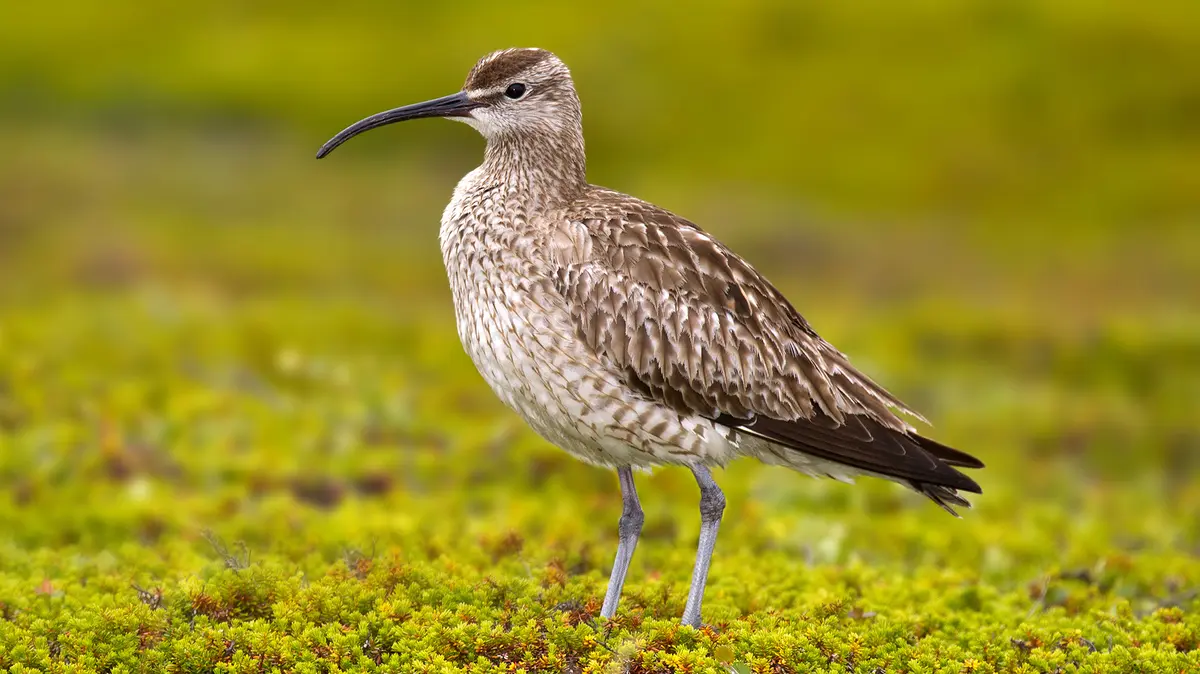
The Eurasian whimbrel is Numenius phaeopus, a wading bird with a down-curved bill and a distinctive pale crown stripe. Its body is largely brownish above and paler below. These features help distinguish it from similar shorebirds. Identification still benefits from the combination of shape, plumage and other observed characteristics rather than one isolated feature.
Whimbrels use northern breeding areas and migrate to warmer regions outside the breeding season. Their movements are not identical across the species' range. Information about birds migrating through western Europe, for example, cannot establish where a particular Kerala bird bred. The present resighting gives two known points in an individual's history. Those points do not establish the route taken between them.
The bird's curved bill is suited to feeding on coastal invertebrates. Species accounts describe foods including crabs, shrimps, worms and molluscs during passage. These food resources help explain the importance of shores and tidal wetlands. Migratory birds need places to feed and rest along their journeys, not only protected breeding grounds at the journey's far end.
Elathur and Kadalundi are different locations
The September photograph came from Elathur beach; Kadalundi-Vallikkunnu was the earlier marking site. Keeping those places distinct is essential to understanding the record. Combining them into a single location would remove the movement information that makes the resighting useful. The news concerns an identified bird recorded again along the same wider coast.
At Kadalundi, the river meets the Arabian Sea among islands, mangroves and tidal habitats. Kerala Tourism describes this estuarine setting and its use by migratory birds. An estuary is a transition between river and sea, shaped by freshwater inflow and tides. Its exposed feeding areas and surrounding vegetation provide different resources as water levels change.
For conservation, the connection between such places is important. A bird that uses several sites can be affected by changes at any of them. Protecting only a place where it was first marked would not cover its whole annual life. The record supports attention to the coastal habitat network, although it does not identify every site this individual used.
Survival, age and population status are separate measures
The interval since ringing establishes a minimum period of survival after that event. It is not necessarily the bird's total age, because the bird was already alive when marked. Nor can one successful resighting determine the population's survival rate. That requires a much wider set of observations and analysis of how likely marked birds are to be seen again.
The British Trust for Ornithology lists the species' global conservation category as Least Concern. It also notes a different United Kingdom conservation assessment. Global and national assessments operate at different scales. Neither removes the need to maintain local feeding and resting habitat. A common global category should not turn a valuable coastal site into an expendable one.
Conclusion
The Elathur observation turns a familiar shorebird sighting into a documented individual history. Its strongest finding is continuity of survival and renewed coastal use after more than six years. Further resightings could reveal additional connections, while the current evidence leaves the intervening route open. Accurate reporting of codes, dates and locations is what allows small observations to build a larger picture of migration.