

Why in news?
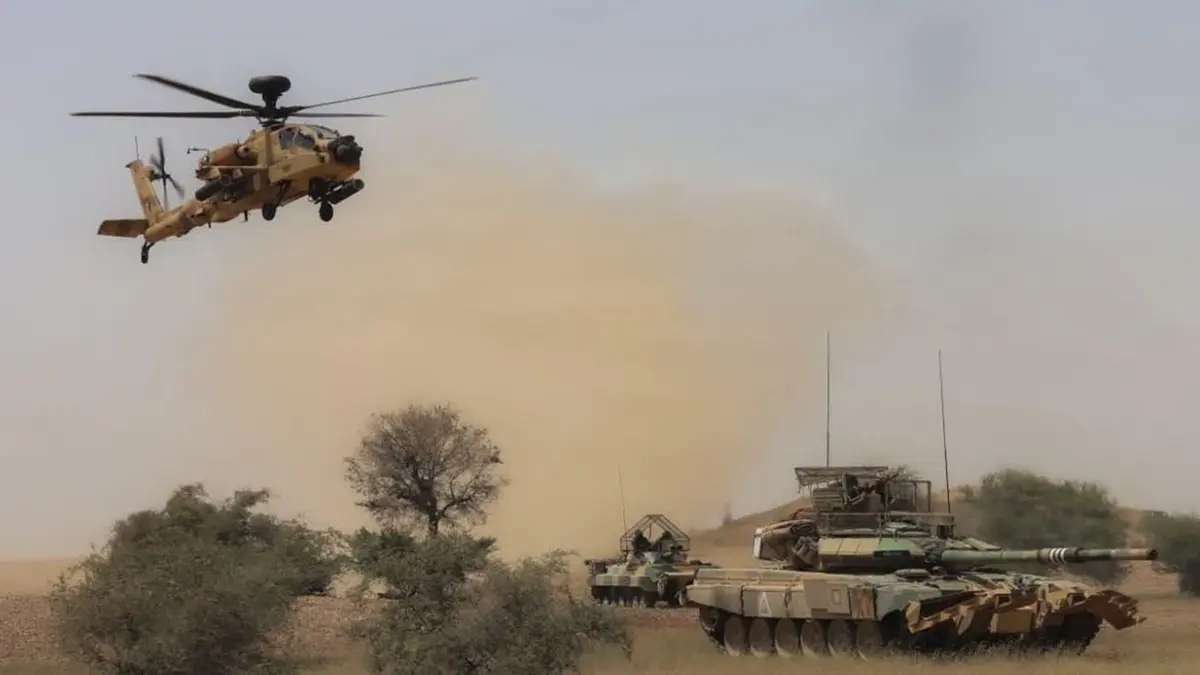
The Indian Army's Konark Corps conducted Exercise Rudra Raptors near Jaisalmer in Rajasthan. Details of the desert training became public on 4 September. It joined attack helicopters with tanks in a forward sector. The exercise tested whether air and ground elements could act as one combat team.
What happened during the exercise
The drill brought the Thar Raptors' attack helicopters together with the Black Mace Brigade's tanks. The first report identified the helicopters as AH-64E Apache aircraft. The participants practised coordinated movement, communication and engagement under demanding conditions. No foreign military was reported as part of this exercise.
The word “joint” can carry different meanings in defence reporting. Here, it described integration between Army Aviation and Army ground formations. The available account did not identify a tri-service or international component. The exercise should therefore be understood as an integrated Army training event.
Konark Corps and the Rudra formation
Konark Corps is also known as XII Corps and operates under the Army's Southern Command. Its desert responsibilities make mechanised mobility and air-ground coordination especially important. The Black Mace formation was described as a Rudra all-arms brigade. Such a formation places several combat and support capabilities under one headquarters.
The Ministry of Defence had earlier reported a Rudra Brigade under Konark Corps. It participated in Exercise Akhand Prahaar during November 2025. That larger event combined mechanised forces, infantry, Army Aviation and other arms. It also tested indigenous drones, counter-drone systems and electronic warfare equipment.
A Rudra brigade is intended to shorten coordination between specialised units. Tanks provide protected movement and direct fire on the ground. Attack helicopters can observe, manoeuvre rapidly and strike from another direction. Engineers, artillery, air defence and logistics sustain the combined effort.
What air-ground integration requires
Helicopters and tanks move at very different speeds and heights. Their crews need a shared picture of friendly and hostile positions. Communications must remain clear when formations disperse across a wide area. Timing also matters because an air attack may expose or protect ground movement.
Commanders must prevent friendly-fire incidents while retaining operational speed. They need agreed target identification and airspace procedures. Crews must also practise when communications become weak or contested. Repeated field training can reveal gaps that classroom planning cannot show.
The AH-64E is designed for reconnaissance and precision attack missions. Its sensors and data links can support operations during day or night. However, the aircraft remains dependent upon maintenance, ammunition, fuel and protected operating locations. Integration is therefore wider than simply flying beside tanks.
Why Jaisalmer matters
Jaisalmer lies in western Rajasthan within the Thar Desert. The district shares India's international boundary with Pakistan. Its dry terrain, long distances and sparse landmarks create a demanding training setting. These features make navigation, supply and equipment reliability central to operations.
Desert warfare also creates strong pressure on machines and personnel. Dust can affect sensors, engines and moving parts. Heat raises water, medical and maintenance needs. A realistic exercise should therefore test support systems alongside visible combat platforms.
How the result should be read
An exercise validates procedures under a designed scenario. It does not by itself prove effectiveness in every conflict. Useful assessment asks whether communications worked and decisions arrived on time. It should also record equipment failures and correct them before later training.
Public information about Rudra Raptors remains limited for operational reasons. The available report establishes the location, participants and broad aim. It does not provide casualty simulations, performance scores or detailed tactical outcomes. Claims beyond that record would be speculative.
Conclusion
Exercise Rudra Raptors focused on practical cooperation between helicopters and armoured forces. Its Jaisalmer setting added real geographical and logistical demands. The drill also fits the Army's wider move towards integrated all-arms formations. Strong performance depends upon communications, sustainment and disciplined command procedures. Later exercises must show whether those lessons remain effective at greater scale.