

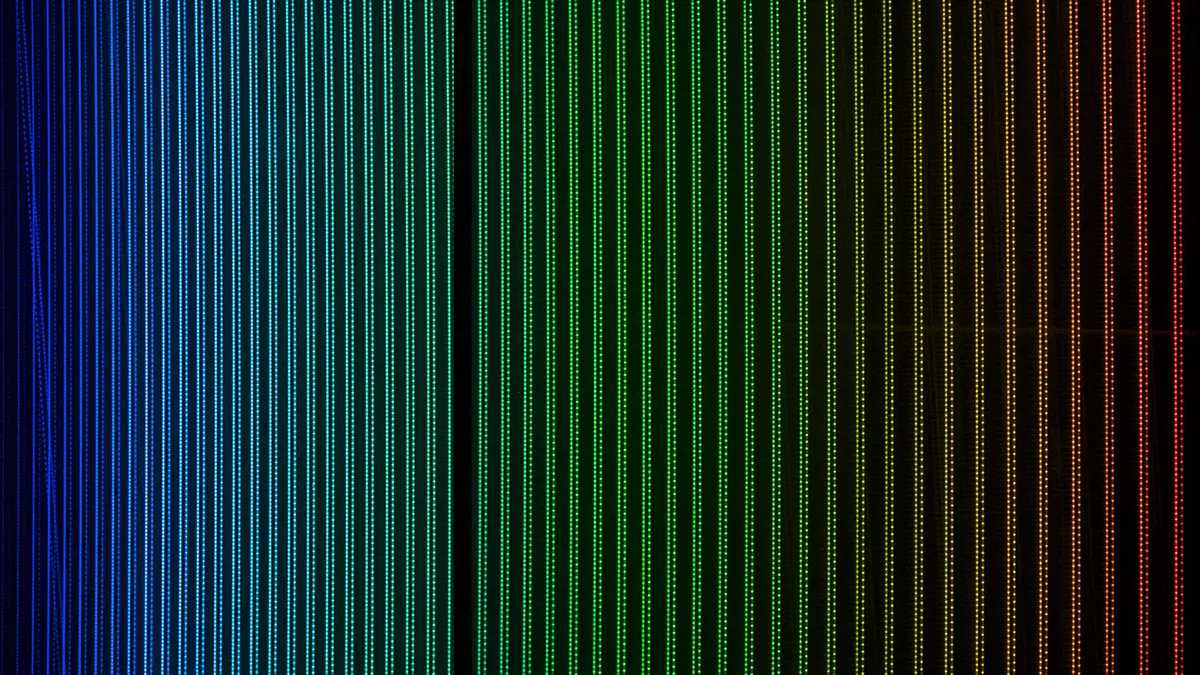
Why in news?
Frequency combs have recently been spotlighted for their role in advancing optical clocks and exoplanet detection. A new laboratory demonstration showed how these devices can link optical frequencies to radio frequencies with unprecedented accuracy.
Background
A frequency comb is a special kind of laser whose spectrum consists of thousands of discrete, evenly spaced frequencies. When plotted on a graph, these frequencies resemble the teeth of a comb. By counting the spacing between the teeth, scientists can measure extremely high optical frequencies using radio‑frequency electronics. The development of frequency combs earned John Hall and Theodor W. Hänsch the Nobel Prize in Physics in 2005.
How they work and applications
- Optical clocks: Frequency combs link optical frequencies to microwave standards, allowing atomic clocks to tick with an accuracy better than one second over millions of years. This accuracy is essential for global positioning systems, telecommunications and fundamental tests of physics.
- Astrophysics: When attached to telescopes, frequency combs calibrate spectrographs with extraordinary precision. They help detect minute shifts in starlight caused by orbiting planets and gravitational fields, enabling the discovery of Earth‑like exoplanets.
- Spectroscopy: Broad‑band frequency combs measure the absorption and emission spectra of molecules in a single shot. This facilitates rapid identification of gases and pollutants.
- Metrology and navigation: Their ability to bridge optical and radio frequencies improves satellite navigation and tests of general relativity.
Conclusion
Frequency combs have revolutionised precision measurement by turning light into a ruler. Their ongoing development promises even more accurate clocks, better navigation systems and new insights into the universe.
Sources: The Hindu