

Why in news?
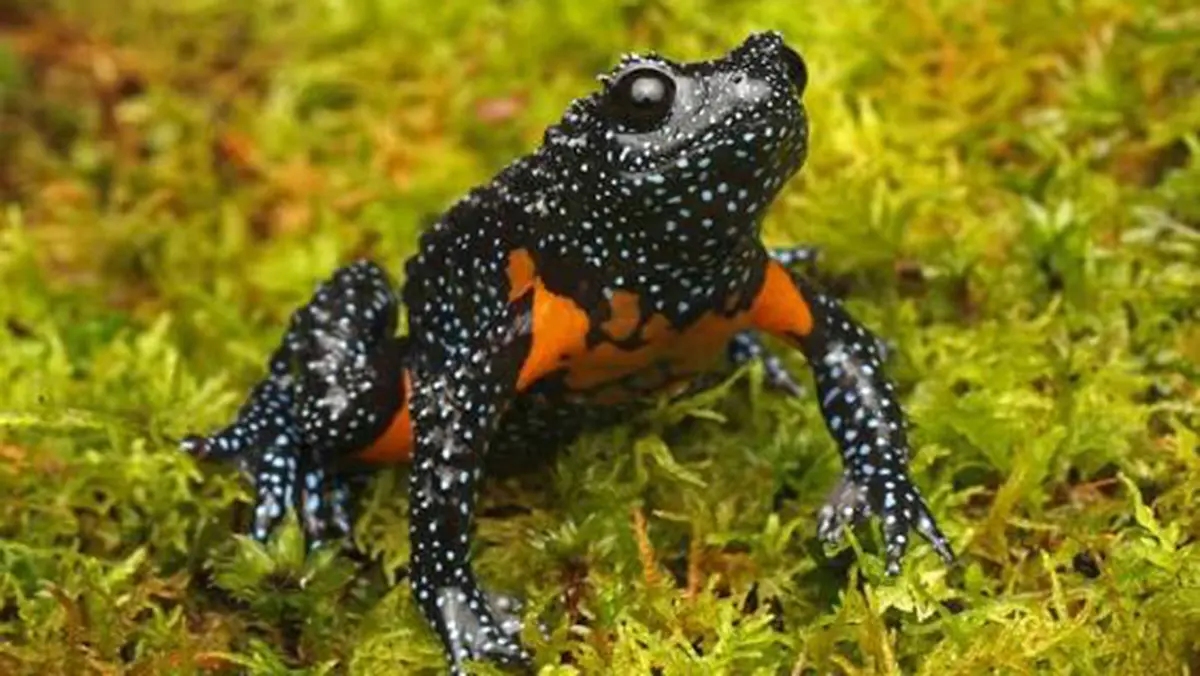
India Today reported on 29 September that Tamil Nadu official Supriya Sahu shared photographs of the galaxy frog. Scientifically named Melanobatrachus indicus, this small amphibian belongs to the southern Western Ghats and has been known to science since 1878. Its striking appearance can draw attention to an animal that is otherwise rarely encountered. But its conservation needs concern the damp forest-floor refuges where it lives, not simply the circulation of attractive images. The International Union for Conservation of Nature’s published global amphibian assessment identifies it as Vulnerable because of habitat loss within a restricted range. This is renewed public attention to an existing species, not the announcement of a newly discovered frog.
A distinctive animal in a restricted landscape
The American Museum of Natural History’s taxonomic reference places the species in the narrow-mouthed frog family, Microhylidae. Its original description was based on material from the Anamalai hills. It remains the only recognised species in its genus, Melanobatrachus. That taxonomic distinctiveness helps explain scientific interest without requiring unsupported claims that it is the world’s oldest or rarest frog.
The species is endemic to the southern Western Ghats, meaning its natural distribution is confined to that region. Records come from Kerala and Tamil Nadu. Its forest habitats occur along a mountainous landscape rather than within one isolated park. State boundaries divide administration, but do not by themselves explain the ecological conditions that make a particular patch suitable for the frog.
Why small refuges matter
A conservation blueprint prepared through the Zoological Society of London documents observations beneath decaying logs in moist forest. These are microhabitats: small places whose shelter, moisture and other conditions can differ from the wider surroundings. A forest may look extensive on a map while particular refuges within it remain limited. Protecting the tree canopy alone is therefore not a complete description of habitat protection.
The blueprint also makes clear how little was known about population size. Many historical records involved only a few individuals, and the absence of sightings was not a reliable census. A secretive animal may remain undetected even where suitable habitat persists. Surveys need repeatable methods and adequate coverage before observers can turn a series of encounters into a defensible estimate of abundance or change.
New records do not automatically mean recovery
A 2023 paper in the Journal of Threatened Taxa added a locality record from Nelliyampathy in Kerala. Researchers encountered two adults during fieldwork in October 2022, beneath rotten logs in a secondary evergreen forest patch. The account improves knowledge of where the species occurs. It also shows why older descriptions based on only a few known localities should not be treated as permanently complete.
A newly documented locality is not necessarily a newly colonised locality. The frogs may have been present before anyone recorded them there. Similarly, a greater number of published records can reflect increased search effort rather than population growth. Distribution research remains valuable, but its meaning depends on what was observed and how the observations were made.
Reading the threat category correctly
Older conservation accounts label the galaxy frog Endangered. The 2022 Red List assessment, cited by the 2023 field paper, instead places it in the Vulnerable category. The global amphibian report published in 2023 also uses Vulnerable. These are different assessment dates, not two current categories that can be used interchangeably. Both terms have a defined meaning within the Red List system.
Vulnerable remains a threatened category, indicating a high risk of extinction in the wild under the applicable criteria. It should not be read as a declaration that conservation work is finished. Nor does a category change alone establish that habitat has recovered. Understanding the reason for a reassessment requires its supporting evidence, while ongoing habitat loss remains a concern identified in the published account.
When observation becomes disturbance
A 2025 study in Herpetology Notes documented a separate concern: disturbance associated with wildlife photography at a monitored site. Researchers described overturned logs and trampled vegetation, followed by unsuccessful searches for frogs in subsequent surveys. They also relayed reports of handling by photographers. This evidence warrants concern, but it does not establish that every missing frog died or that every photograph causes harm.
The authors recommended ethical field practices, including avoiding capture and disruption of microhabitats. That principle follows directly from the animal’s dependence on sheltered forest-floor conditions. Public interest can help conservation when it supports habitat protection and responsible observation. It can work against conservation when finding a photogenic animal becomes a reason to dismantle the refuge that keeps it alive.
Conclusion
The galaxy frog’s conservation story concerns both a distinctive species and the fine-scale habitat that sustains it. Better surveys can improve knowledge of its distribution, while responsible observation can reduce avoidable disturbance. Neither an attractive image nor an isolated sighting demonstrates recovery. The useful outcome of public attention is stronger protection of the conditions in which the animal can continue to live.