

Why in news?
Ganymede has received renewed attention because several observations support a deep ocean beneath its icy surface. Magnetic and auroral measurements provide indirect evidence for a large electrically conducting layer. Spacecraft have also detected salts and organic compounds on parts of the surface. However, those surface materials do not prove a direct pathway to the buried ocean.
A moon larger than a planet
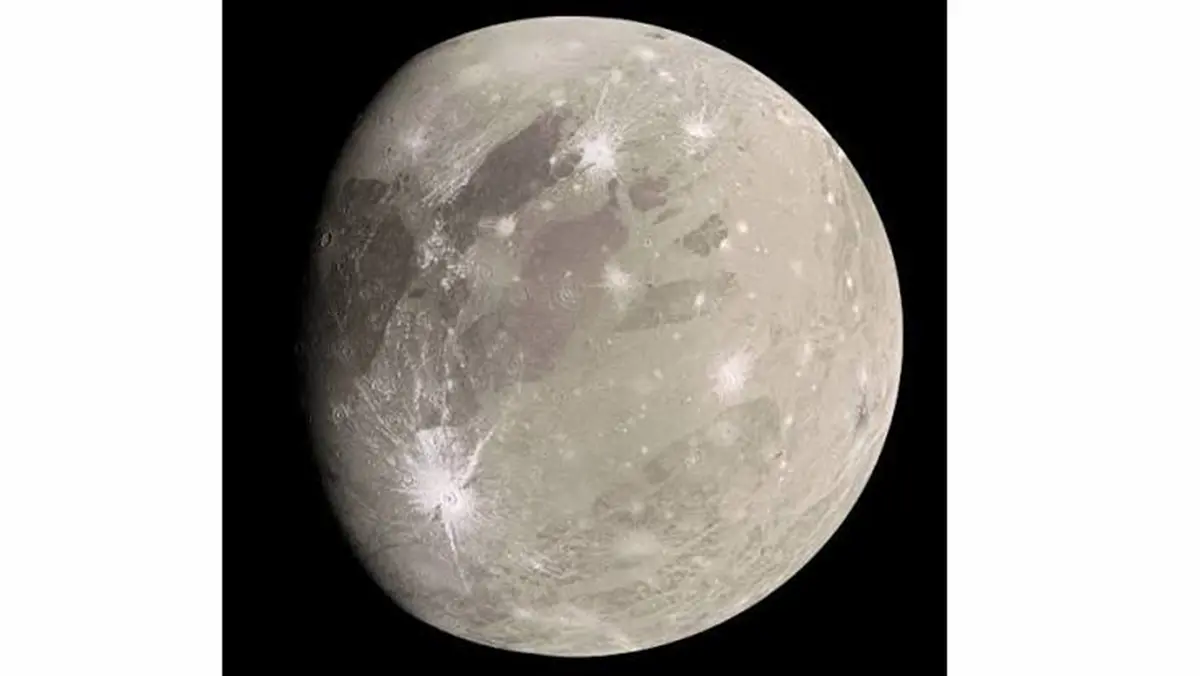
Ganymede is Jupiter's largest moon and the largest moon in the Solar System. Its diameter is about 5,268 kilometres, making it wider than Mercury. It remains less massive than Mercury because much of it is ice. Galileo Galilei observed it with three other large Jovian moons in 1610.
The moon orbits Jupiter at roughly 1.07 million kilometres. It is the third of the four large Galilean moons by distance. Io and Europa orbit closer to Jupiter, while Callisto lies farther away. Their different distances shape radiation exposure and tidal heating.
Ganymede has a mixed surface of bright grooved terrain and darker ancient regions. Impact craters record a long geological history. Faulted grooves show that parts of the crust once stretched and moved. Its extremely thin atmosphere contains oxygen but cannot support breathing.
Evidence for an ocean
Ganymede is the only known moon with its own internally generated magnetic field. Jupiter's much stronger field also changes around it. Measurements by the Galileo spacecraft indicated a secondary induced magnetic response. Salty liquid water below the ice can conduct electricity and produce such a response.
Hubble Space Telescope observations provided another line of evidence. Researchers tracked how ultraviolet auroras moved as Jupiter's magnetic field changed. Their limited rocking matched the damping expected from a conductive ocean. The result strengthened an interpretation already suggested by spacecraft data.
Models commonly place the ocean beneath an outer ice shell around 150 kilometres thick. NASA describes the ocean itself as roughly 100 kilometres deep. These values are estimates rather than direct drilling measurements. Internal layers may also include high-pressure forms of ice.
What surface salts can and cannot tell us
NASA's Juno mission observed mineral salts and organic compounds on Ganymede's surface. The detections came from infrared measurements during a close flyby. Material near the equator may receive some shielding from Jupiter's strongest radiation. This can preserve chemical signatures longer than at exposed latitudes.
Some material may have originated inside Ganymede, but its route remains uncertain. Impacts, ancient geology and local surface alteration can all redistribute compounds. A thick ice shell makes recent ocean exchange difficult to demonstrate. Surface chemistry cannot yet define the modern ocean's composition.
High-pressure ice may separate the ocean from the rocky interior at great depth. Such separation could limit useful chemical reactions between water and rock. Other interior models allow more complicated layered contact. Habitability therefore depends upon structure, heat and chemistry, not liquid water alone.
Why the ocean matters
Ocean worlds allow scientists to study environments beyond Earth's traditional habitable zone. Liquid water, energy and suitable chemistry are basic ingredients for known life. Evidence for them makes a world scientifically compelling. It is not evidence that life actually exists there.
Ganymede also provides a natural laboratory for magnetic interactions. Its small magnetosphere sits inside Jupiter's enormous one. Charged particles interact with its surface, atmosphere and auroras. Studying this system improves understanding of both moons and magnetised planets.
What the JUICE mission will examine
The European Space Agency launched the Jupiter Icy Moons Explorer in April 2023. The mission is commonly known as JUICE. It will study Jupiter, Ganymede, Callisto and Europa after reaching the system. Ganymede is its primary long-term target.
JUICE is planned to enter orbit around Ganymede late in 2034. It would become the first spacecraft to orbit a moon beyond Earth's Moon. Radar will probe icy layers, while other instruments examine gravity, chemistry and magnetic fields. Combined measurements can narrow the possible interior structures.
The mission cannot directly sample an ocean buried beneath such deep ice. It can test predictions from competing models. Repeated close observations may identify thin areas or signs of past exchange. Strong conclusions will require agreement among several instruments.
Conclusion
Ganymede almost certainly hides a major ocean beneath its icy crust. Magnetic and auroral evidence supports that conclusion more strongly than surface colour alone. Important questions remain about depth, layering and contact with rock. JUICE can reduce these uncertainties through sustained measurements. Any discussion of life must remain separate from evidence for water.