

Why in news?
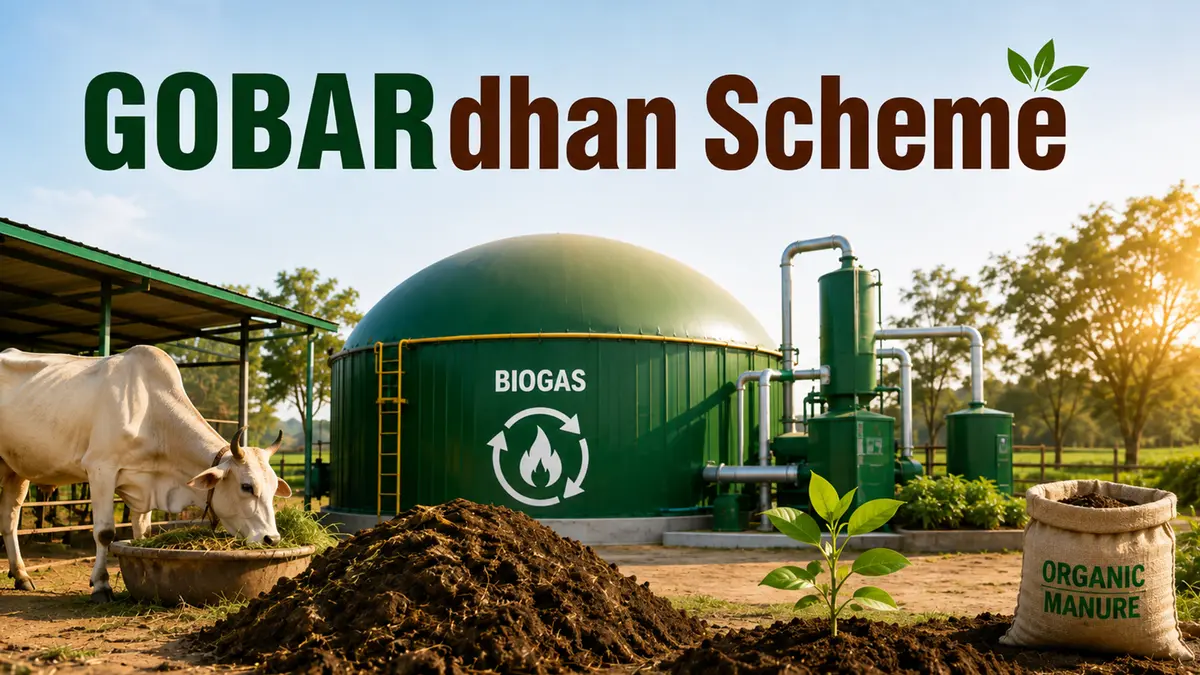
On 6 August 2026, the Union Cabinet approved GOBARdhan as the National Circular Bioenergy Scheme. GOBARdhan means Galvanizing Organic Bio-Agro Resources Dhan; the approved outlay is ₹23,731 crore. The Ministry of Petroleum and Natural Gas will run the scheme from 2026–27 to 2035–36.
It combines demand assurance, pricing and capital support. Pipeline links, credit support and local ecosystem development enter the same compressed-biogas framework.
From decentralised waste management to a national gas market
GOBARdhan began in 2018 under the rural sanitation programme. It sought to convert cattle dung and biodegradable waste into biogas and manure. It gradually became an umbrella for several ministries’ programmes; these included the Sustainable Alternative Towards Affordable Transportation initiative.
Other supports covered fermented organic manure markets and biomass-aggregation machinery. Pipeline infrastructure and National Bioenergy Programme finance were also linked.
Microorganisms produce biogas by breaking down organic material without oxygen. The raw gas contains methane, carbon dioxide and smaller gas fractions.
Processing removes carbon dioxide, moisture and contaminants to the required standard; the methane-rich product becomes compressed biogas, or CBG. The Cabinet release calls CBG chemically equivalent to natural gas; it can therefore enter the existing gas ecosystem.
Possible feedstocks include cattle dung and farm residue. Sugar-mill press mud and segregated municipal organic waste are other sources.
The government says over 200 CBG plants were commissioned before this approval. The 2026 scheme is not India’s first biogas programme.
Its importance lies in combining separate forms of support. Earlier projects faced uncertain buyers, volatile revenue and high initial costs. Scattered feedstock and weak credit created further barriers. Some plants also stood far from gas networks.
The six-part architecture
| Component | What the Cabinet release provides | Policy purpose |
|---|---|---|
| Assured offtake | City-gas entities will procure CBG towards a rising obligation. It is 3 per cent in 2026–27 and 4 per cent in 2027–28. It reaches 5 per cent from 2028–29. The obligation covers transport compressed natural gas and domestic piped natural gas. | Create predictable demand and improve plant utilisation. |
| Stable price | An administered price of ₹2,110 per million British thermal units will apply. The government-backed horizon is at least ten years. | Give lenders and producers longer revenue visibility while sharing costs. |
| Capital assistance | Eligible greenfield projects may receive up to ₹2 crore per tonne of daily CBG capacity. Qualifying brownfield expansion and value-chain assets also receive support. | Reduce the initial financing burden. |
| Pipeline infrastructure | Support for cluster-based and standalone connections to trunk pipelines and city gas networks. | Lower the cost and difficulty of moving gas to buyers. |
| Credit guarantee | A dedicated mechanism for eligible micro, small and medium enterprise-based projects. | Share lender risk and widen access to institutional credit. |
| Ecosystem Challenge Fund | District-level resource mapping, aggregation infrastructure, planning, technology improvement, manure value addition, training and awareness. | Develop the local system around a plant, not only the digester. |
Potential benefits—and the conditions attached to them
Domestic biomethane can replace part of fossil natural-gas demand. Potential uses include transport, households and industry. Anaerobic digestion can capture methane from decomposing manure or food waste; this offers a waste-management benefit.
Farmers and local enterprises may earn by supplying dung and residue. Processed digestate can enter fertiliser markets.
The strongest projects deliver several results together; they provide clean waste management, dependable gas, safe manure and local income.
Those benefits are not automatic; a plant needs reliable and segregated feedstock every day. Crop residue is seasonal and bulky. Municipal organic waste often contains plastic, metal and inert material.
Cattle dung may already serve local fuel or soil needs. Long transport can erase financial and environmental gains.
District mapping should test competing uses and seasonal supply; it should also measure moisture, collection costs and distance to buyers.
Methane leakage creates another major condition. Leaks can occur during feedstock handling, digestion, upgrading and digestate storage. The International Energy Agency warns that leakage can weaken the climate benefit. At high levels, it may eliminate that advantage.
Standards should require gas-tight equipment and covered digestate storage; they also need measurement, leak detection and repair.
Unavoidable off-gas requires safe flaring or oxidation. Public reporting should disclose methane intensity, because output alone is an incomplete measure.
Digestate and manure markets need quality control. Poor stabilisation or mixed-waste contamination can shift pollution into soil and water. Excess nutrients and unsafe storage create similar risks. Product testing, traceability and agronomic guidance can build farmer confidence.
Siting decisions must also examine water use, odour and traffic. Local communities need honest information and meaningful consultation.
Governance and distribution
A unified design reduces fragmentation; it also concentrates discretion over prices, eligibility and project approval. Government should show how the ₹23,731-crore outlay is divided. Each of the six components needs a transparent allocation.
The administered price formula also needs disclosure. Citizens should know who bears the market-based share of support.
Rules must address shortfalls by city-gas entities. Competitive procurement and milestone-based assistance can reduce the risk of stranded assets.
Public performance data would expose plants that remain idle; it would also help distinguish good projects from announced capacity. Formal eligibility alone will not secure participation by cooperatives and women’s groups. Small rural enterprises face the same limitation.
Large developers may control finance, technology and gas contracts. Small suppliers can still carry most feedstock risk.
Model contracts and prompt digital payments can improve fairness. Weighing and quality rules must be transparent.
Grievance channels and aggregation support are also necessary; they can share value with the people supplying organic material.
Conclusion
GOBARdhan’s redesign addresses several CBG barriers within one framework; a substantial ten-year outlay supports the effort. Success is not announced capacity; it means dependable gas, safe waste diversion, low leakage, useful digestate and fair local income.