

Why in news?
Carnegie Mellon University researchers have reported an unusual Hall response in an ultrathin layered device. The team paired a topological semimetal with a ferromagnetic insulator. It detected a transverse electrical signal linked with magnetisation lying within the material’s plane. The result could support compact sensors that measure more than one magnetic-field direction.
The ordinary Hall effect
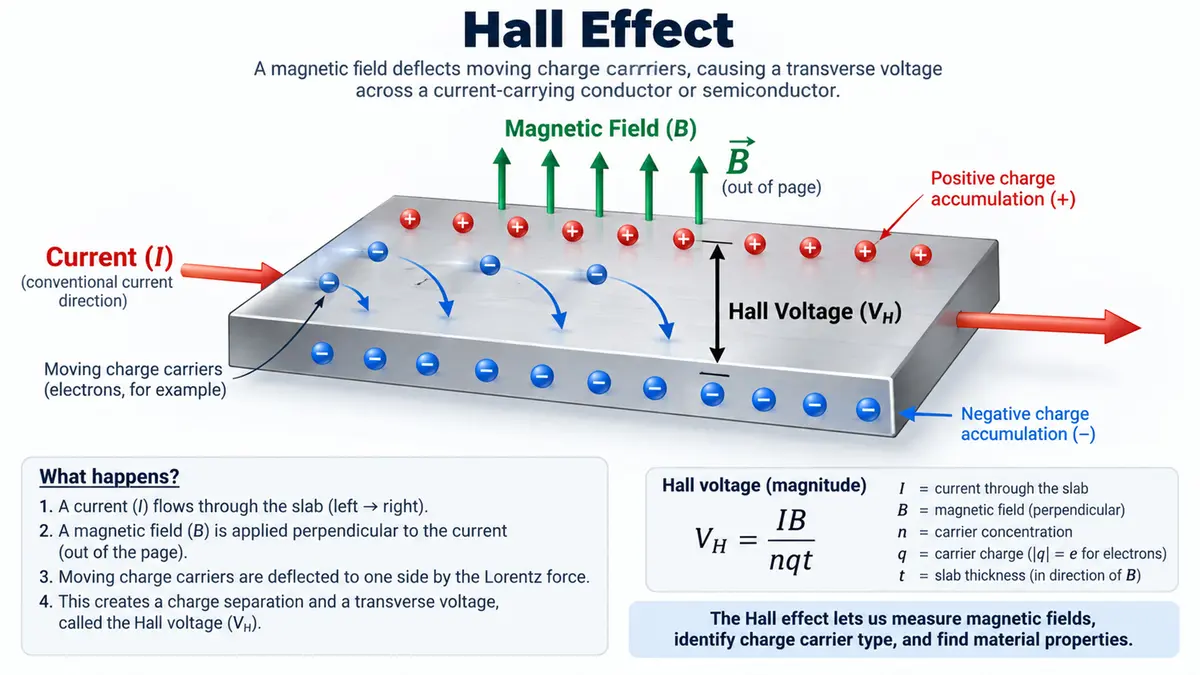
Edwin Hall discovered the effect in 1879. A current-carrying conductor is placed within a perpendicular magnetic field. Moving charge carriers experience a sideways Lorentz force. Charge then gathers along one edge and produces a measurable transverse voltage.
The voltage reveals whether positive or negative carriers dominate conduction. Its size can help estimate carrier density and mobility. Hall measurements are therefore standard tools in material research. Hall sensors also measure position, speed and magnetic fields in everyday devices.
The conventional geometry has a clear limitation. The magnetic field must contain a component perpendicular to the conducting plane. A purely in-plane field produces little ordinary Hall voltage. Measuring several directions normally needs multiple sensors or a three-dimensional arrangement.
What makes the anomalous version different?
Magnetic materials can show an anomalous Hall effect without the same external-field geometry. Magnetisation and spin-orbit interactions influence electron motion inside the material. The electronic band structure can also carry a geometric property called Berry curvature. These effects can generate an additional transverse voltage.
Symmetry determines which responses are permitted. A highly symmetric crystal can force some electrical terms to cancel. Lowering that symmetry may reveal a previously forbidden signal. The new experiment used this principle within a carefully chosen heterostructure.
A heterostructure joins thin layers of different materials. Their interface can display properties missing from either layer alone. Electrons in one layer feel magnetism or electric fields from its neighbour. This proximity effect avoids mixing both materials into one bulk crystal.
How the new device works
The conducting layer was tantalum iridium telluride, written as TaIrTe4. It is a low-symmetry topological semimetal only a few layers thick. The magnetic neighbour was chromium germanium telluride, written as Cr2Ge2Te6. This second material is a ferromagnetic insulator.
Magnetic proximity induced a response within the TaIrTe4 layer. Its low crystal symmetry allowed sensitivity to in-plane magnetisation. The same device retained a conventional response to perpendicular magnetisation. Researchers could therefore separate signals associated with different field components.
The team fabricated several devices and adjusted them with an electric gate. Changing gate voltage altered carrier conditions and the measured Hall signal. Repetition across devices strengthened the result. It reduced the chance that one contact defect produced the observation.
Why the result matters
An ultrathin sensor that measures several field directions could simplify magnetic mapping. Possible applications include robotics, navigation, medical instruments and compact electronics. Such systems often need vector information rather than field strength alone. Fewer separate sensing elements could reduce size and alignment errors.
The work also tests theories of topology and symmetry in real materials. Unusual transport can reveal how electrons respond collectively. Gate control offers another way to tune that behaviour. These insights matter even before a commercial sensor exists.
However, the experiment remains laboratory research. Chromium germanium telluride has a low magnetic ordering temperature. The detailed microscopic mechanism also needs further study. Room-temperature operation, durability and scalable fabrication have not been demonstrated here.
How to read the claim carefully
The researchers describe an in-plane anomalous Hall effect. They have not reversed the basic laws behind the ordinary effect. Instead, quantum and magnetic interactions create an additional permitted response. The distinction prevents a striking headline from becoming a misleading physics claim.
The paper appeared in Nature Materials on 28 August 2026. The university explained its implications publicly in late August. Peer review supports the experimental record. Independent reproduction will still be important for a new device concept.
Conclusion
The new heterostructure broadens the directions accessible through one Hall device. Low symmetry and magnetic proximity are central to the result. The experiment advances both sensor design and fundamental electronic research. It does not yet establish a room-temperature commercial technology. Further replication and materials development will determine its practical value.