

Why in news?
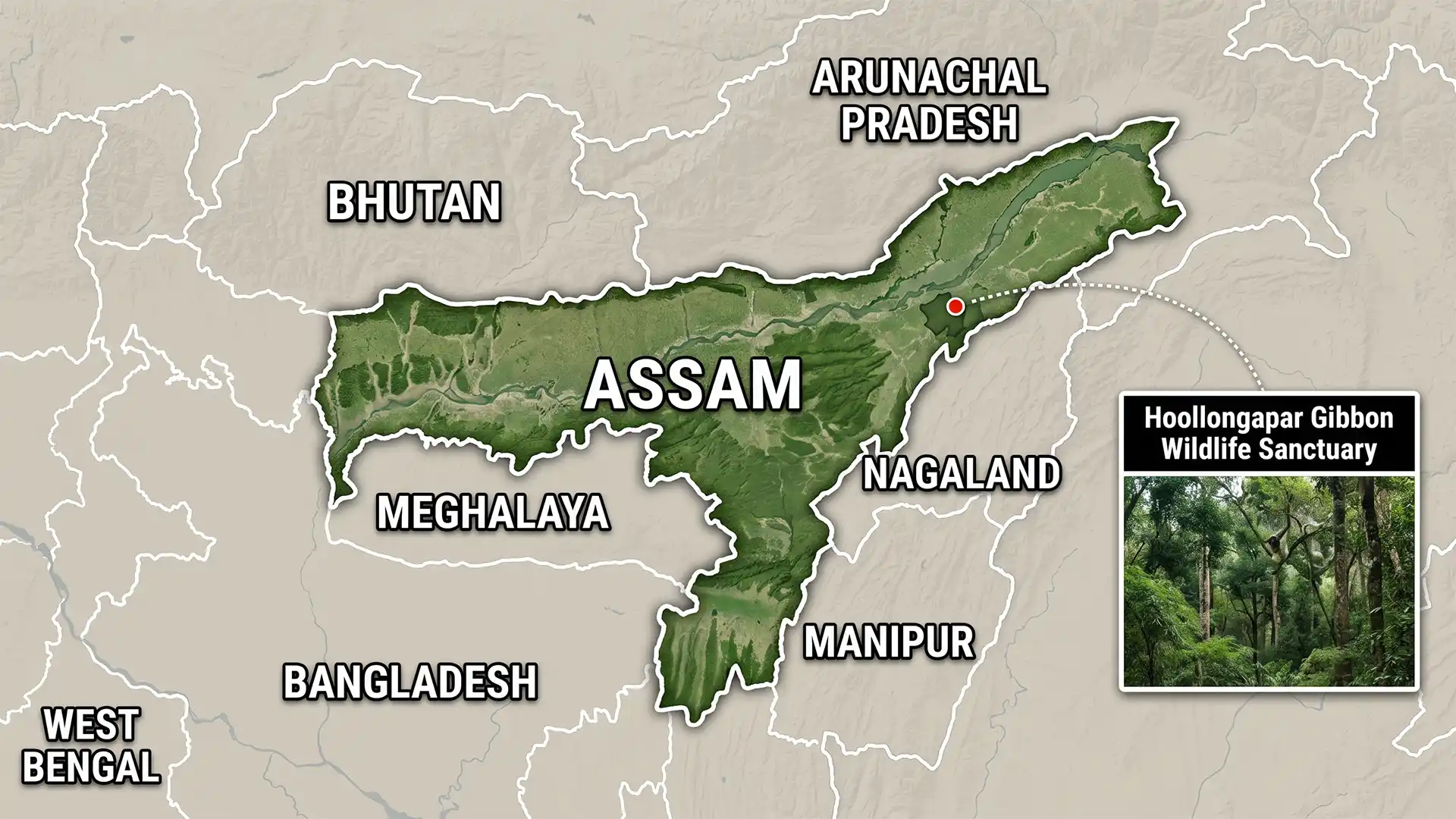
A new field guide records 281 butterfly species from this Assam sanctuary. Researcher Sarangapani Neog surveyed the forest between 2012 and 2024. The updated book provides photographs and identification information. The inventory highlights the sanctuary’s exceptional diversity despite its small, isolated area.
Background
The sanctuary covers about 20.98 square kilometres within eastern Assam’s Jorhat district.
Surrounding tea gardens, villages and farms make the natural forest resemble an ecological island.
British authorities created the reserve in 1881, before later additions joined nearby forest blocks.
Assam declared it a wildlife sanctuary in 1997 and adopted the gibbon-linked name in 2004.
“Hoollongapar” also refers to hollong, a prominent tree within the upper forest canopy.
Why is the sanctuary nationally special?
Gibbons are India’s only apes and differ from monkeys because they lack tails.
The sanctuary protects western hoolock gibbons, which are classified as Endangered.
The Wildlife Institute of India identifies two important national distinctions.
- It is India’s only protected area named after a primate.
- It has India’s highest primate diversity among protected areas.
This compact forest has seven primates, including western hoolock gibbons and Bengal slow lorises.
Five others include capped langurs and Assamese, rhesus, stump-tailed and northern pig-tailed macaques.
Size clarification: Hoollongapar is a very small sanctuary, but it is not Assam’s smallest. Official protected-area records list several Assam sanctuaries with smaller notified areas.
What kind of forest does it contain?
Assam’s tropical evergreen and semi-evergreen vegetation includes tall hollong trees within its upper canopy.
Nahar trees occupy lower layers, while climbers, shrubs and ground vegetation create smaller habitats.
This layered forest supports many animals, while gibbons spend almost their entire lives within its canopy.
Their long arms support rapid branch-to-branch movement, which is called brachiation.
Continuous canopy cover is therefore essential for safe movement.
What did the butterfly survey establish?
The 281-species photographic guide updates an earlier edition after twelve years of repeated field observations.
A 2015 study recorded 211 species, but the higher new total does not prove sudden population growth.
Longer surveys find overlooked seasonal species, while taxonomic revisions can also change totals.
The book creates a better baseline for identifying future additions, losses and seasonal changes.
Records depend on season, rainfall, sunlight, observer effort and access to different forest layers.
Researchers should repeat standard routes and timings before comparing abundance between two years.
Photographs support verification, but difficult species may still need morphological or genetic examination.
Why are butterflies useful for conservation?
- Many species depend on particular plants during their caterpillar stage.
- Adults react quickly to changes in light, moisture and temperature.
- Short life cycles can reveal environmental changes relatively quickly.
- Some adults pollinate plants while feeding on nectar.
- Larvae and adults support birds, spiders and other predators.
- Repeated counts can show changes in habitat quality.
A long list cannot prove healthy populations without abundance, distribution and long-term trend information.
Why does forest fragmentation threaten gibbons?
A railway crossing the forest since the nineteenth century divides it into two unequal sections.
Roads and farms create more gaps, while gibbons usually avoid descending to the ground.
Open gaps can separate families, restrict food access and reduce breeding opportunities between isolated groups.
Moving trains create collision risks for animals crossing at low height.
Canopy bridges provide safer links, but they must complement habitat restoration and careful transport planning.
Bridges work best along crossing routes that resident gibbon families already use.
Monitoring cameras can confirm animal use and reveal whether each bridge needs design changes.
What conservation actions are needed?
- Native trees should gradually reconnect broken forest canopy sections.
- Railway operations need wildlife-sensitive speed and monitoring measures.
- Butterfly surveys should repeat the same seasonal methods.
- Nearby tea gardens can reduce pesticides along forest edges.
- Local communities need lasting benefits from successful habitat protection.
- Illegal felling and hunting require continuous field enforcement.
Prelims points: The sanctuary is in Jorhat district, Assam. It protects western hoolock gibbons within the Brahmaputra Valley’s evergreen and semi-evergreen landscape.
Conclusion
The butterfly record strengthens the case for reconnecting and protecting this remarkable forest island.