

Why in news?
During a visit to Berlin, Indian Defence Minister Rajnath Singh addressed a group of German parliamentarians and called for deeper defence‑industrial partnerships between India and Germany. He invited German companies to co‑create, co‑develop and co‑innovate with Indian industry under the “Aatmanirbhar Bharat” initiative.
Background
On 21 April 2026, as part of a three‑day visit to Germany, the Raksha Mantri met the German Parliamentary Standing Committee on Defence and Security. He stressed that both countries face complex and interconnected security challenges requiring coordinated responses and trusted partnerships. Singh said that India’s start‑ups and private firms were rapidly expanding their capabilities and could complement Germany’s large companies and Mittelstand (small and medium enterprises). He highlighted India’s proactive strategy to manage geopolitical instability, such as disruptions in West Asia, through inter‑ministerial coordination to safeguard energy supplies and control inflation.
Germany – a geographical overview
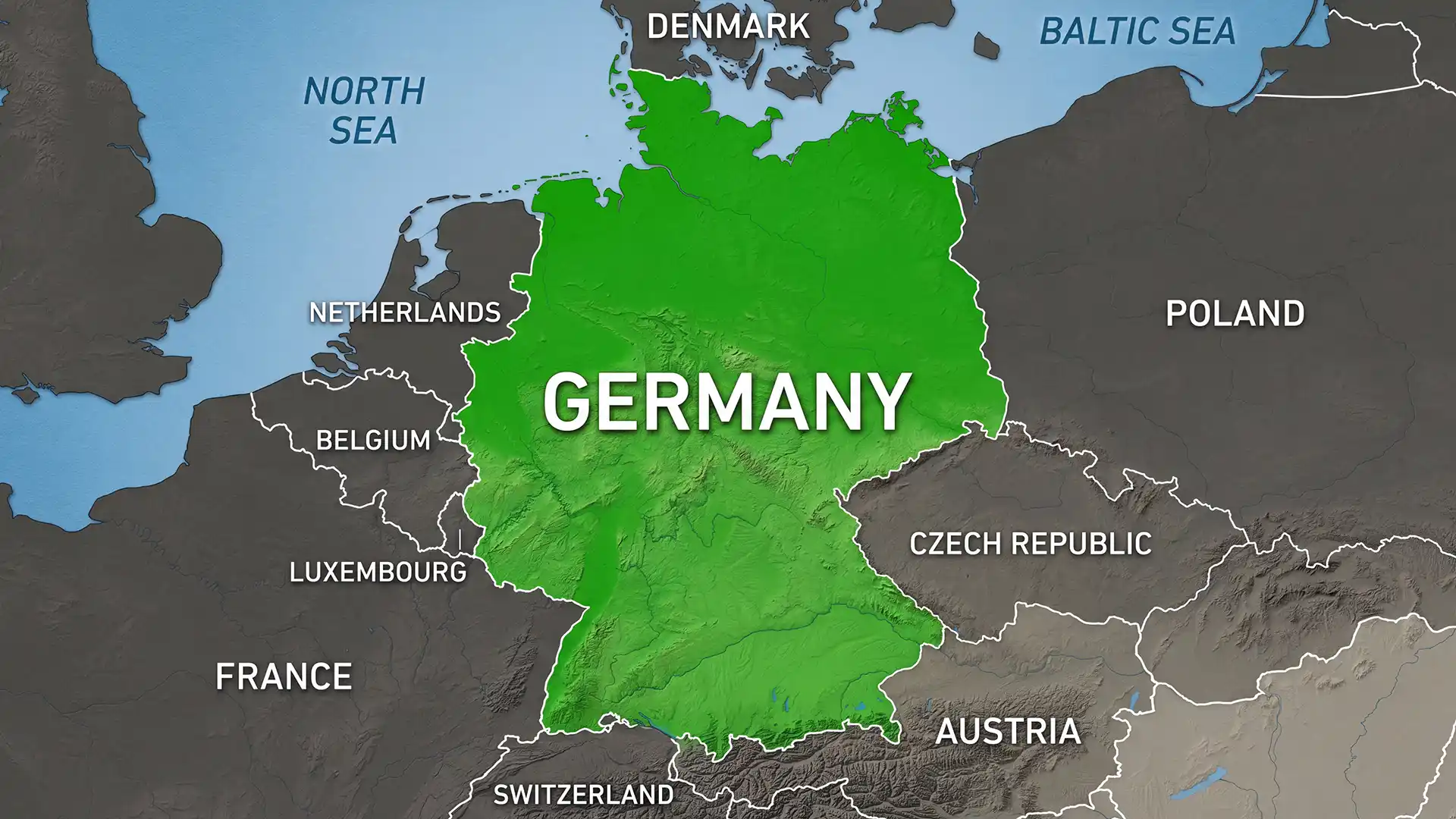
- Location and neighbours: Germany lies in central Europe. It is bordered by Denmark to the north, Poland and the Czech Republic to the east, Austria and Switzerland to the south, and France, Luxembourg, Belgium and the Netherlands to the west.
- Maritime boundaries: The North Sea borders Germany’s northwest, while the Baltic Sea lies to its northeast.
- Capital and climate: Berlin is the capital. The country generally enjoys a temperate climate with warm summers and cold winters.
- Major landforms: The Alps and Bavarian highlands dominate the south. Other notable features include the Central Uplands (Mittelgebirge) and the flat North German Plain.
- Rivers and lakes: Important rivers are the Rhine, Elbe and Danube. Lake Constance, shared with Austria and Switzerland, is the largest freshwater lake.
- Natural resources: Germany possesses lignite, coal, natural gas, iron ore, copper, nickel, potash and uranium, which support its industrial base.
Significance
Germany is an economic powerhouse and a key player in the European Union. Stronger defence and industrial ties with Germany could accelerate technology transfer, innovation and manufacturing in India while offering German firms opportunities to access India’s growing market. Enhanced cooperation also aligns with India’s goal of self‑reliance in defence production.
Source: Press Information Bureau