

Why in news? India and Greece are exploring deeper economic ties, particularly in financial services, fintech and digital payments. Understanding the geography and history of Greece helps contextualise this cooperation.
Background
The Hellenic Republic of Greece lies on the southern tip of the Balkan Peninsula in southeastern Europe. It won independence from the Ottoman Empire in 1830 and became a kingdom. After a turbulent 20th century marked by wars, occupation, civil conflict and military rule, Greece abolished the monarchy and became a parliamentary republic in 1974. It joined the European Community (now the European Union) in 1981 and the euro currency union in 2001. The country endured a severe debt crisis from 2009 to 2018 but has since stabilised its economy.
Geographical features
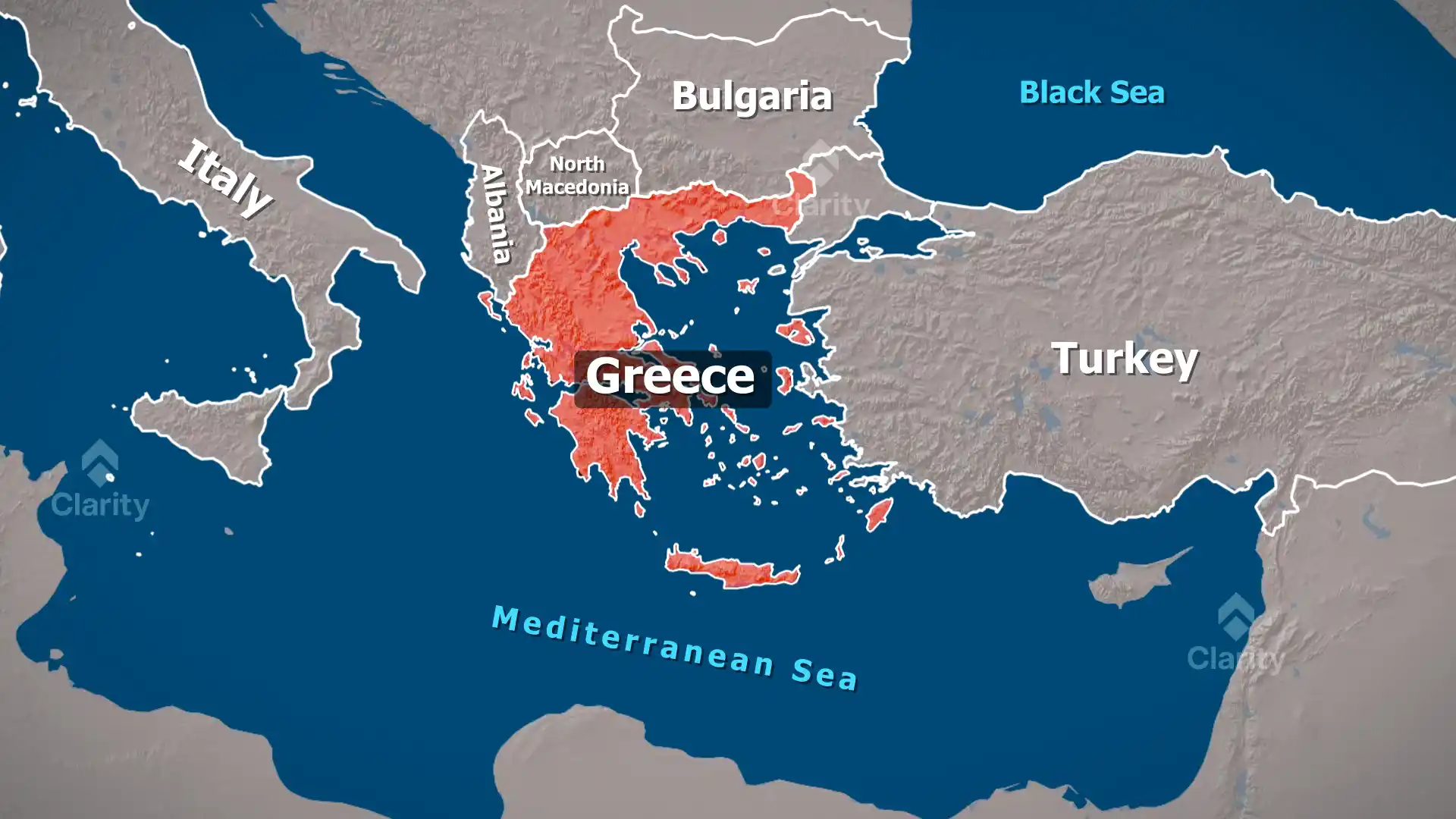
- Location and borders: Greece is bounded by the Ionian Sea to the west, the Aegean Sea to the east and the Mediterranean Sea to the south. It shares land borders with Albania, North Macedonia, Bulgaria and Turkey.
- Terrain: Approximately four‑fifths of Greece is mountainous or hilly. The Pindus range extends from north to south, forming deep gorges such as the Vikos Gorge, which plunges about 1,100 m. The highest point is Mount Olympus at 2,917 m.
- Coastline and islands: Greece has one of Europe’s longest coastlines at 13,676 km. It includes thousands of islands, of which around 200 are inhabited. The islands divide the Ionian and Aegean seas into numerous gulfs and straits.
- Climate: Most of Greece experiences a Mediterranean climate with hot, dry summers and mild, wet winters.
- Natural resources: Greece’s resources include lignite (brown coal), petroleum, iron ore, bauxite, nickel, marble and hydropower potential.
Economy and partnerships
Greece’s economy relies heavily on shipping, tourism, agriculture and services. In recent years the country has sought to diversify by promoting technology and financial services. For India, Greece offers opportunities in ship‑building, ports, digital payments and renewable energy. Enhanced cooperation could include UPI‑based remittances, joint fintech ventures and partnerships in maritime logistics.
Conclusion
Greece’s strategic location between Europe, the Middle East and Africa, coupled with its recovering economy, makes it an attractive partner for India. Deeper engagement in finance and technology could benefit both countries and strengthen ties beyond traditional sectors like shipping and tourism.
Sources: NOA