

Why in news?
India and Italy discussed closer tourism cooperation at their second Joint Working Group meeting on 29 September 2026. The talks covered film-linked tourism, partnerships between destinations, skills, tourism data and business connections. Such a working group provides a channel for officials to turn broad bilateral ambitions into practical tasks. The two sides agreed on technical groups and designated contact points, while a 2027 Year of Culture and Tourism remained a proposal. Italy’s varied landscape makes the cooperation wider than promotion of a few famous cities: mountain, coastal and cultural destinations have different needs. The meeting created a basis for follow-up; it did not itself establish new travel services or prove an increase in visitor numbers.
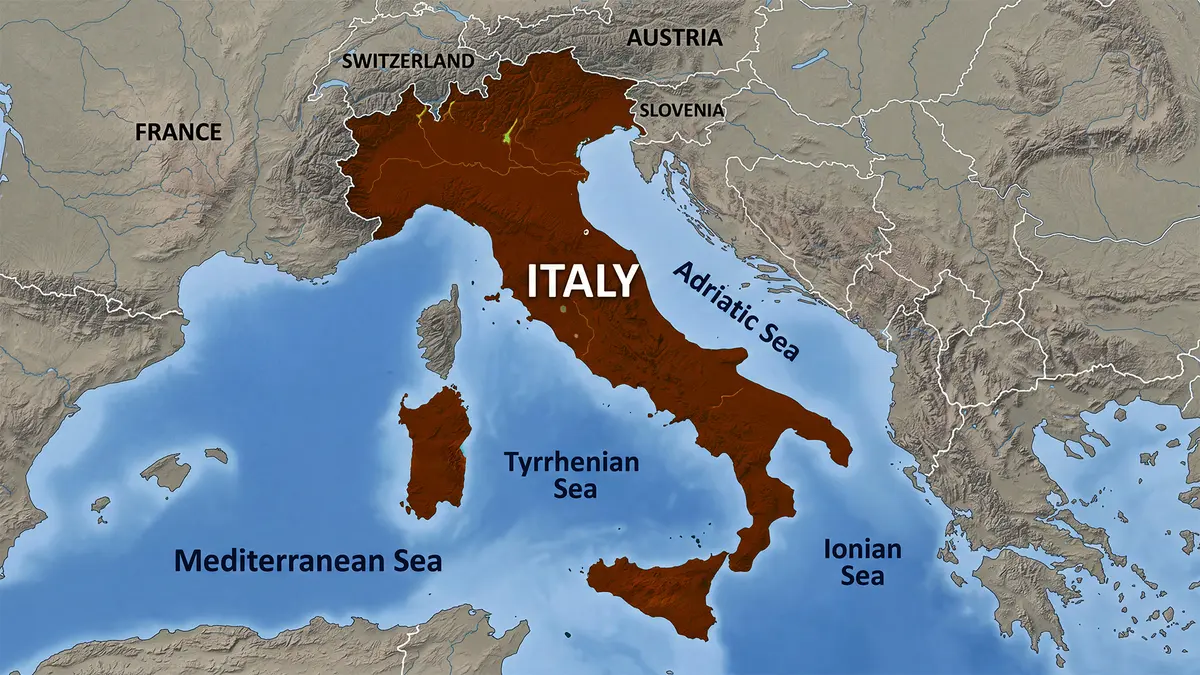
Locating Italy and all its land neighbours
Italy lies in southern Europe, with a long peninsula extending into the Mediterranean Sea. Its northern land neighbours are France, Switzerland, Austria and Slovenia, from west to east. Two additional sovereign states, San Marino and Vatican City, are enclosed by Italian territory. Vatican City lies within Rome, Italy’s capital. Counting only the northern boundary therefore leaves the country’s land-neighbour list incomplete.
The surrounding waters are parts of the Mediterranean, not separate oceans. The Adriatic lies east of the peninsula, the Ionian towards its south, and the Tyrrhenian and Ligurian seas to the west. Sicily lies beyond the peninsula’s southern end, while Sardinia lies farther west. These islands and long coastlines connect Italy with maritime routes as well as its continental neighbours.
Mountains, plains and a major river
The Alps form the great mountain arc along northern Italy. South of them lies the Po Valley, while the Apennines extend down the peninsula. This is not one uniform physical region. Alpine valleys, a broad northern plain, mountain corridors and coastal settlements create different conditions for transport, farming and tourism. A route that appears short on a map may cross terrain that makes travel less straightforward.
The Po flows across northern Italy to the Adriatic Sea and is the country’s longest river. The Italian Space Agency describes its delta as an important wetland and agricultural landscape. Its drainage links the northern mountains and plain with the coast. That connection is useful for understanding Italy beyond its outline: water, settlement and economic activity are organised around physical systems, not merely administrative regions.
The European Space Agency’s observations also show how the enclosing mountains influence conditions in the Po Valley. Weak air movement and temperature inversions can trap pollution over the plain. An inversion occurs when warmer air overlies colder air near the surface, limiting vertical mixing. This example illustrates why the same country can contain distinct environmental challenges alongside its different tourism attractions.
What the cooperation terms mean
Film-linked tourism concerns interest in places seen on screen. A destination partnership can involve exchanging practical experience about visitor services or promotion. These are possible areas of cooperation, not proof that any particular location will receive a surge of tourists. The official meeting account identifies the themes; the details of projects and their results depend on subsequent work by the participants.
The useful implementation question is what a partnership changes for visitors and local communities. For example, shared training could be assessed through the service it improves, rather than only the number of meetings held. Better tourism data could help participants understand patterns of demand. These are ways to evaluate future work, not outcomes already demonstrated by the September discussion.
Matching promotion to the destination
Italy’s official tourism material presents mountain areas, historic settlements, coastal landscapes and regional experiences as different parts of its offer. That diversity makes destination-specific planning more useful than a single promotional formula. A mountain route requires different access arrangements from an urban museum visit. A coastal destination faces different seasonal pressures from a year-round city attraction.
For bilateral cooperation, this suggests a practical sequence: identify the destination and its problem, choose a suitable partner, and specify the work. Promotion should be connected with the ability to welcome visitors and protect the place they came to see. Otherwise, additional attention can arrive before suitable services. This is an implementation consideration, not a claim that the working group has already solved those challenges.
Conclusion
The India–Italy meeting provides an organised route for further tourism cooperation, with technical follow-up agreed and a cultural year proposed. Italy’s borders, seas, mountains and river plains explain why that cooperation needs to be specific to destinations. Its success should be judged through completed projects and useful services, rather than treating a joint discussion as a completed expansion of tourism.