

Why in news?
India and Kuwait held their inaugural Joint Defence Committee meeting in New Delhi. The meeting took place on 28 August 2026. Both sides discussed training, exercises, medicine, industry and research. The new committee begins practical work under their 2024 defence cooperation agreement.
What happened at the first meeting
The Joint Defence Committee, or JDC, provides a formal channel for defence cooperation. Joint Secretary Amitabh Prasad co-chaired the Indian side. Brigadier General Raed Alsakran led Kuwait’s five-member delegation. Representatives of India’s three armed services joined the discussions.
The Indian delegation also included the Department of Defence Production. The Defence Research and Development Organisation, or DRDO, participated. The Armed Forces Medical Services and Ministry of External Affairs were represented. This composition allowed policy, operations, technology and health matters to be considered together.
The Kuwaiti delegation visited the National War Memorial in New Delhi. It also met representatives of India’s defence industry at their official centre. Defence public sector companies use that facility for industry engagement. These meetings explored possible cooperation without announcing contracts.
How the committee was created
India and Kuwait signed a Memorandum of Understanding on Defence Cooperation in December 2024. The document accompanied the Indian Prime Minister’s visit to Kuwait. The wider relationship was upgraded to a strategic partnership during that visit. The JDC now gives the memorandum an institutional mechanism.
A committee can turn broad promises into an annual work programme. It can identify exercises, training slots and staff contacts. It can also review delayed activities. Regular meetings reduce dependence on occasional high-level visits.
Areas of cooperation
Training can include professional military courses and exchanges between specialised institutions. Exercises can improve communication and operating familiarity. Military medicine covers trauma care, health systems and field support. Staff talks allow services to discuss practical requirements directly.
Defence industry cooperation may cover equipment, maintenance or supply chains. Research and development can involve institutions or companies from both countries. Every technology transfer will still require separate approvals. The committee does not remove export controls or procurement rules.
Maritime security is a natural area for dialogue. Kuwait’s economy relies heavily on Gulf shipping and energy infrastructure. India also depends on secure sea lanes for trade and energy. Cooperation can support awareness and resilience without creating a military alliance.
Kuwait’s geographic setting
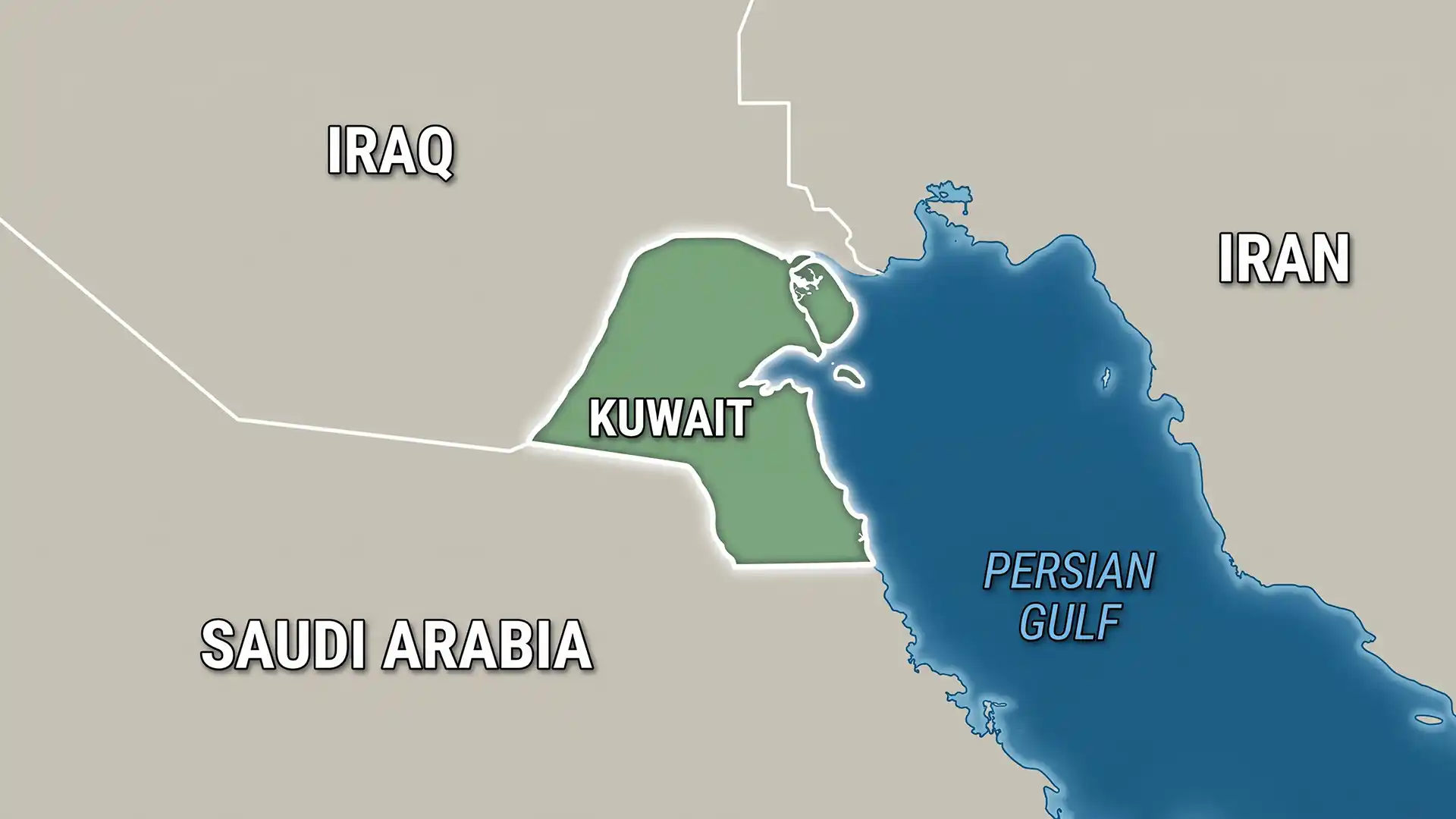
Kuwait lies at the north-western end of the Arabian Gulf. Iraq borders it to the north and north-west. Saudi Arabia lies to the south and south-west. The Gulf forms its eastern maritime frontage.
The country covers about 17,818 square kilometres. Much of its land is low, arid and desert-like. Kuwait City and major ports face the Gulf. This position made maritime trade important long before the modern oil economy.
Kuwait sits close to southern Iraq and the approaches to important Gulf energy routes. It also shares a maritime neighbourhood with Iran. Regional tensions can therefore affect shipping, air defence and energy security. Geography gives a small state substantial strategic importance.
The wider India–Kuwait relationship
India established diplomatic relations with Kuwait in 1962, soon after Kuwaiti independence. Older links developed through pearl, date and textile trade. The Indian rupee circulated there before 1961. Maritime contact across the Arabian Sea supported these exchanges.
Energy, trade and the Indian community now anchor the relationship. Kuwait has supplied crude oil and petroleum products to India. Indian professionals and workers support many Kuwaiti sectors. Their welfare and consular protection remain important bilateral concerns.
Defence cooperation adds a security layer to these economic and social ties. It can improve institutional familiarity during regional crises. However, cooperation should remain transparent about its scope. Strategic partnership does not mean identical policies on every regional issue.
What to watch next
The first meeting mainly created direction. Measurable results will come from scheduled courses, exercises and staff exchanges. Industry discussions should be followed through ordinary procurement and licensing processes. Public statements should distinguish exploration from signed agreements.
Future meetings can review maritime security and emergency coordination. Military medical exchanges could produce early practical gains. Research cooperation may take longer because technology rules are stricter. A regular calendar would make the committee more credible.
Institutional cooperation is not a procurement announcement
The meeting discussed industry and research opportunities. It did not identify a signed weapons contract. Any purchase or technology transfer will need separate legal and commercial decisions.
Conclusion
The inaugural JDC gives India–Kuwait defence ties a regular working structure. Its agenda fits the two countries’ Gulf and Indian Ocean interests. Training and medicine can produce useful early cooperation. Industry plans must pass normal scrutiny and export rules. Consistent follow-through will decide whether the committee becomes strategically meaningful.