

Why in news?
Minister of State Jitin Prasada visited Morocco on 24 and 25 August. He co-chaired the seventh India–Morocco Joint Commission with Morocco’s Omar Hejira. Both sides agreed to seek doubled bilateral trade within five years. They also signed arrangements on food safety and cultural exchanges.
Where Morocco lies
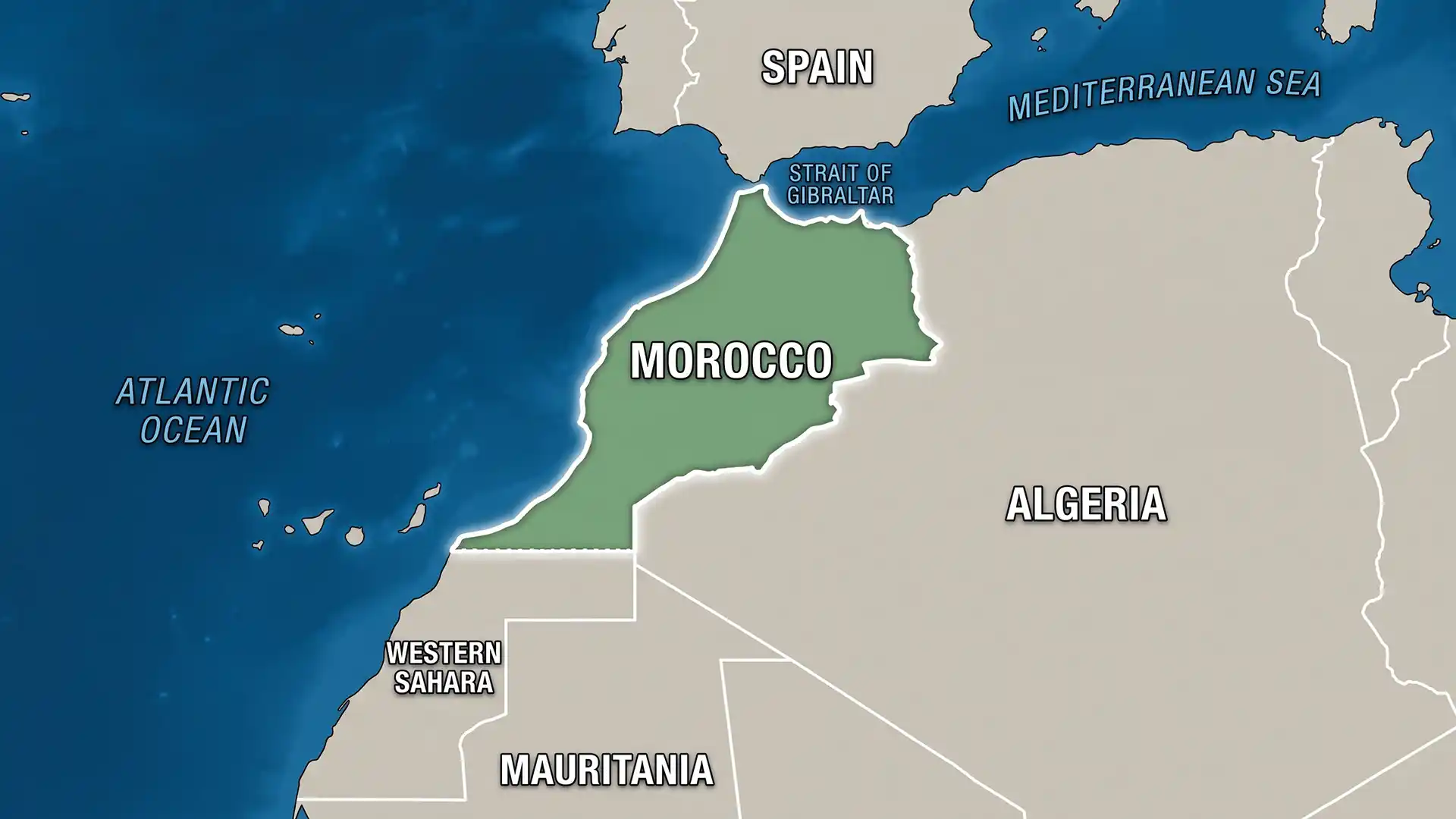
Morocco occupies the north-western edge of Africa in the Maghreb region. The Atlantic Ocean lies to its west and the Mediterranean Sea to its north. Algeria shares its eastern land border. The Strait of Gibraltar separates northern Morocco from southern Spain.
The status of Western Sahara to Morocco’s south remains disputed internationally. Morocco administers most of that territory and claims sovereignty over it. The United Nations continues to list Western Sahara as a Non-Self-Governing Territory. Geography descriptions should therefore avoid presenting the dispute as settled.
The Rif Mountains rise near the Mediterranean coast. The High Atlas, Middle Atlas and Anti-Atlas extend through the interior. Jebel Toubkal reaches 4,167 metres and is North Africa’s highest peak. Plains support cities and farming, while arid land increases towards the Sahara.
Why its location is strategic
Morocco sits near major Atlantic and Mediterranean sea routes. Europe is close across the Strait of Gibraltar. Ports such as Tanger Med connect African production with European and global markets. This location supports logistics, automotive exports and industrial investment.
The country also holds major phosphate resources and a large fertiliser industry. Phosphates link Morocco directly with India’s farm-input security. Water scarcity and repeated drought create serious economic constraints. Cooperation must therefore consider both trade opportunity and climate resilience.
Background to India–Morocco relations
India recognised independent Morocco on 20 June 1956. Diplomatic relations developed soon afterwards. Political and commercial contact expanded significantly after 2015. Defence, fertilisers, pharmaceuticals, information technology and renewable energy now form important areas.
India’s Ministry of External Affairs recorded bilateral trade at about US$3.819 billion in 2025. Moroccan exports to India include phosphate fertilisers, phosphoric acid, ores and inorganic chemicals. Indian exports cover petroleum products, vehicles, textiles, pharmaceuticals and machinery. The composition makes supply security as important as trade value.
What the seventh Joint Commission decided
The Joint Commission reviewed trade, investment, industry and fertilisers. Agriculture, pharmaceuticals, energy, mining and digital transformation were also discussed. Both sides agreed to work towards doubling trade in five years. A joint working group will examine a possible preferential trade agreement.
The Food Safety and Standards Authority of India signed an understanding with Morocco’s National Office of Food Safety. It provides for information exchange, technical cooperation and capacity building. Stronger regulatory cooperation can reduce avoidable barriers. It must still preserve independent safety checks for each shipment.
A Cultural Exchange Programme covers 2026 to 2030. It includes artists, festivals, heritage conservation, museums, libraries and archives. The countries will mark seventy years of diplomatic relations in 2027. The eighth Joint Commission is planned for New Delhi on a mutually agreed date.
Business and investment priorities
A Morocco–India Business Forum met in Casablanca on 24 August. Discussions covered automotive value chains, electric vehicles and renewable energy. Artificial intelligence, finance, healthcare and pharmaceuticals also featured. An Indian business delegation accompanied the minister.
Indo Maroc Phosphore (IMACID) represents an older industrial connection. The joint venture links Morocco’s phosphate sector with Indian partners. Fertiliser cooperation can support stable supplies, but concentration also creates risk. India benefits from diversified contracts, efficient logistics and careful nutrient policy.
What deeper trade will require
A target does not automatically change trade flows. Businesses need reliable standards, customs procedures and payment arrangements. Shipping links and market information influence smaller firms strongly. Any preferential agreement will require detailed negotiation on products and safeguards.
Investment can build value chains rather than only exchange raw materials. Moroccan logistics may support Indian access to African and European markets. Indian pharmaceuticals and digital services can find new opportunities. Local employment and technology transfer will shape public support in both countries.
Western Sahara needs precise wording
Morocco’s southern geography is connected with an unresolved sovereignty dispute. This article records Morocco’s administration and claim without treating international status as finally decided.
Conclusion
The seventh Joint Commission moved India–Morocco relations towards practical economic work. Food standards and a possible trade arrangement can widen market access. Phosphates remain a powerful strategic link between both economies. Morocco’s location also offers wider logistical value. Implementation must now convert broad targets into transparent and balanced commercial outcomes.