

Why in news?
India and the Netherlands reviewed agricultural cooperation during ministerial talks in New Delhi on 28 September 2026. India's Agriculture Ministry publicised the meeting on 2 October. Shivraj Singh Chouhan and Dutch minister Silvio Erkens discussed progress towards 25 Centres of Excellence, seed-sector cooperation and agricultural innovation. These centres are intended to connect technical knowledge with practical farming through demonstration and training. The discussion matters because better equipment or research alone does not ensure that farmers can use it effectively. The announcement records cooperation under review and areas to explore. It does not report the opening of all 25 centres or a new trade agreement already changing market-access rules.
A low-lying European country with a wider constitutional geography
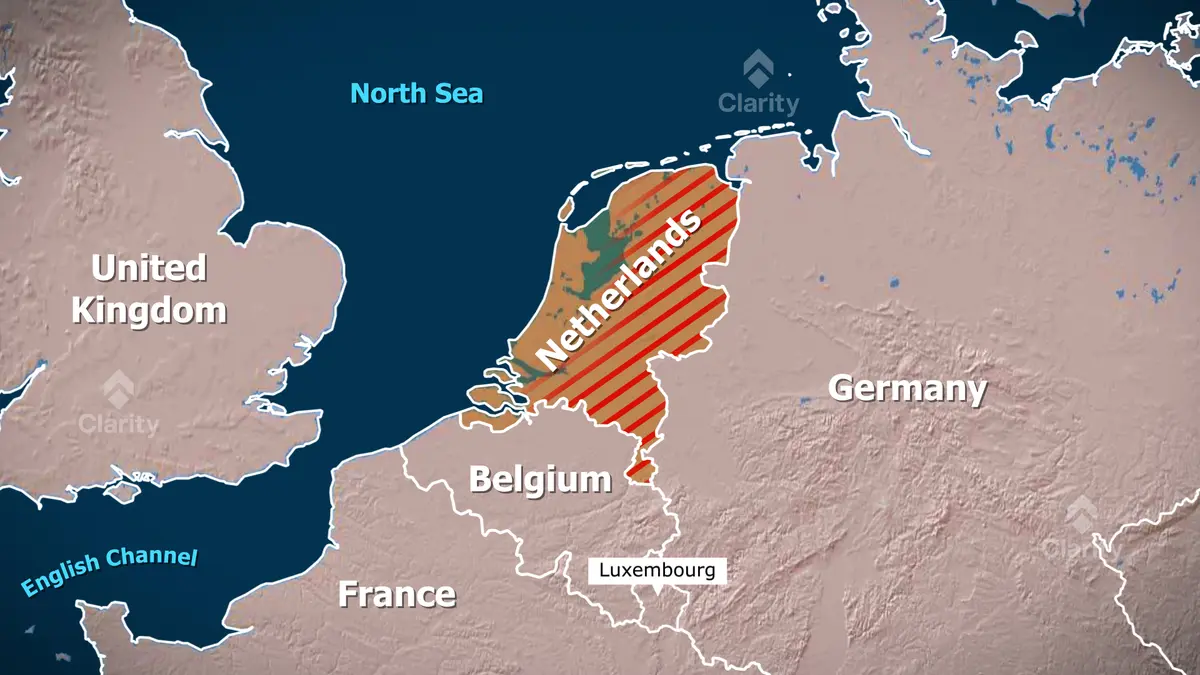
The European Netherlands lies in northwestern Europe, with Germany to its east and Belgium to its south. These are its two land-border neighbours. The North Sea borders its western and northern sides. Amsterdam is the capital, while The Hague is the seat of government. This coastal position and low-lying terrain make water management a central part of the country's geography.
The Netherlands and the Kingdom of the Netherlands are not identical geographical units. The Dutch government identifies four countries within the Kingdom: the Netherlands, Aruba, Curaçao and Sint Maarten. The country of the Netherlands also includes Bonaire, Sint Eustatius and Saba as Caribbean public bodies. A statement about the European mainland's landscape or borders should therefore not be assumed to describe every territory within the Kingdom.
Why water management and agriculture are closely connected
The European Netherlands occupies the downstream setting of major river systems, particularly the Rhine and Meuse. Water arriving from outside its borders interacts with a low-lying coastal landscape. The Dutch water authority, Rijkswaterstaat, describes both flood risk during high river levels and water shortages during prolonged drought. Managing only one extreme would leave the country exposed to the other.
Its Room for the River programme illustrates a response that goes beyond raising barriers. Allowing rivers more space can help accommodate high flows, while planning must also consider dry-period water availability. That involves choices about land, settlements and livelihoods. The example helps explain the country's experience in linking water and land management. It does not mean that India adopted that programme at the September meeting.
What a Centre of Excellence is meant to do
A centre can demonstrate a method under local conditions and provide training before wider adoption. This matters because a technique developed elsewhere may need adjustment for climate, soils, farm size and available resources. A demonstration site creates a place to examine those practical requirements. The benefit depends on what farmers can learn and apply, not simply on a building carrying the centre's name.
An earlier Indo-Dutch example opened at Ambalavayal in Kerala's Wayanad district in November 2020. The Indian embassy's account describes vegetable and flower cultivation, planting material, training and post-harvest facilities. The centre was based at the Kerala Agricultural University's regional research station. It provides a concrete example of how cooperation can move from government discussion into a site where cultivation and handling methods are demonstrated.
Post-harvest handling concerns what happens after produce is collected, including storage and preparation for sale. Better cultivation does not automatically preserve quality through that later journey. The Wayanad example therefore connects production with handling and marketing, rather than treating yield as the only relevant result. Training and access to suitable planting material are separate links in the same chain.
What the latest talks leave to be worked out
The September meeting included exploration of a seed-sector work plan and possible areas of agricultural innovation. A work plan would need to turn broad cooperation into defined activities, responsibilities and implementation steps. The announcement does not supply those details or establish that a particular seed product has received regulatory approval. Cooperation discussions and permission to sell or import a product are different processes.
The same distinction applies to the proposed network of centres. Progress towards establishment can involve preparation, construction, staffing and training at different sites. It cannot be read as evidence that every centre already provides services. A useful assessment would ask which facilities operate and who receives training. It would also examine whether demonstrated methods remain useful and affordable when adopted beyond the demonstration site.
Conclusion
The talks seek to deepen an existing agricultural partnership through demonstration, knowledge exchange and more focused cooperation. Their practical value will emerge when specific plans translate into functioning centres and usable methods. The relevant test is not the number discussed at a meeting, but whether farmers can apply the resulting knowledge under their own conditions.