

Why in news?
Orang Tiger Reserve in Assam has reported its first official record of the Indian peafowl, according to Hub Network's 28 September account. The report describes staff observations followed by photographic confirmation, adding the familiar bird to the reserve's documented wildlife. Orang occupies part of the Brahmaputra's northern floodplain, where grasslands, wetlands and woodland form a varied habitat. The significance is local: a species well known elsewhere has now been formally recorded at this protected area. The sighting does not establish that peafowl have never occurred there before, nor does it demonstrate a permanent breeding population. It provides a starting point for closer observation of their presence and habitat use.
A familiar bird with distinctive biology
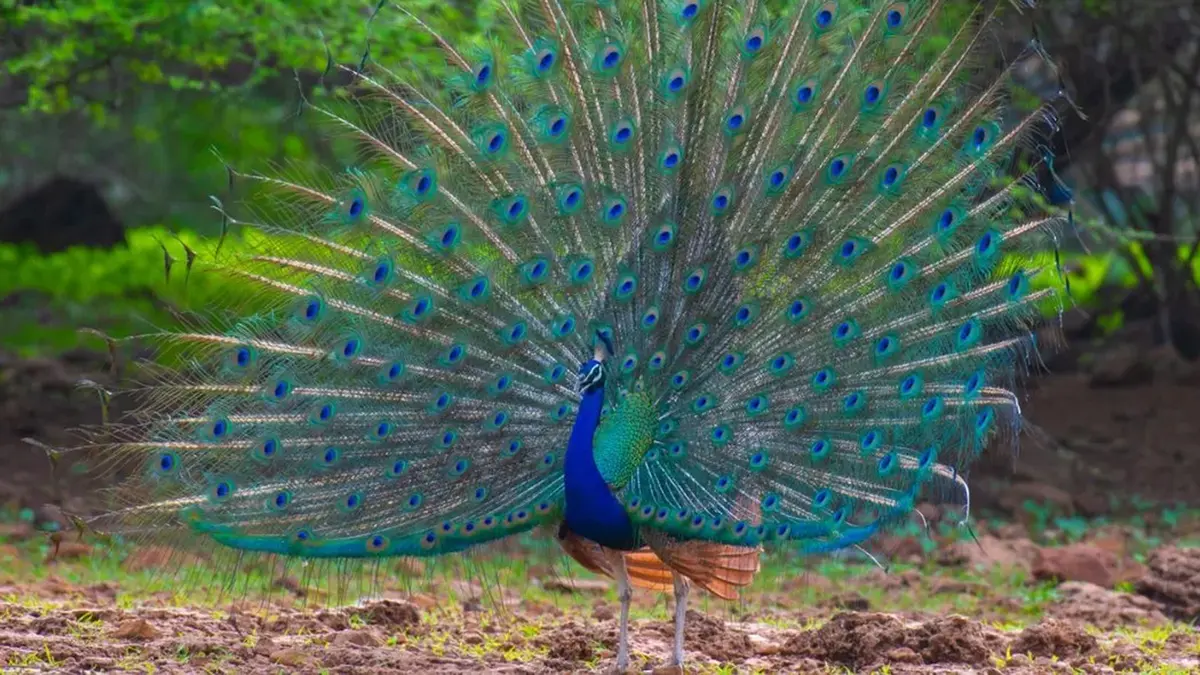
The Indian peafowl's scientific name is Pavo cristatus. The male is commonly called a peacock, while the female is a peahen. Their appearance differs markedly. Adult males have a vivid blue neck and conspicuous display feathers; females are less brightly coloured. These differences help identification, but a reliable wildlife record should still document the bird rather than depend on a passing impression.
The male's spectacular fan is a train of elongated upper-tail coverts, the feathers lying above the true tail. It is not simply an unusually long tail. During display, the male raises the train and exposes its patterned feathers. This is part of courtship. The visual display belongs to the bird's reproductive behaviour, rather than being a feature shared equally by males and females.
Peafowl spend much of their feeding time on the ground and use trees for roosting. Their food includes plant material and small animals. Seeds, fruits and insects are among the foods described in zoological accounts. This varied diet helps explain why suitable habitat can include woodland edges and cultivated landscapes, rather than only undisturbed forest.
The species is native to South Asia, including India and Sri Lanka, rather than being confined to Assam. Populations have also been introduced outside its native range. Its wide familiarity does not make a local observation unimportant. Distribution records answer where a species is documented, while the biology explains the kinds of resources it can use there.
Where Orang fits into the Brahmaputra landscape
Orang lies on the north bank of the Brahmaputra in Assam. The Wildlife Institute of India's reserve profile describes a floodplain mixture of grasslands, wetlands and woodland. Its wetland depressions are often called beels. Such a landscape changes through flooding, sediment movement and seasonal differences in water availability; it is not a uniform block of dense forest.
The reserve also belongs to a wider riverine wildlife landscape that includes other protected areas and river islands. This matters because protected-area boundaries are administrative lines within a connected environment. Animals use the habitat available to them, while rivers and floods influence how that habitat is arranged. A new local record should therefore be examined alongside conditions around the reserve, not only inside its boundary.
For peafowl, the combination of feeding ground and suitable roosting cover is especially relevant. The reported presence raises useful questions about where the birds feed and rest. Repeated observations could establish whether they use the same locations, move seasonally or remain for longer periods. The current report does not answer those questions by itself.
What a first record can establish
A documented first record means the species has entered a particular area's verified record. It does not necessarily identify the moment of arrival. Earlier presence may have gone unnoticed or undocumented. Equally, a photograph cannot by itself explain whether an individual dispersed naturally, escaped captivity or belonged to a previously overlooked group. Those possibilities require evidence rather than an automatic explanation.
The distinction between presence and establishment is important. Presence can be shown by a sound observation. Establishment would require stronger evidence of continuing use and, where claimed, reproduction. Records of several individuals, repeat sightings or breeding behaviour could deepen understanding. None should be assumed merely because the first photographed bird appears healthy or the surrounding habitat seems suitable.
Global status and local monitoring answer different questions
BirdLife's India species table lists the Indian peafowl as Least Concern on the global conservation scale. It lists the green peafowl, Pavo muticus, separately as Endangered. These are different species, so a status attached to one should not be transferred to the other. Scientific names help avoid confusion when familiar common names sound similar.
A global category does not measure the size or security of every local population. A widespread species can still be scarce at a particular site. Conversely, adding one species to a reserve's list does not demonstrate that all its habitats are improving. Monitoring becomes more informative when records include location, date, identification evidence and subsequent observations, allowing comparisons over time.
Conclusion
The Orang record adds a useful piece to the reserve's wildlife documentation. Its value lies in a verified observation and the questions that follow: how regularly are peafowl present, and how do they use this floodplain? Careful repeat monitoring can turn a noteworthy sighting into ecological understanding. The evidence currently supports a new official local record, not a discovery of a species or proof of an established population.