

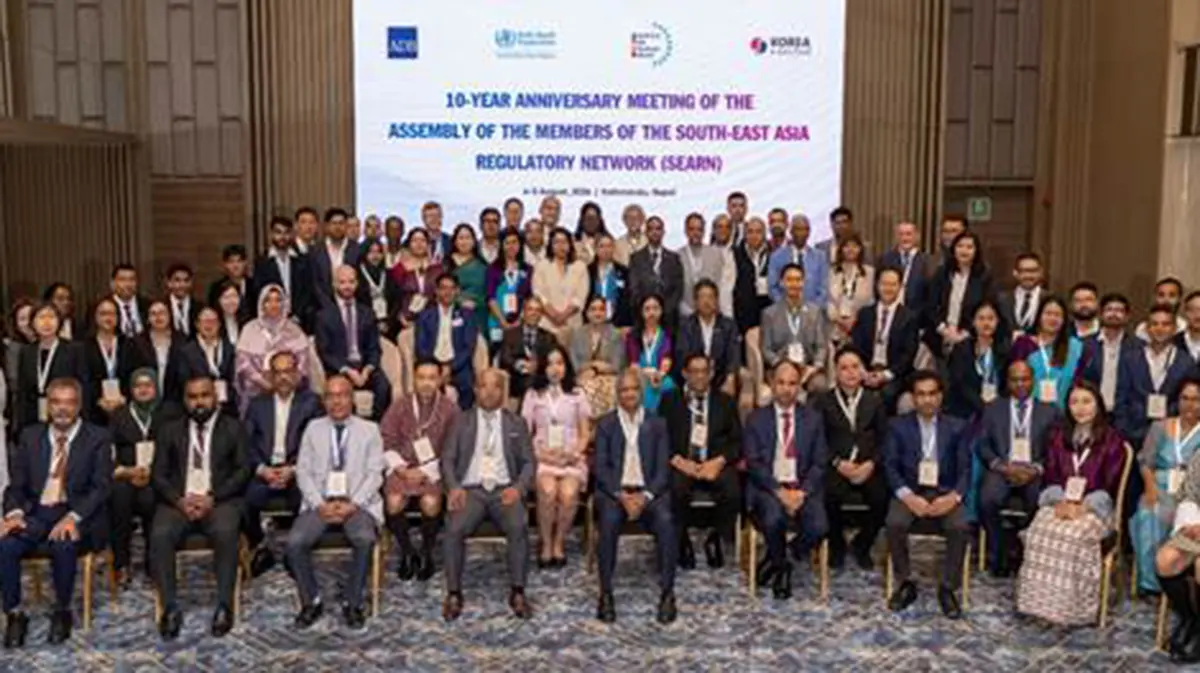
Why in news?
A regional regulatory network recognised two technical roles for the Indian Pharmacopoeia Commission. It became a centre of excellence for pharmacovigilance. It also became the network's technical centre for medicine quality. The recognition does not convert the Indian body into a World Health Organization agency.
Background
A pharmacopoeia is an official collection of medicine-quality standards; its monographs describe identity, purity, strength and testing methods. Manufacturers and laboratories use these standards to assess products and ingredients.
India published its first national pharmacopoeia during 1955; later editions expanded coverage and updated analytical methods. Regular revision is necessary because medicines and laboratory technology keep changing.
The Indian Pharmacopoeia Commission became fully operational as an autonomous institution on 1 January 2009. It works under the Ministry of Health and Family Welfare; its headquarters are at Ghaziabad in Uttar Pradesh.
Autonomy permits specialised management, while the Commission develops standards instead of exercising licensing powers. Central and state drug regulators retain those enforcement responsibilities.
The Indian Pharmacopoeia and its legal effect
The Commission publishes the Indian Pharmacopoeia, usually abbreviated as IP. Its standards receive legal force through the Drugs and Cosmetics Act framework; the Act's Second Schedule recognises applicable compendial requirements.
A monograph may specify identification tests, impurity limits and assay ranges. General chapters explain common methods and equipment; reference substances help laboratories compare unknown samples with authenticated material.
The Commission supplies Indian Pharmacopoeia Reference Substances for that purpose; these materials support consistent results across testing laboratories. They are standards for analysis, not medicines for patient use.
The Commission also publishes the National Formulary of India; a formulary supports rational prescribing and medicine use. It should not be confused with the pharmacopoeia's enforceable quality specifications.
Pharmacovigilance responsibilities
Pharmacovigilance covers detecting, assessing and preventing adverse effects linked with medicines; India launched its current national programme during July 2010. Coordination moved from the All India Institute of Medical Sciences to the Commission during April 2011.
Hospitals and reporting centres send suspected adverse-reaction reports into the system. Analysts search for unusual patterns called safety signals; regulators and programme managers can then investigate possible causal relationships.
A safety signal is not final proof that a medicine caused harm. Illness, other medicines and reporting bias may offer alternative explanations; strong decisions require clinical, statistical and regulatory assessment together.
The Commission also coordinates safety monitoring for medical devices through a related programme. Device reporting requires different technical expertise from medicine reporting. Both systems depend upon timely reports from health professionals and patients.
The South-East Asia Regulatory Network
The World Health Organization created the South-East Asia Regulatory Network during 2016. Its abbreviation is WHO-SEARN; the network connects national regulatory authorities across eleven regional member countries.
Members cooperate on medicine quality, vaccines, clinical trials, devices and safety monitoring. Shared training can reduce duplicated effort and strengthen smaller systems; national law still governs each regulator's final decisions.
The network marked its tenth anniversary in Kathmandu on 4–5 August 2026. At that meeting, it formally recognised the Commission's two regional roles; one covers pharmacovigilance and the other medicine-quality expertise.
A centre of excellence can host training and share specialised practice. A technical centre can support methods, standards and quality work; neither title gives the Commission authority over another country's regulator.
Why the recognition matters
Weak quality systems can allow substandard or falsified medicines to circulate; regional laboratory cooperation improves detection and response. Common terminology also helps countries compare safety information.
India has a large pharmaceutical industry and extensive testing experience; sharing that expertise can strengthen regional access to reliable medicines. It can also expose Indian systems to useful peer review.
Success should be measured through training outcomes and faster signal assessment. Published methods and transparent conflict rules will support trust; a title alone cannot improve medicine safety.
Conclusion
The new roles recognise Indian technical capacity in standards and safety monitoring. Their value depends upon practical regional support without blurring national regulatory responsibility.