

Why in news?
India and Germany held their fourth Environment Forum in New Delhi on 1 September. Ministers and officials discussed climate resilience, biodiversity, circular economy and pollution control. The meeting marked 75 years of diplomatic relations between both countries. It also prepared environmental cooperation for the next phase of their strategic partnership.
What the forum covered
The forum carried the theme “Together for More Resilience”. India’s Environment Minister Bhupender Yadav co-chaired the meeting. Germany was represented by Environment Minister Carsten Schneider. Government agencies, businesses and technical organisations joined the discussions.
Sessions examined climate adaptation and nature-based solutions. Participants also discussed resource efficiency, waste and circular production. Industrial decarbonisation requires finance, technology and standards. These fields connect environmental policy with jobs and trade.
The Indo-German Environment Forum began in 2008. It provides a high-level channel for bilateral policy dialogue. Technical projects continue between its ministerial meetings. The forum can align those projects with new national priorities.
Germany’s location and physical setting
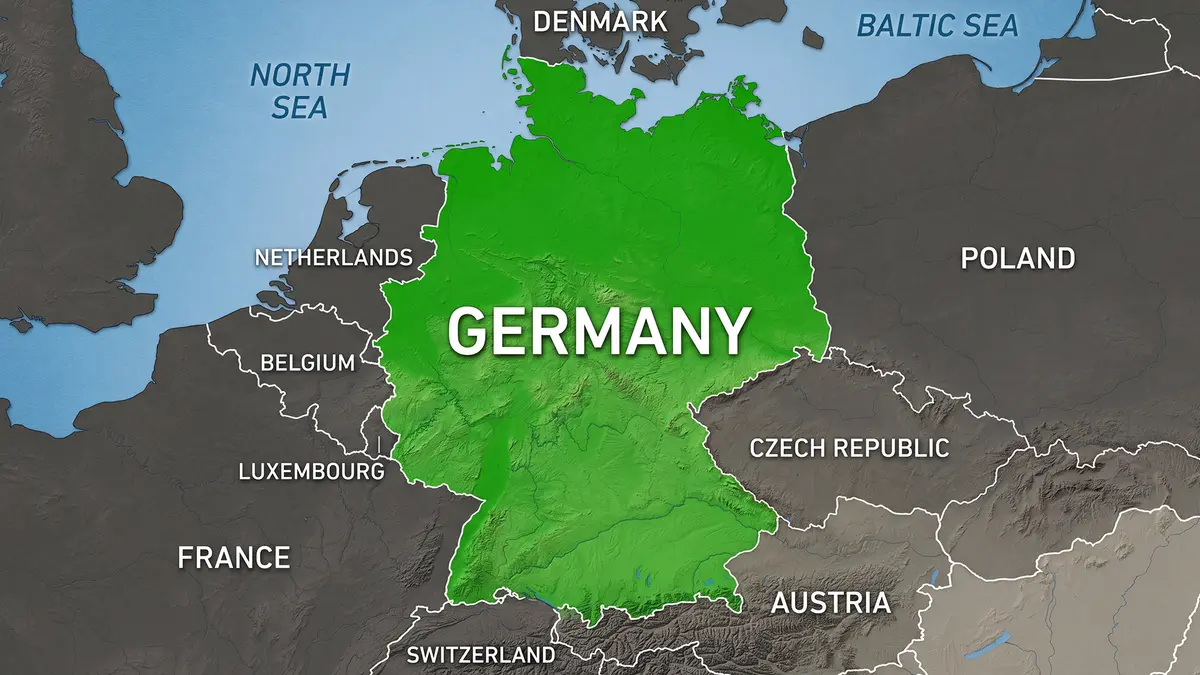
Germany lies in the heart of Europe. It borders nine countries, more than any other European Union member. Denmark lies north, while Poland and Czechia lie east. Austria and Switzerland form much of the southern neighbourhood.
France, Luxembourg, Belgium and the Netherlands border Germany in the west. Germany has coastlines on the North Sea and Baltic Sea. Major rivers include the Rhine, Elbe and Danube. These waterways support cities, industry, farming and cross-border trade.
The north has broad lowlands, while central Germany contains wooded uplands. The Bavarian Alps rise in the south. This varied geography creates different climate and flood risks. It also shapes renewable energy and transport networks.
Political and economic profile
Germany is a federal parliamentary republic with sixteen states. Berlin is the capital. The federal president is head of state, while the chancellor leads the government. Friedrich Merz has served as chancellor since May 2025.
Germany is a founding member of the European Union’s earlier communities. It uses the euro and participates in the Schengen area. Its economy is Europe’s largest by total output. Manufacturing, engineering, chemicals and services remain major strengths.
Federalism gives states important responsibilities for education, policing and administration. European Union rules also shape national environmental policy. Decisions therefore operate across local, state, federal and European levels. India must often engage several institutions for practical projects.
India–Germany relations
India and the Federal Republic of Germany established diplomatic relations in 1951. Their strategic partnership began in 2000. Regular Intergovernmental Consultations bring both cabinets together. The eighth consultation is expected during 2026.
Trade, investment, research and skilled mobility support the relationship. German companies have a long presence in Indian manufacturing. Indian firms also invest and employ people in Germany. Education and scientific exchanges deepen the institutional connection.
The Green and Sustainable Development Partnership gives climate cooperation a broad framework. It covers energy transition, urban development and resilient infrastructure. Development finance supports selected projects. Results still depend on local implementation and measurable outcomes.
Why environmental cooperation matters
India and Germany face different development conditions but share climate risks. Heat, floods and ecosystem loss affect both countries. Germany brings technology and regulatory experience. India offers scale, diverse ecosystems and rapid infrastructure growth.
Clean industrial production can support trade under changing carbon rules. Common standards may reduce uncertainty for businesses. Circular design can lower material imports and waste. Cooperation should also protect affordability for smaller firms.
Biodiversity projects need community participation and long-term finance. Climate adaptation must reach cities, farms and coastal areas. Technical pilots are useful only when institutions can maintain them. Transparent indicators should track the real environmental benefit.
Areas requiring balanced negotiation
India continues to stress climate equity and different national capacities. Germany and the European Union emphasise faster global emissions reduction. These positions can create debate over finance and trade measures. Dialogue is valuable when it produces workable compromises.
Technology transfer also involves patents, costs and industrial competition. Public money should not merely subsidise equipment purchases. Training and local capability are essential. Joint research can create longer-lasting value.
Environmental cooperation must avoid vague announcements. Each initiative needs a budget, timeline and responsible institution. Communities affected by projects should see accessible information. Independent evaluation can improve trust on both sides.
The forum is a policy platform
It coordinates priorities and partnerships. Individual projects still require separate funding, design, legal approvals and implementation.
Conclusion
The fourth Environment Forum gives India and Germany a timely policy platform. Their economic relationship can accelerate practical environmental solutions. Geography and governance make their experiences different but complementary. Cooperation should combine finance, technology, skills and accountability. Clear outcomes will matter more than the number of declarations.