

Why in news?
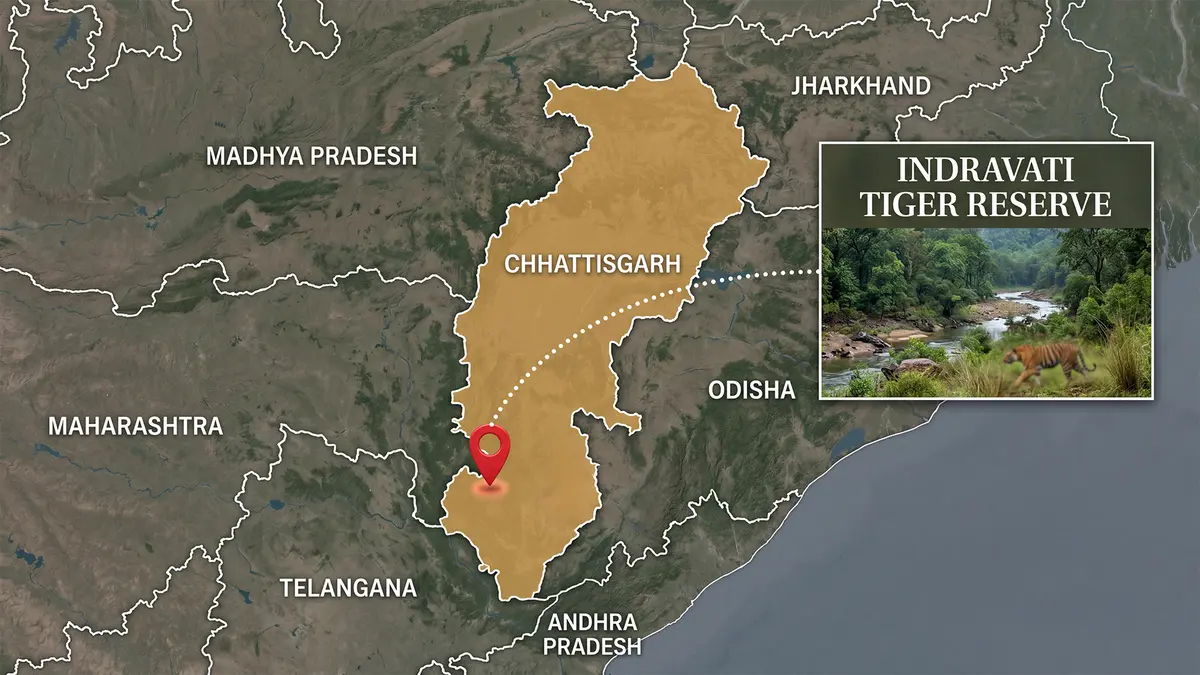
Chhattisgarh’s forest department is preparing to open organised tourism in Indravati Tiger Reserve from 1 November 2026. Hindustan Times reported the plan on 15 September, citing senior forest officials. The reserve lies in Bijapur district, within the Bastar region, where prolonged armed conflict restricted access for decades. Improved access has allowed preparations for vehicles and visitor routes, alongside wider fieldwork. The proposed reopening could support local livelihoods and introduce visitors to an important forest landscape. However, route selection, ecological carrying capacity and a police security assessment remained part of the preparations. The announced date is a plan, not an already operational safari service.
The reserve and its landscape
Indravati National Park was established in 1981, before Chhattisgarh became a separate state. It came under Project Tiger in 1983. The tiger-reserve landscape is broader than the idea of a single sightseeing destination. Its notified core and buffer together cover 2,799.07 square kilometres, according to the National Tiger Conservation Authority’s reserve records.
The core covers 1,258.37 square kilometres, while the buffer covers 1,540.70 square kilometres. These are different management components, not separate tourism parks. Protecting important habitat remains the central purpose. A buffer also requires attention to the relationship between conservation and surrounding human use. Its inclusion does not mean unrestricted construction or unrestricted tourist access.
The reserve takes its name from the Indravati River, which crosses the wider region from east to west. Indravati belongs to the Godavari drainage system, with its upstream catchment extending into Odisha. Around the reserve, hills, seasonal streams, grasslands and deciduous forests form a varied landscape. Watercourses and forest cover connect these habitats rather than leaving them as isolated patches.
More than a place to see tigers
The National Tiger Conservation Authority describes both moist and dry mixed deciduous forests, including areas with teak. Deciduous trees shed leaves seasonally, so vegetation changes through the year. Grasslands and water-associated habitats add to this diversity. The resulting mixture supports different feeding, shelter and breeding requirements; a tiger sighting alone cannot represent the condition of the entire reserve.
Indravati is also important for wild buffalo. The district’s wildlife account identifies the national park as a refuge for a remaining wild population. Other recorded animals include leopards, sloth bears, gaur and deer. Wild buffalo and gaur are different animals, even though both are large wild cattle. Conservation planning needs to recognise these differences in habitat and population requirements.
Restricted access also affects what can be known about wildlife. If surveys repeatedly cover only accessible areas, their results cannot automatically describe every part of a reserve. Better access may reveal animals previously missed rather than prove a sudden increase in their numbers. This distinction is particularly important when new sightings or preliminary departmental counts attract attention.
What regulated access needs to achieve
The reported preparations include an assessment of carrying capacity: the amount of visitor use a site can accommodate without unacceptable effects. That involves more than choosing a convenient daily ticket total. Routes, vehicle movement, wildlife sensitivity and the condition of particular locations all matter. An apparently quiet forest can still contain sensitive breeding or feeding areas.
Concentrating visits in suitable areas can make supervision more manageable. But the design must account for the fact that animals move across human administrative boundaries. A road, queue or stopping point may affect movement even when it occupies little space. Visitor facilities therefore need to be considered as part of the habitat, not simply as additions outside conservation work.
Local livelihoods are another part of the proposed opening. Guiding, driving and hospitality could provide opportunities, but these remain possibilities to be organised rather than guaranteed incomes. Training, transparent access to opportunities and dependable operating arrangements would influence who benefits. Local residents should not be reduced to a background attraction within a tourism plan.
Access, knowledge and protection
Improved field access can support patrolling, habitat observation and more representative wildlife surveys. These functions matter even where tourists are not allowed. Security clearance for a visitor route is also narrower than a declaration that every area is freely accessible. Different parts of a large reserve can remain subject to different practical and ecological restrictions.
Conclusion
Indravati’s proposed opening is significant because it connects renewed access with conservation and potential community income. Success should not be judged only by visitor numbers or tiger photographs. Safe, limited routes, reliable ecological monitoring and meaningful local participation are the more durable tests. The reserve’s wider forest life must remain the reason for managing tourism, not a casualty of its expansion.