

Why in news?
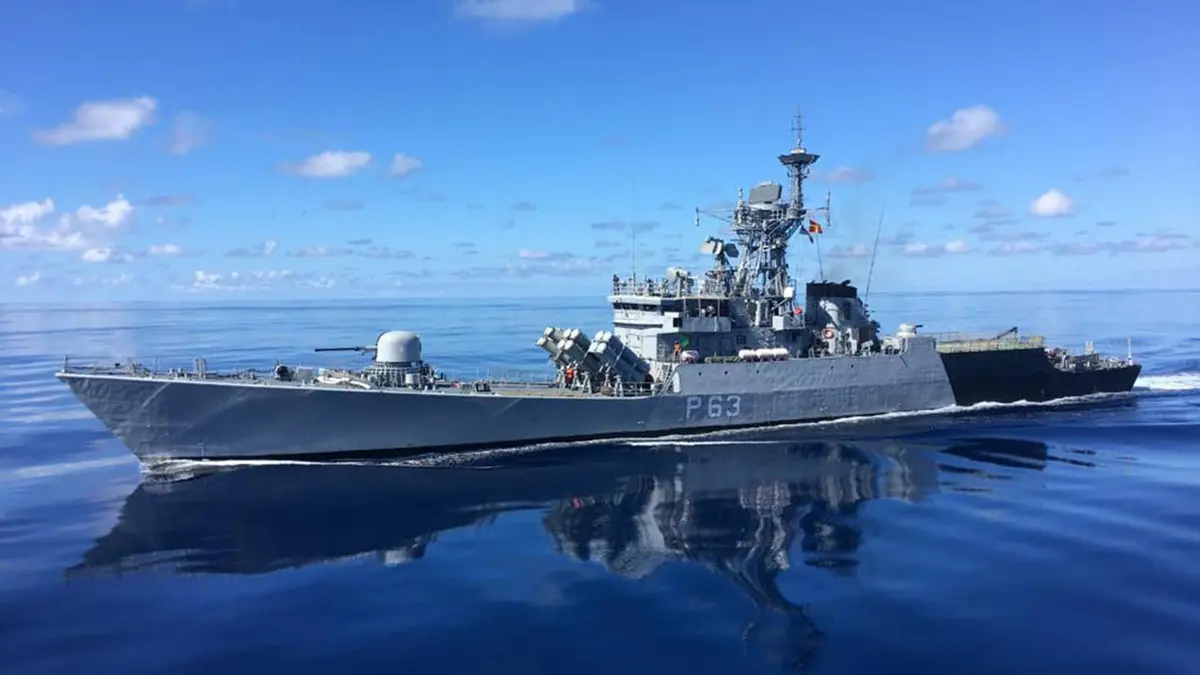
Indian Naval Ship (INS) Kulish arrived at Ream Naval Base in Cambodia on 12 September 2026. The Defence Ministry announced the visit the following day as part of the Eastern Fleet’s operational deployment. Kulish is a guided-missile corvette: a relatively compact warship intended for combat duties, including action against surface vessels. Its Cambodia programme included planned professional discussions, familiarisation activities and other exchanges with the Royal Cambodian Navy. Such visits create practical contact between crews that normally operate under different procedures. The ministry placed the engagement within India’s wider cooperation with Southeast Asia. The announcement described a naval visit and planned interactions, not a new alliance, permanent Indian base or completed joint combat operation.
The ship and its role
Kulish belongs to the Kora class of guided-missile corvettes. Garden Reach Shipbuilders and Engineers’ published records list its commissioning in August 2001. Commissioning marks a ship’s formal entry into naval service. The September 2026 news therefore concerns the deployment of an established ship, not the delivery or induction of a new vessel.
A corvette is generally smaller than a frigate or destroyer, although naval classifications differ between countries. Its effectiveness depends on its assigned weapons, sensors, endurance and operating role, not size alone. The Kora class was developed for missile-armed surface warfare. Historical specifications should not automatically be treated as a complete account of a ship’s present equipment.
The shipbuilder’s records also locate this class within India’s domestic warship-building programme. Constructing a naval vessel involves integrating the hull, propulsion, electrical systems and mission equipment into one working platform. That industrial history provides context for Kulish’s service, but the port visit itself does not demonstrate a new weapons capability.
Where Ream fits on the regional map
Cambodia lies in mainland Southeast Asia. It borders Thailand to the west and northwest, Laos to the northeast, and Vietnam to the east. Its southwestern coast faces the Gulf of Thailand. Ream is a Cambodian naval base on this maritime side of the country, rather than an inland facility near the capital, Phnom Penh.
The Gulf of Thailand opens towards the South China Sea. This places Cambodia’s coast within a connected regional maritime space used by commercial and naval traffic. Cambodia is therefore not landlocked, despite its prominent inland river and lake systems. Its Mekong River and Tonle Sap landscape form another important part of its geography.
The location explains the visit’s regional setting without establishing a particular strategic concession. Access for a scheduled port call and the right to maintain a permanent foreign military presence are different arrangements. The Defence Ministry’s announcement supports the former. It does not supply evidence for the latter.
What naval exchanges can achieve
The announced programme included professional interactions and familiarisation visits, alongside sports and other activities involving the two navies. Professional contact can help personnel understand one another’s working methods and communication practices. Familiarity becomes useful when countries later need to coordinate at sea, although the benefits depend on sustained engagement rather than ceremony alone.
For example, cooperation during a maritime emergency requires clear communication, an agreed understanding of responsibilities and dependable contact channels. A port visit can contribute to those relationships without itself being a search-and-rescue exercise. Distinguishing the visit’s actual programme from its possible longer-term benefits keeps the significance clear.
Interoperability means the ability to work together. It does not require two navies to have identical ships or equipment. Shared procedures and a better understanding of each other’s capabilities can matter as much as hardware. Whether a particular engagement improves this ability must be judged from its activities and outcomes.
The policy background
India’s Act East Policy, announced in 2014, broadened engagement with Southeast Asia and the wider region. It builds on the earlier Look East approach. The government describes cooperation in trade, culture, connectivity and defence, rather than a naval policy alone. Cambodia is one of India’s partners within that wider setting.
The Defence Ministry also connected the visit with MAHASAGAR, meaning Mutual and Holistic Advancement for Security and Growth Across Regions. In this announcement, the phrase expresses India’s wider approach to maritime partnership. It should not be mistaken for the name of a treaty signed during Kulish’s visit or a newly established combined command.
Conclusion
Kulish’s arrival brought India–Cambodia maritime cooperation into a practical, crew-level setting. The visit’s immediate substance lies in the announced exchanges at Ream. Its longer-term value would come from sustained professional familiarity and useful cooperation, while claims about new basing rights or alliances would require separate evidence.