

Why in news?
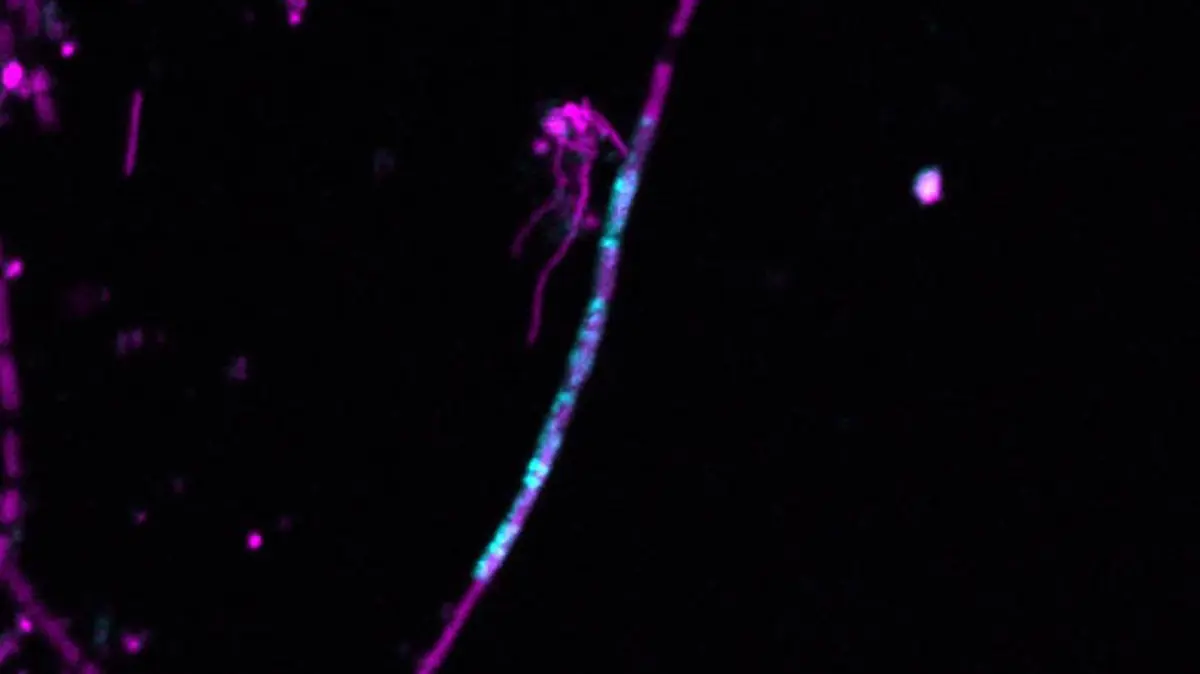
Scientists tracked mobile intron material moving between very different microorganisms. It travelled from a bacterial predator into dead archaeal cells. The result shows that genetic material can cross major biological boundaries. However, the study did not prove permanent gene transfer.
Background
Cells store hereditary information mainly in deoxyribonucleic acid, and this substance is commonly called DNA.
A cell copies selected DNA information into ribonucleic acid, and this second substance is commonly called RNA.
Some initial RNA copies contain intervening sections called introns, and the useful retained sections are commonly called exons.
RNA processing removes an intron and joins the surrounding sections, and this cutting and joining process is called splicing.
Simple sequence: DNA is copied into an early RNA molecule. Splicing removes introns before the RNA performs its mature function.
Do all introns occur inside protein-coding genes?
Introns can also occur inside ribosomal RNA genes, as examined in this study.
Ribosomal RNA forms an important part of ribosomes, and ribosomes are the cell structures that build proteins.
The study therefore did not examine an ordinary protein-coding messenger RNA, and this distinction is essential for understanding the result.
What is a Group I intron?
Group I introns are mobile genetic elements found in some organisms. Many can help remove themselves from an RNA molecule.
Their folded RNA can perform a chemical reaction, and an RNA molecule with enzyme-like activity is called a ribozyme.
Some removed intron molecules can form circles, and circular RNA may resist normal breakdown better than an open RNA strand.
Mobility means that an element can sometimes enter a new genetic location. It does not mean every intron moves regularly.
Which organisms were studied?
The predator was a tiny bacterium called “Candidatus Velamenicoccus archaeovorus”, and it attaches to another cell’s outer surface.
The prey was Methanothrix soehngenii, a methane-producing archaeon, and it grows as long filaments in oxygen-free environments.
Bacteria and Archaea are separate domains of life, and both generally lack a membrane-bound cell nucleus.
Archaea are not simply unusual bacteria, and their cell machinery and evolutionary history contain important differences.
Researchers maintained this anaerobic, limonene-degrading enrichment culture for over twenty years.
What did the researchers observe?
- The bacterial predator attacked the methane-producing archaeal filaments.
- A Group I intron was removed from the predator’s ribosomal RNA.
- Researchers designed molecular probes for the released intron RNA.
- The signal appeared inside a very small number of archaeal cells.
- Those recipient cells were dead rather than living.
- The signal remained absent from healthy archaeal cells.
The team used an enhanced fluorescence method to see the RNA. Fluorescent probes bind selected molecular sequences and create visible signals.
RNA sequencing showed that the intron was extremely uncommon. There was about one copy per 20,000 mature ribosomal RNA molecules.
Why is the predator-to-prey direction surprising?
Material usually moves from consumed prey into a predator’s digestive system, and this observation showed movement in the opposite direction.
The transfer also crossed the boundary between Bacteria and Archaea, and that boundary represents a very deep evolutionary separation.
Predation placed both cells in close contact. Such contact can create an opportunity for mobile material to cross cell boundaries.
What is horizontal gene transfer?
Vertical transfer moves genetic information from parent to offspring, and horizontal transfer occurs outside that parent-offspring pathway.
Horizontal gene transfer is common among microorganisms, and it can spread useful traits much faster than reproduction alone.
- Transformation involves taking free genetic material from the surroundings.
- Transduction uses a virus to carry material between cells.
- Conjugation moves material through direct cellular contact.
- Other mobile elements can use specialised enzymes and pathways.
Transferred DNA can spread antibiotic resistance or new metabolic abilities. Stable inheritance requires integration or continued replication inside the recipient.
Did this study prove horizontal gene transfer?
No, because it detected released intron RNA only inside dead foreign cells. The observation shows movement, but not successful genetic integration.
The researchers did not show conversion of the RNA into DNA. They also did not show insertion into the archaeal genome.
Dead cells cannot pass a new trait to descendants. The movement is therefore a possible first step, not completed inheritance.
The predator contains an enzyme resembling reverse transcriptase. Such enzymes can make DNA from RNA, but this pathway remains a hypothesis.
Accuracy caution: The study observed mobile RNA inside dead prey cells. It did not watch a complete gene enter and function inside living prey.
Why does the finding matter?
The result provides direct evidence that released intron RNA can enter a foreign cell. It also broadens possible routes for genetic exchange.
Predator-prey contact may help mobile elements cross biological boundaries, and similar interactions happen widely within microbial communities.
The work also shows that extracellular RNA can survive long enough for cellular entry. Future studies can test whether living recipients inherit it.
What questions remain?
- Did the RNA enter before or after the archaeal cell died?
- Which structure carried the RNA across the cell boundary?
- Can a living archaeal cell receive the same molecule?
- Can reverse transcription produce a matching DNA copy?
- Can that copy enter a genome and remain heritable?
Conclusion
The finding reveals a possible route for genetic exchange. It remains an early step, not proof of stable horizontal transfer.