

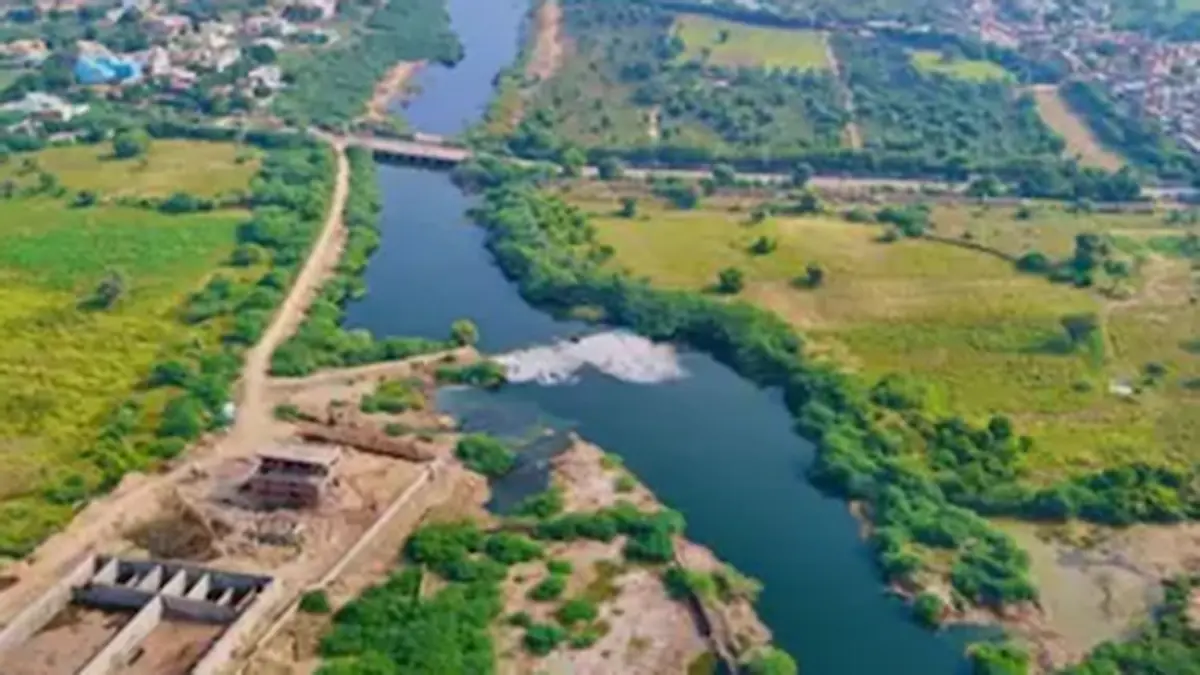
Why in news?
The Supreme Court ordered interim safeguards for Rajasthan’s Jojari River on 24 August. It barred construction within 100 metres of the river’s edge. Potentially polluting activities face a 500-metre restriction on either side. The measures continue while authorities scientifically map the High Flood Line and ecological buffers.
What the Court directed
The order came in a suo motu civil case concerning Jojari contamination. Justices Vikram Nath and Sandeep Mehta formed the bench. They found an interim measurable protection area necessary. Scientific demarcation had not yet been completed.
No construction or development activity may occur within 100 metres from the river edge. The Court linked this measure with national technical guidelines on floodplain zoning. Essential infrastructure can require separate lawful consideration under those guidelines. The order itself establishes the general interim restraint.
A second safeguard applies within 500 metres on both sides. Where an existing flood line is identified, measurement begins there. Otherwise, it begins from the present flow path. Hazardous or potentially damaging industry and activity is prohibited within this zone.
The case and its institutions
The case is titled “In Re: 2 Million Lives at Risk, Contamination in Jojari River, Rajasthan”. It is Suo Motu Writ Petition (Civil) Number 8 of 2025. The Court had passed a detailed coordination order on 7 August 2026.
That earlier order required an Integrated Coordination Group headed by Rajasthan’s Chief Secretary. It also sought a comprehensive resolution plan and a state river authority. A High-Level Ecosystem Oversight Committee continues independent monitoring. The latest order clarifies that the two bodies have distinct functions.
The Court also involved National Law University, Jodhpur. Its project will examine environmental law, restoration and community rights. This adds legal and social analysis to technical work. River repair affects health, livelihoods and access to clean water.
Where the Jojari flows
The Jojari is an ephemeral river in arid western Rajasthan. A Rajasthan urban-infrastructure report places its origin near Pudlu village in southern Nagaur district. It flows through the Jodhpur area and enters the Luni system near Siwana. The Luni later drains towards the Rann of Kachchh.
The same official report describes Jojari as the Luni’s right-bank tributary. Unlike most Luni tributaries, it does not begin in the Aravalli hills. Its natural flow responds strongly to monsoon rainfall. Outside rains, wastewater can dominate parts of the channel.
How pollution changed the river
Jodhpur’s urban drains and industrial areas discharge into the Jojari system. Earlier proceedings documented untreated or poorly treated effluent and contaminated sludge. Obstructions and encroachments have also disturbed the flow path. Polluted water then spreads towards farms and pasture.
Textile processing has been central to long-running disputes in the wider Jojari–Bandi–Luni system. Common Effluent Treatment Plants are meant to treat clustered industrial wastewater. Their success depends on capacity, inlet quality and continuous compliance. A plant’s existence does not prove clean discharge.
Why the High Flood Line matters
A river’s visible dry-season channel is not its full flood space. High flows can occupy a much wider area. The High Flood Line identifies the reach of significant floodwater using scientific evidence. Mapping helps protect life, property and river functions.
Building inside flood space can obstruct drainage and raise local risk. It may also place residents beside contaminated floodwater. Ecological buffers filter runoff and preserve room for channel movement. Accurate mapping is therefore both a planning and public-health task.
Implementation challenges
Authorities must identify the present edge and flow path consistently. Land records, satellite images and field surveys should be reconciled. Existing lawful structures and fresh activity also require separate treatment. Clear public maps can reduce uncertainty and opportunistic enforcement.
Buffers alone cannot clean the river. Pollution control needs functioning treatment plants and strict discharge monitoring. Contaminated sludge requires safe handling. Restoration must also recover natural flow and protect affected agricultural communities.
The buffers are provisional
The Court imposed measurable interim distances because scientific demarcation remains unfinished. Final High Flood Lines and ecological buffers may be based on detailed study. The present restrictions protect the river during that process.
Conclusion
The order prevents fresh damage while Rajasthan maps the river scientifically. Its 100-metre and 500-metre safeguards address different risks. Long-term recovery still requires pollution control, restored flow and accountable institutions. Public maps and transparent monitoring will be crucial. River protection must also repair harm suffered by nearby communities.